
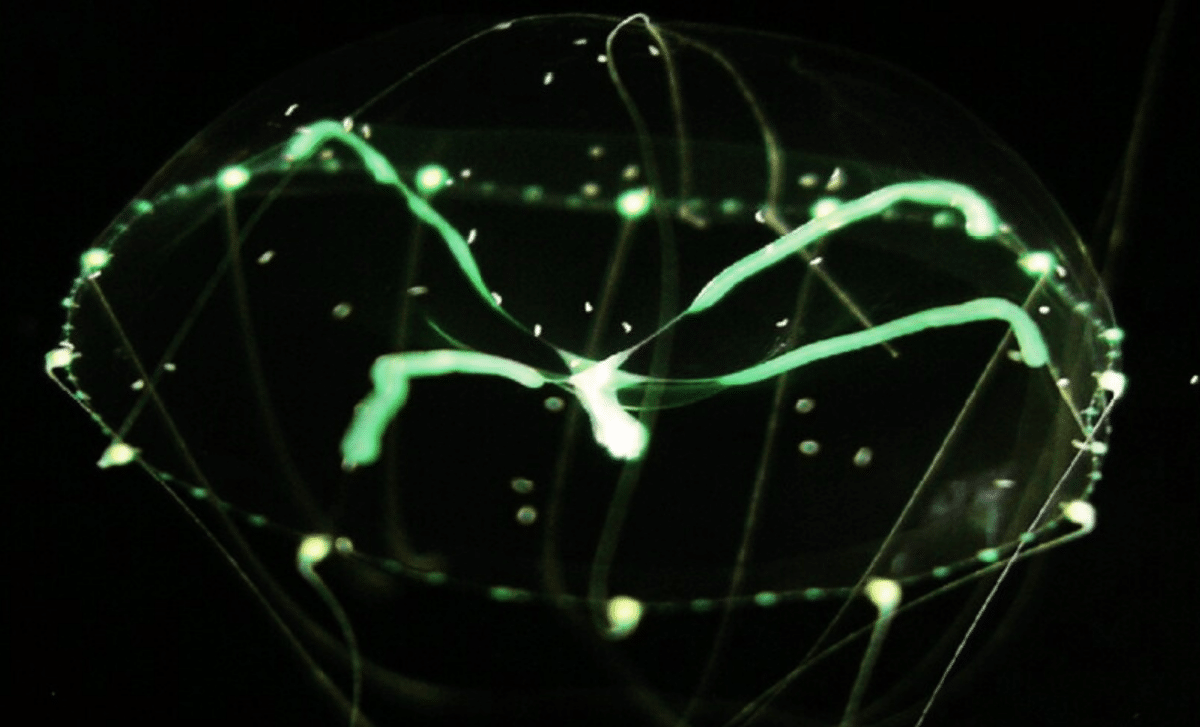
A newly discovered species of jellyfish has been confirmed in Japan’s coastal waters, and it’s being called the “Milky Way” jellyfish due to its unique appearance. The discovery of Malagazzia michelin was published in ZooKeys, a prominent scientific journal that documents important advancements in marine biology. This tiny, speckled jellyfish adds to the growing body of knowledge on marine life, underscoring the ongoing need for meticulous study of even the most overlooked creatures in our oceans.
The Discovery of Malagazzia Michelin in Japan’s Coastal Waters
In a recent breakthrough, marine scientists in Japan have uncovered a new species of jellyfish that has been overlooked for years. Named Malagazzia michelin, this jellyfish is only the second of its kind to be found in Japanese waters. It was first spotted in the shallow, warm waters of Nagasaki and Yamaguchi prefectures, where it had gone unnoticed despite the region’s active marine research. Researchers were able to confirm its identity after studying it in captivity, allowing them to track its full lifecycle from its earliest stages to adulthood.
The study, which has been published in ZooKeys, a well-respected journal for marine taxonomy, revealed that Malagazzia michelin exhibits distinct features that set it apart from other jellyfish species. Its small size and translucent body make it difficult to spot in the wild, and its brown spots on its central stomach resemble tiny droplets of oil. These spots increase in number as the jellyfish matures, which led scientists to liken it to a restaurant gaining stars for its quality.
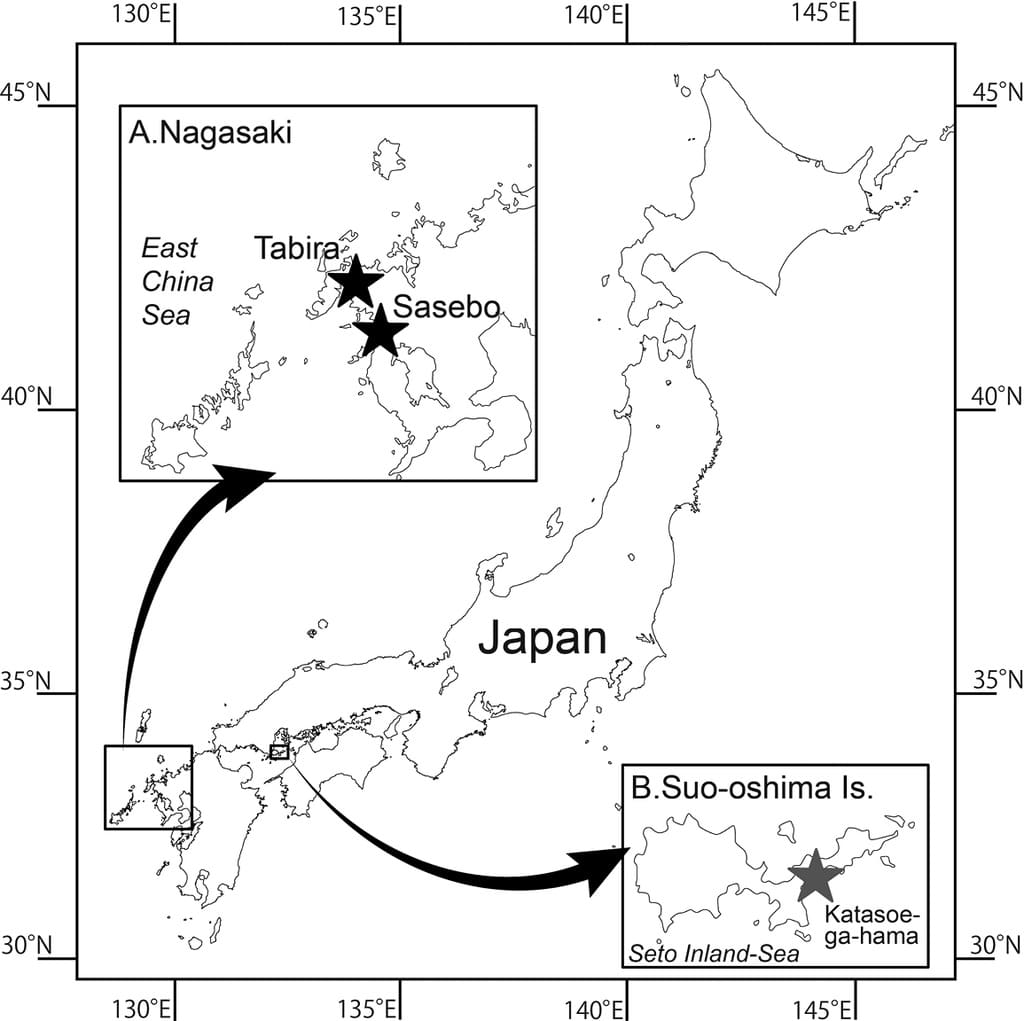 Sampling localities of Malagazzia michelin. A. Tabira and Sasebo, Nagasaki Pref. (indicated by black stars); B. Katasoe-ga-hama, Yamaguchi Pref. (by grey star).
Credit: ZooKeys
Why Malagazzia Michelin is Unique Among Jellyfish Species
The new jellyfish species, Malagazzia michelin, stands out due to its unmistakable features. Its dome-shaped body is about 0.47 to 0.79 inches wide, making it small enough to sit on the tip of a finger. This species shares the basic anatomy of other jellyfish in the Malagazzia genus, including its four-lipped mouth and straight reproductive organs. However, what truly distinguishes it is the series of brown, oil-like spots that adorn its reproductive organs and central stomach.
These brown spots are not just visually striking; they also play a role in identifying the species. As the jellyfish matures, the number of spots increases, creating a visual effect that resembles stars in the Milky Way. This earned it the Japanese common name ama-no-gawa-kurage, which directly translates to “Milky Way Jellyfish.” These visual patterns, combined with DNA analysis, confirmed that Malagazzia michelin is a new and unique species within its genus.
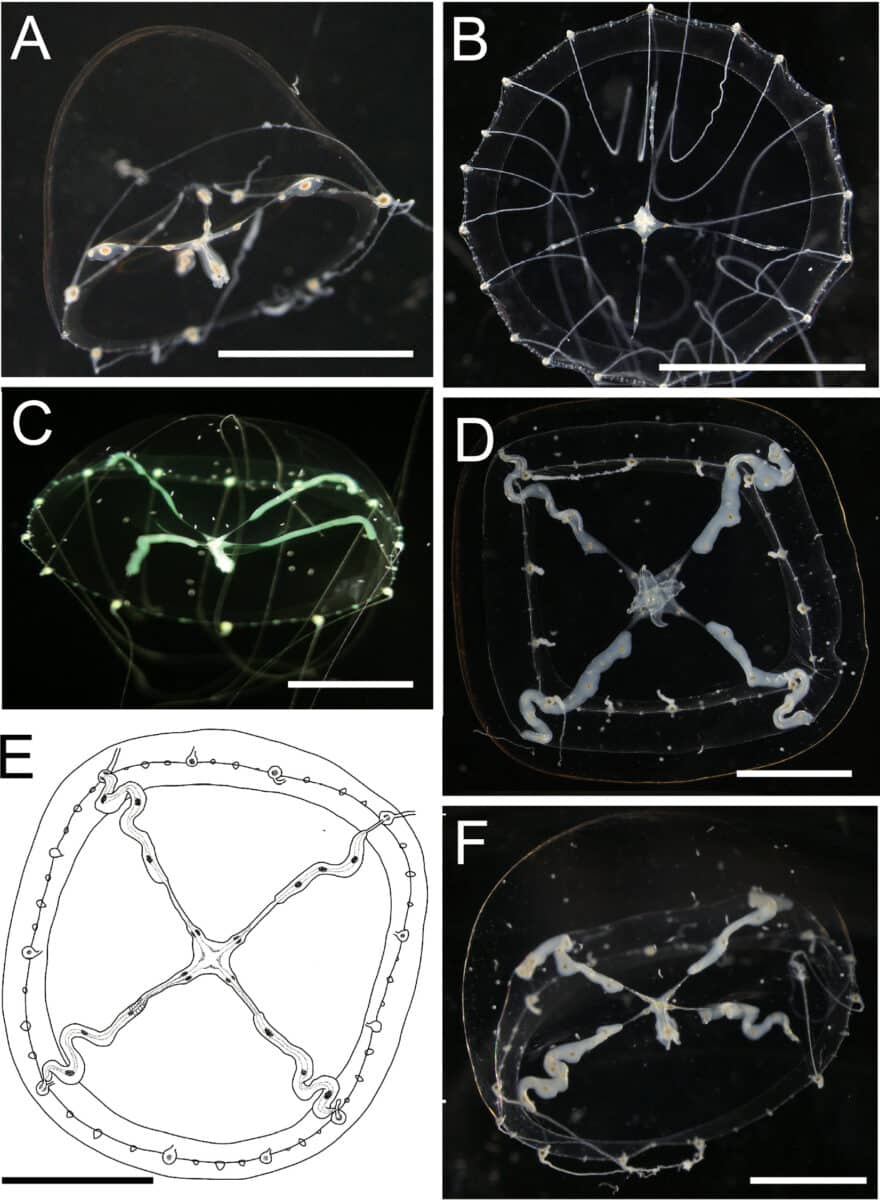 External view of the living medusae of Malagazzia michelin. A, B. NSMT-Co 1933; A. Lateral view; B. Oral view; C. Lateral view of Kuju-kushima 3 with lighting; D–F. Kuju-kushima 1; D. Aboral view; E. Sketch from aboral side; F. Lateral view. Scale bar: 5 mm.
Credit: ZooKeys
The Role of Aquariums in Scientific Discovery
Aquariums play an essential role in marine research, providing the controlled environments necessary for scientists to study delicate species like Malagazzia michelin. The team behind this discovery, led by Takato Izumi from Fukuyama University, worked closely with aquariums such as Tsuruoka City Kamo Aquarium and the Saikai National Park Kuju-kushima Aquarium. Their efforts were crucial in keeping the jellyfish alive long enough to observe its full lifecycle.
Aquarium staff are experts in caring for fragile species and keeping them alive for extended periods. This enabled the research team to track the jellyfish’s development, from its early polyp stage to its mature medusa form. The ability to study the jellyfish’s full lifecycle provided important insights into its biology, helping to confirm its status as a distinct species. This highlights the valuable role aquariums play in advancing marine science and conservation.
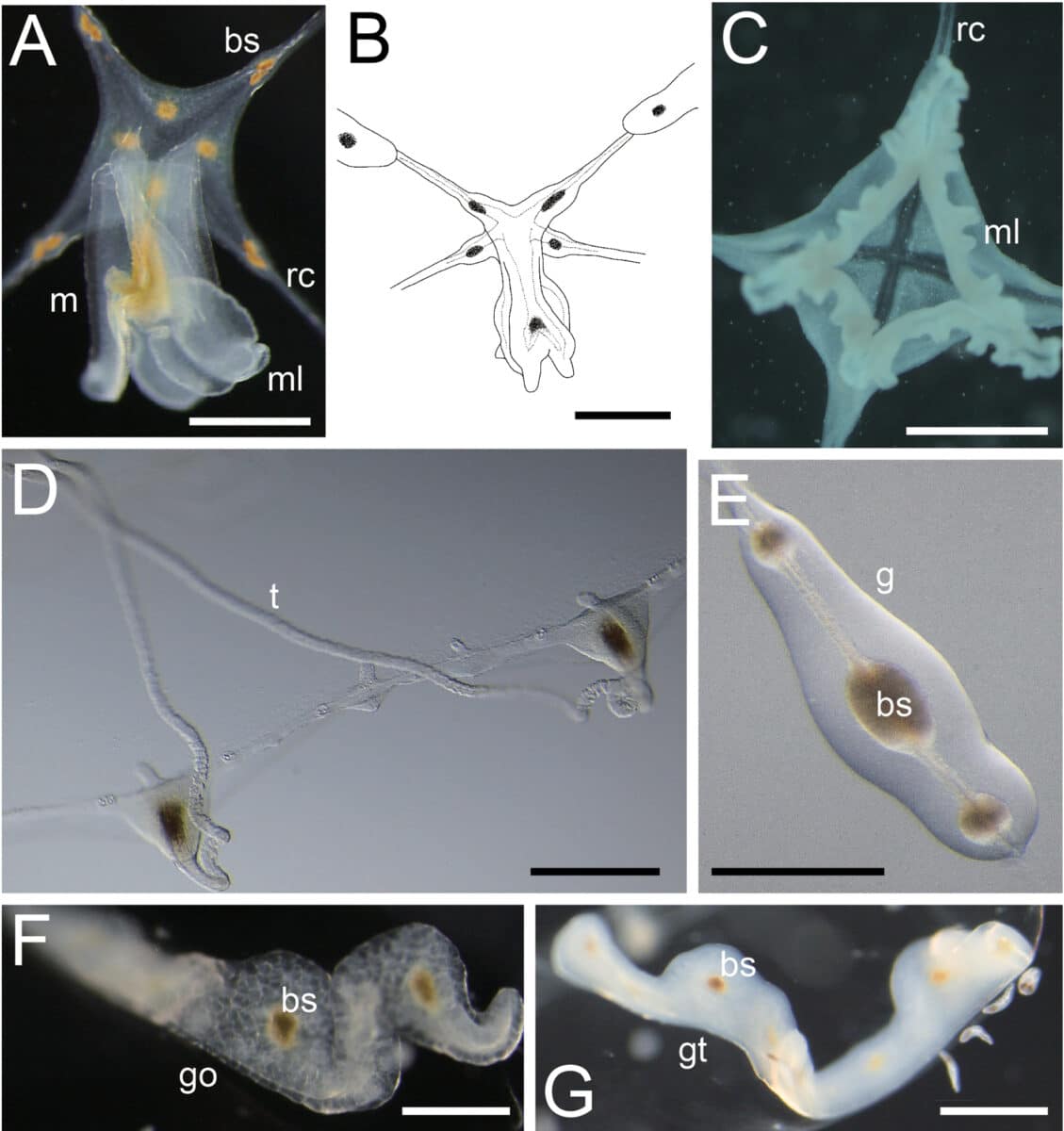 Enlarged view of the structures of living Malagazzia michelin. A–C. Manubrium, lips and radial canals; A, B. Closed lips (Kuju-kushima 1); C. Open lips (NSMT-Co 1933); D. Tentacles and tentacular bulbs (Kuju-kushima 1). E–G. Gonads; E. Immature (CMNH-ZG 1933); F. Mature female (Kuju-kushima 2); G. Mature male (Kuju-kushima 1). Abbreviations. bs: brown spot; g: gonad; go: gonad (ovary); gt: gonad (testis); m: manubrium; ml: mouth lip; rc: radial canal; t: tentacle. Scale bar: 0.1 mm.
Credit: ZooKeys
The Importance of Formal Taxonomy in Identifying New Species
One of the key takeaways from this discovery is the importance of formal taxonomic work in identifying and classifying new species. Malagazzia michelin was previously misidentified as a species from the genus Laodicea, which is not closely related. This misclassification was due to the jellyfish’s similarities to other species in the genus. However, with the help of detailed DNA analysis and careful observation, the researchers were able to confirm that this jellyfish was entirely new to science.
This error highlights the challenges of identifying marine species, especially those that are tiny and transparent like many jellyfish. Without careful study and taxonomic precision, these species could easily slip through the cracks, leaving them unidentified and unrecorded. The study published in ZooKeys emphasizes how essential accurate scientific classification is in understanding the full scope of marine biodiversity.
The Milky Way Jellyfish’s Cultural Significance in Japan
In addition to its scientific importance, the Malagazzia michelin also holds cultural significance in Japan. Its common name, ama-no-gawa-kurage, is derived from the Japanese word for the Milky Way, due to the jellyfish’s unique appearance. This name connects the species to the broader cultural appreciation of the stars and the cosmos. The jellyfish’s speckled appearance and ethereal glow evoke a sense of wonder, aligning with the Japanese reverence for natural beauty.
In Japan, jellyfish are often a subject of fascination, appearing in various art forms and traditional celebrations. The Milky Way Jellyfish now adds to this cultural connection, symbolizing the ongoing mystery and beauty of the natural world. The combination of scientific discovery and cultural significance makes Malagazzia michelin a truly unique addition to Japan’s marine life catalog.
The Ongoing Search for Marine Species in Japan’s Waters
Despite the ongoing research in Japan’s coastal waters, discoveries like Malagazzia michelin remind us that there is still much to learn about the marine ecosystem. Many species, particularly small and translucent organisms like jellyfish, remain underexplored and under-documented. The discovery of this new species underscores the importance of continued marine research and exploration.
Researchers estimate that a significant portion of marine species, especially soft-bodied creatures like jellyfish, are still unknown to science. Malagazzia michelin serves as a reminder that the ocean is vast, and even in well-studied regions, there are still countless species waiting to be discovered. This ongoing research will help fill in the gaps in our understanding of marine biodiversity.
Why Are Jellyfish So Hard to Identify?
Jellyfish are notoriously difficult to identify, especially because they often appear only during certain seasons and their bodies are transparent. Their physical similarity to other species can make it challenging to distinguish one jellyfish from another without detailed observation and genetic analysis. In the case of Malagazzia michelin, its transparent body and small size made it easy to overlook, especially in regions where jellyfish research is common.
Moreover, many jellyfish species look almost identical until they mature, and even then, they might require DNA testing to confirm their identity. This challenge is part of the reason why so many marine species remain undocumented. As researchers continue to study jellyfish and other gelatinous animals, they are uncovering more previously unknown species in the process.