
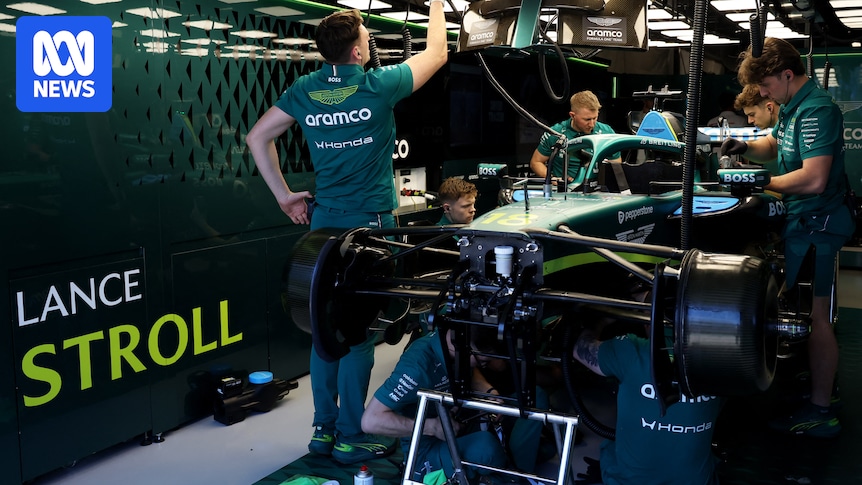
Aston Martin is running the risk of not being able to participate in Sunday’s Formula 1 Australian Grand Prix, at least, as issues grow for the beleaguered team.
One day after team principal Adrian Newey announced fears the vibration in the car could cause “permanent nerve damage” to his drivers, Aston Martin is now using its final two batteries for the weekend.
During Friday’s team principal press conference, between practice one and two at Albert Park, Newey revealed that two of the four batteries Aston Martin had brought to Melbourne were no longer operational.
Aston Martin drivers ‘risk permanent nerve damage’
It means the final two batteries left are in the cars of Fernando Alonso and Lance Stroll, with any issue to them meaning they almost certainly cannot start Sunday’s grand prix.
“We are short on batteries. We’ve only got two batteries left, the two that are in the car,” Newey said on Friday.
“So if we lose one of those, then it’s obviously a big problem. So we’ve got to be very careful on how we use the batteries.”
The two failed batteries meant Stroll could only manage three laps in the first practice, while Alonso did not even put his racing suit on.
“We’ve had conditioning problems or communication problems with two of those batteries, which means, as we sit here today, only got two operational batteries,” Newey continued.
“That, given our kind of rate of battery damage, is quite a scary place to be in.”
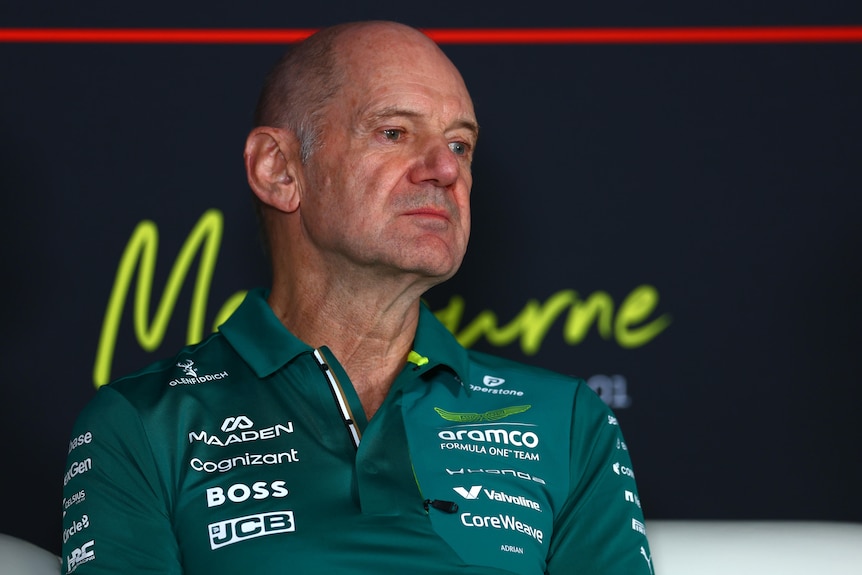
Adrian Newey is dealing with serious issues at Aston Martin. (Getty Images: Joe Portlock)
It is the latest in a series of issues that Aston Martin is having with its partner, Honda.
This is the first season Honda has supplied power units to Aston Martin, and the Japanese manufacturer has been plagued by issues.
The vibration from the power unit severely limited how much running the team could do in preseason, putting it well behind its rivals in terms of data and knowledge of the car in a new era of regulations.
The issue was so bad Newey said on Thursday that his drivers did not believe they could complete even half of the grand prix distance without hurting themselves.
The Briton, who masterminded Red Bull’s success for nearly two decades, said the team was put in a difficult position because of limitations on its ability to run its cars.
“I think it’s one where I kind of feel a bit powerless because clearly we’ve got a very significant PU [power unit] problem and our lack of running then also means at the same time we’re not finding out about the car,” Newey said.
“Our information on the car itself is very limited because we’ve done so little running, and particularly running at low fuel because fuel acts as a damper to the battery.
“Honda has limited us to how much low-fuel running we can do. It just becomes a self-feeding problem.”
Newey said Aston Martin and Honda were working very hard to get on top of their issues, with the start of the F1 season being crammed into just a few weeks.
The Chinese Grand Prix will be held next weekend, while the Japanese Grand Prix — Honda’s home race — will be at the end of March.
“It’s using a lot of energy in the human sense, as opposed to the kilowatt sense on our part, to try to work with Honda and to produce the best overall solution,” Newey said of the challenge ahead to get the cars ready as soon as possible.
“Because we can turn around and say, ‘Oh, it’s not our problem,’ but this is our problem, because ultimately, the car is the combination of chassis and PU.”
Newey said the time and effort were taking a toll on the team’s mechanics in Melbourne, who had done a lot of work for little result so far in 2026.
“I think there’s very clear action on Honda to try to reduce the vibration. This is emanating from the PU. They are working on that.
“It’s not going to be a quick fix, because it involves fundamental balancing and damping projects that they will need to conduct. I can’t comment how quickly they can achieve that, but that has to be the main drive.
“Once they’ve got past that, then they can really start to concentrate on performance.
“But at the moment, this vibration issue is sucking all energy in every area, emotionally.
Our mechanics were up until four o’clock this morning. So of course, they’re on their knees. The factory has been offering a lot of support.
“So it’s something we really need to try to get on top of as quickly as possible.”