
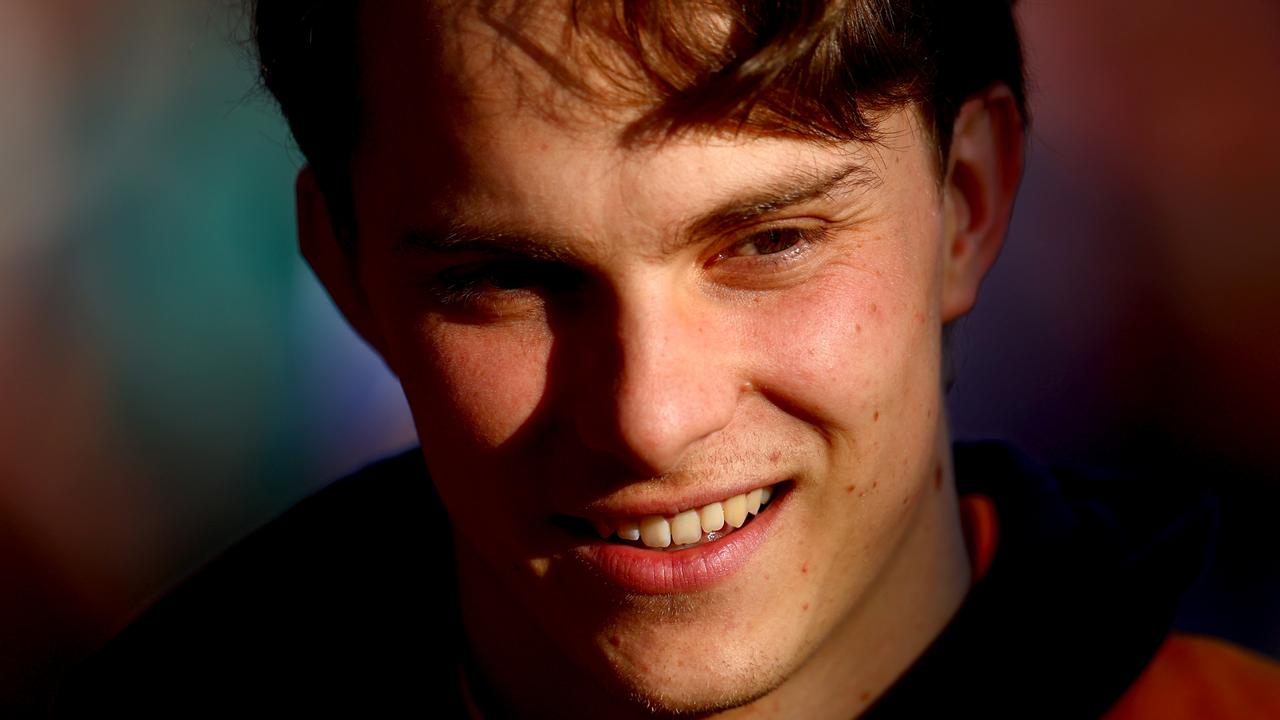
McLaren has been keen to play down expectations for the early part of the season, insisting that it’s a step behind presumed leader Mercedes and even likely contender Ferrari.
The team has been leaning hard into the narrative that not being a works constructor is going to cost it results early in the season, when the engine manufacturers will have a knowledge advantage when it comes to operating the motor.
That may well be true, but on Friday afternoon Oscar Piastri did his best to zero the difference.

Fox Sports, available on Kayo Sports, is the only place to watch every practice, qualifying session and race in the 2026 FIA Formula One World Championship™ LIVE in 4K. New to Kayo? Join now and get your first month for just $1.
The home favourite set the fastest time of the day at 1 minute 19.729 seconds. For those playing along at home, that’s 3.3 seconds slower than last year’s FP2, which is in the ballpark for the usual time loss after a major regulation change.
But Piastri said his day-topping time shouldn’t be read as the sandbags coming out of the car and McLaren showing the true pace it had hidden all along.
Instead he said McLaren had simply got more from the package at a time most teams are struggling for consistency under the new rules.
FRIDAY WRAP: Near 300km/h disaster after baffling act as Piastri fastest in mega Aus GP statement
“Especially at the moment, if you can just have the car operate roughly how you expect it to, then you find a huge amount of lap time,” he said. “I think that’s probably a big thing at the moment.
“I don’t think we ever thought we’re a long way behind Mercedes and Ferrari. I think I always felt like we were always just a little step behind.
“I’m still optimistic that if we get everything into a more optimal place, maybe we don’t have the outright performance if everyone’s at 100 per cent, but I think the biggest thing is how close to 100 per cent you can get a at the moment.”
Positive, then, for the odds of a first Australian home pole position.
Piastri’s assessment is borne out by teammate Lando Norris’s subdued showing.
The Briton lost laps in FP1 to a gearbox gremlin, and though his FP2 session was relatively uninterrupted, he ended the day down on experience and 1.065 seconds off the pace.
“We’re a little bit behind in terms of running and learnings,” Norris said. “With these new regulations, time in the car is very important, so we’ve got a bit of work to do this evening to recover.
“We’ve got some good bits of data to go over from the second half of FP2, and there’s plenty we can learn from what our competitors have been doing.
“We’ll work hard tonight and try to close that gap before we get back in the car for FP3 tomorrow.”
It’s a good start for McLaren, but consensus suggests that it could all change again tomorrow — positive for Norris, perhaps less so for Piastri.
Early chaos as Piastri faces issues | 00:58
IT’S CLOSE AT THE TOP
Though McLaren’s resurgence is something of a small surprise, not surprising is that the front of the field looks close, with almost nothing to separate Mercedes and Ferrari.
The narrow gaps on one-lap pace are replicated on race pace, with Formula 1 analysis predicting the top three teams are separate by just 0.15 seconds per lap, with Red Bull Racing further adrift.
Race pace forecast
1. McLaren: fastest
2. Mercedes: +0.07 seconds
3. Ferrari: +0.15 seconds
4. Red Bull Racing: +0.33 seconds
5. Haas: +0.83 seconds
6. Alpine: +1.13 seconds
7. Williams: +1.17 seconds
8. Racing Bulls: +1.64 seconds
9. Audi: +2.07 seconds
10. Cadillac: +2.56 seconds
11. Aston Martin: +2.77 seconds
Red Bull Racing seemed like the least easygoing team after practice. Both Isack Hadjar and Max Verstappen were off the track at various points, and neither driver really looked like troubling the top of the order. Verstappen was the quickest of the two but was still 0.637 seconds slower than Piastri.
Chief engineer Paul Monaghan said feedback from the drivers was generally positive but that nailing set-up and execution was critical to extracting performance under these new rules.
“The variation in how we do the lap is of such great influence — that’s what we’ve got to sort out primarily for tomorrow,” he said.
Notwithstanding the likelihood of substantive changes come Saturday morning, after the teams have digested the lessons of Friday, this data bears out some of the suppositions from testing.
There is a gap between the top four and the midfield, though it doesn’t look as large as some had feared, with at least one team within a second.
There’s also clearly a line between the midfield and the backmarkers, though Audi is straddling the middle.
It’s most sobering for Aston Martin — more on the sport’s crisis team below — that it looks slower than newcomer Cadillac.
Hamilton Avoids 300km/h Disaster! | 00:45
HAMILTON-COLAPINTO NEAR MISS DEMONSTRATES BIG RULES FEAR
One of the concerns about the new rules and the way the engines work is the risk of massive speed differences on the straights, and the sport got an alarming glimpse of this risk in FP2.
Franco Colapinto was travelling slowly on a preparation lap on the racing line when a fast-closing Hamilton suddenly appeared behind him.
The Ferrari driver had to take rapid evasive action to avoid what would have been an aeroplane accident.
The incident was sent to the stewards, who announced hours after the incident that they would take no further action.
Stewards were satisfied with the explanation that Colapinto had a false neutral approaching the final turn and was being instructed by his team about fixing the issue while on the main straight.
Their ruling adds: “COL explained that he was watching his mirrors the whole time and knew that HAM was approaching. He said that he was instructed by the Team to stay to the left because the Race Director’s Competition Notes (Emergency Exit Map) marks the exit point on the main straight on the left side of the track. He said that if he had tried to move off the racing line when he had no drive he could have created a more dangerous situation.
“The Stewards were satisfied that there was nothing about COL’s driving which was erratic. Given his mechanical problem, he was not driving “unnecessarily” slowly.”
Though the circumstances appeared relatively mundane in the sense that there have always been cases of drivers dawdling on the racing line during practice and even qualifying, the fear is that these moments will be more frequent in 2026 given the need for drivers to lift and coast into the straights as well as given the engines automatically redirecting power away from the rear axle, in both instances to charge the battery.
Both have the effect of suddenly slowing the car down the straights or in fast corners. Unlike in previous years, when lifting and coasting was generally subtle and only really seen in race conditions, these recharge methods are deployed at will by the drivers in every session — and because every power unit is different, these slow-going moments aren’t always predictable.
There can also be massive speed differences based on how and when the drivers choose to deploy electrical energy.
Piastri, for example, was almost 20 kilometres per hour faster down the front straight than Kimi Andrea Antonelli when comparing their fastest laps.
“Trying to do practice sessions at the moment is really difficult if you’re off sequence with people,” Piastri said. “I’m sure you’ve probably seen most of us are launching our laps halfway down the pit straight, so trying to judge the car behind is very, very tough.
“There are certainly some pretty major quirks that we’ve got to get used to. It’s going to be an interesting weekend still to go.”
And that was just practice. Imagine how much more complicated it could be in Q1, when all 22 cars will likely be on track at the same time attempting a fast lap.
It’s perhaps no surprise that the Friday night drivers briefing appeared to run for quite a while after the new rules were put through their paces for the first time at a grand prix weekend.
“Interesting” could be a massive understatement.
Can the Aston Martin last even 10 laps?! | 01:41
ASTON MARTIN: IT’S ALL HONDA’S FAULT
This is, of course, paraphrasing what Aston Martin team boss Adrian Newey and star driver Fernando Alonso said on a dire Friday for the big-spending team. Though they used more words than that, and though Newey at least attempted to emphasise that Aston Maritn and Honda are one cohesive unit, it became clear on Friday that the team wants to delineate between the theoretically fast chassis and the deeply problematic engine.
It’s perhaps understandable given Friday began in the worst possible way: with Alonso not participating in FP1 due to a power unit problem and Lance Stroll retiring after three laps, also with a power unit problem.
Newey later revealed that both cars had suffered battery problems, leaving them with just one apiece — and with no more available even at the Honda factory.
“I kind of feel a bit powerless, because clearly we’ve got a very significant [power unit] problem, and our lack of running then also means at the same time we’re not finding out about the car,” Newey said after FP1.
“I still believe we have on the chassis side [the potential] to catch back up — or would have done without the distraction that’s now caused.
“We have, as we sit here today, only got two operational batteries. That, given our kind of rate of battery damage, is quite a scary place to be in.
“We’re hopeful that we can get through the weekend and start two cars and so on and so forth, but it’s very difficult to be concrete at the moment about that.”
The team boss also claimed that he and Aston Martin didn’t realise Honda had lost most of its title-winning personnel in 2022 and was behind on its 2026 targets until last November after following up on “rumours” of underperformance.
Alonso was even more pointed at the end of Friday after completing 18 laps.
“Not much learning, to be honest,” he said. “Unfortunately the Honda issue in FP1 and some Honda issues as well in FP2 a little bit limited our number of laps today, and that was not needed again, because we need to recover a little bit in terms of understanding the car as well and the window of where this car operates.”
Asked about his prospects of the weekend, he made his disappointment even more explicit.
“I don’t know, I just drive the car,” he said. “It’s more a question for Honda.
“Obviously I feel disappointed to not have stock [despite Honda] only supplying one team, but this is the situation, so it’s more a question for them.”
Alonso’s fastest lap of FP2 would have been just fast enough for him to qualify for the race had it been Q1, but Stroll’s best effort — albeit after ending his session early — would have seen him barred from entering the race.
This weekend isn’t likely to be a big test for the Aston Martin car given how few laps it can complete and now even the chance it won’t be allowed to race.
But it will be the first big test of the team’s culture as it manages a major competitive crisis, and it looks like the finger pointing has already begun.