
They feared commotion.
This was the summer of 2005, long before every minor morsel of NFL news immediately ignited social media like gasoline. Even then, however, the Minnesota Vikings knew the ramifications of the optics. Mason Ashe, then the agent for Pro Bowl Vikings quarterback Daunte Culpepper, stood on the sidelines of training camp in Mankato, visible to everyone.
“Some of the writers came up to me and asked what I was doing there,” Ashe said recently. “I go, ‘I’m just here visiting!’ They’re like, ‘Nah.’ Nobody believed that.”
The journalists’ spidey senses were right. Culpepper, watching quarterback salaries around the NFL rise, wanted more money. The Vikings knew Ashe was there to negotiate on behalf of his client, but they also knew if their quarterback was spending time on contract conversations, it would mean he was taking his eye off the ball.
So, from the other side of the field, the Vikings’ primary negotiator, Rob Brzezinski, then the vice president of football administration, called Ashe and recommended they meet on the top floor of the players’ dormitory.
“It was like a space command center,” Ashe said.
First, Ashe discussed Culpepper’s preferences with Vikings owner Zygi Wilf. The tension was thick. Culpepper wanted more. The Vikings preferred to spend less.
In Ashe’s recollection, two decades later, the number is less relevant than the dynamics that led to a solution. Brzezinski — known to some as “Rob Zombie” for his monotone voice and stoic demeanor — ran point on most of the specifics, and though each side walked out on the other multiple times over the span of a week, they eventually settled on about an $8 million raise. Without Brzezinski’s tact and creativity, Ashe swears the situation would have spiraled.
What’s the relevance 20-plus years later? Brzezinski, who has been with the Vikings for 27 years, is acting as the interim general manager during one of the most important offseasons in franchise history. In recent years, the relationship between the team’s personnel department and coaching staff has become fractured. The Vikings face serious cap constraints, a major quarterback decision and an NFL Draft that’s monumental to their long-term future.
Ownership’s choice to have Brzezinski oversee these weighty dilemmas in the aftermath of Kwesi Adofo-Mensah’s firing was not random. But his near-anonymity for decades has many people outside the building wondering: Who is he? How’d he get here? What has he done for almost three decades? And would he want to do the job full-time?
Intel from more than a dozen team and league sources provided insights.
“He has a rare character that you don’t always see, whether it’s in football or any other sport,” Ashe said. “He just didn’t get the memo that he’s supposed to be shady. And I don’t want to say that most people are, but a lot of people are. That’s not in his DNA.”
Another longtime agent, Ben Dogra, offered a more unfiltered take: “He’s the consummate team player in a business where everyone says they are a team guy, but they’re all full of s—.”

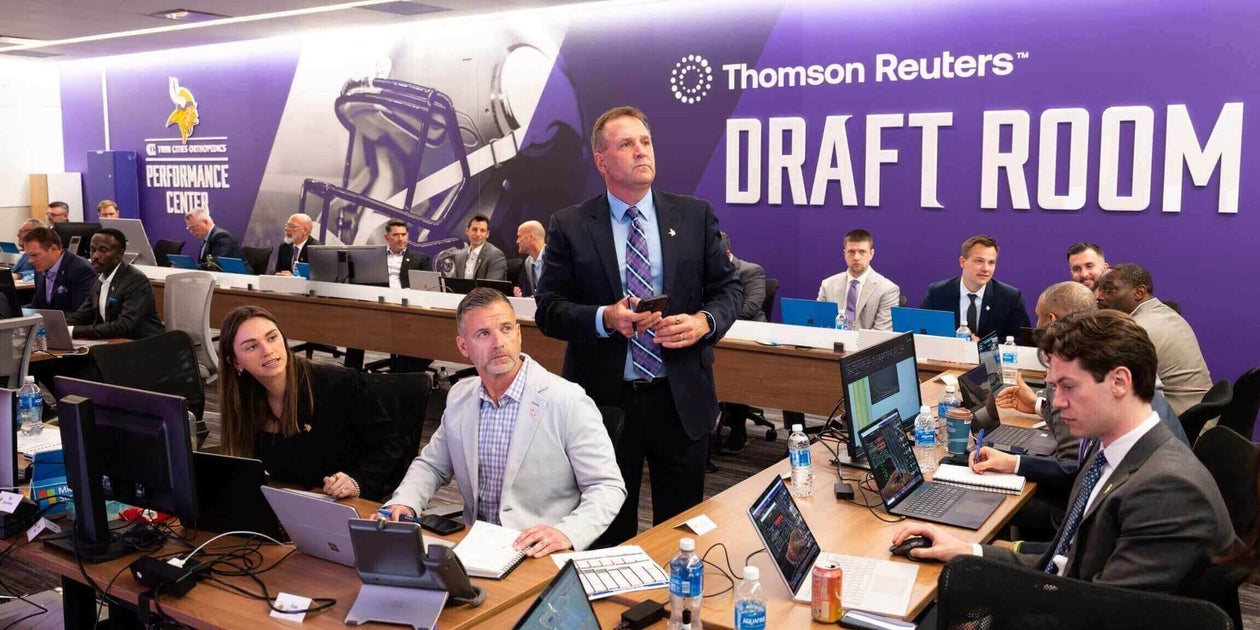
A longtime executive behind the scenes for the Vikings, Rob Brzezinski will have more of a front-facing role this offseason. (Courtesy of the Minnesota Vikings)
The role of an NFL general manager is often misconstrued. It is primarily a leadership position.
Like any chief executive in business, the main responsibilities are to answer to shareholders (ownership) and establish a culture of belief among employees (coaches, scouts, business staffers, etc.). Personnel chops matter, but time doesn’t usually allow GMs who were previously scouts to study players the way they used to.
“The one thing about that position that I think has evolved the most,” former Vikings GM Rick Spielman, currently an advisor for the New York Jets, said recently, “is that it’s about your ability to manage people. To get everybody moving in the same direction. To take your ego out of it and make the best decision for the organization based on all of the knowledge you’ve ciphered through.”
An NFL general manager must understand team-building philosophies, be fluent in the salary cap, know how to navigate media responsibilities and be a strong relationship builder.
“Those are the four tenets of any successful (GM),” said Joe Linta, an NFL agent for more than two decades. “And all of them have a limitation somewhere.”
Issues arise when general managers aren’t aware of their flaws. Building a staff capable of compensating for those flaws is an entirely different skill. Mike Kelly, a former Vikings executive turned technology CEO who remains a season ticket holder, long felt this modesty was what separated Brzezinski from other front-office types.
“Rob is exactly the type of person whose ego will allow him to do those things,” Kelly said.
Brzezinski studied law at Nova Southeastern University near Fort Lauderdale, Fla. In 1993, the Miami Dolphins hired him as staff counsel and salary-cap manager. Brzezinski learned the ropes from late Dolphins executive Bryan Wiedmeier, who had worked closely with heavy-handed coaches like Don Shula, Jimmy Johnson and Nick Saban. The collective bargaining agreement became Brzezinski’s area of expertise.
Needing someone to untangle his salary-cap situation in 1999, former Vikings owner Red McCombs landed Brzezinski, who quickly impressed staffers in all areas. Kelly, then one of the team’s highest-ranking employees, watched Brzezinski digitize the team’s scouting reports and contract databases into a computer for the first time.
Brzezinski sat in on every draft meeting. He devised strategies to land players who seemed unattainable. He left the draft process to organizational fixtures like Scott Studwell, Frank Gilliam, Jerry Reichow and Paul Wiggin. Yet when he received informational tidbits on players from contract discussions, he passed them along without expecting anything in return.
“He has never, ever been one to toot his own horn,” McCombs said in a 2002 story on Brzezinski in The Minneapolis Star Tribune. “He’s never been critical of anybody in the organization, and he’s never been one to get involved in the politics that you see in some places.”
Brzezinski negotiated with agents on McCombs’ behalf, so when the Vikings selected Culpepper with the 11th pick in the 1999 draft, he and Ashe squared off for the first time. Brzezinski seemed sharp in their first few sessions, boardroom back-and-forths digging into the minutiae of guaranteed money and statistical incentives.
Ashe kept his guard up. Any misstep could mean less money for his client, and competitors in the agent space seize on deals that aren’t maximized.
“I was looking for curveballs,” he said. “I was looking for any kind of angle that wasn’t right. Rob wasn’t about any of that. He shot straight.”
Coaches appreciated Brzezinski’s savvy. Former Vikings head coach Brad Childress once listened in on a delicate moment with high-profile agent Tom Condon. They had been heatedly discussing a player’s contract. Brzezinski interjected with levity to lower the temperature.
Another former coach, Leslie Frazier, heeded Brzezinski’s advice on how to proceed with linebacker fixture Chad Greenway. Yet another head coach, Mike Tice, came to think of Brzezinski as a quasi-president, executive, manager, ownership liaison and fixer behind the scenes who never sought credit.
“It’s called consistency,” Tice said. “If you’re consistent, people are going to respect you. And he always was.”
How did the Vikings land Seattle Seahawks Hall of Fame offensive lineman Steve Hutchinson? Brzezinski. He knew that if the Vikings offered Hutchinson a seven-year, $49 million offer, Seattle would find itself in a pickle. The offer required the Seahawks to make Hutchinson the team’s highest-paid lineman, which they couldn’t do because they employed fellow future Hall of Famer Walter Jones. The Vikings pried Hutchinson with financial savvy, and what became known as the “poison pill” approach was later outlawed by the NFL.
Who stepped in to secure Hall of Famer Jared Allen before he exited Minneapolis and opened talks with the Tampa Bay Buccaneers? Brzezinski. He calmed the angst in a room when the subject of his off-field concerns surfaced.
When legendary running back Adrian Peterson was returning to play in 2015, who kept Dogra (then Peterson’s agent) at the bargaining table? Brzezinski. He didn’t back down from confrontation in public, but he remained respectful enough to find common ground. Minnesota added guaranteed money to Peterson’s deal. That year, he led the league with 1,485 rushing yards and 11 touchdowns.
“My job was to do the best possible deal for my client, even if it meant to trainwreck you, to knock your block off like Mike Tyson,” Dogra said. “But Brzezinski was formidable. He was that guy. And when you were done with a deal, you wanted to hug him. Because he’s honest, ethical, smart and you knew you were in for a f—ing battle.”

Team executives such as Rob Brzezinski, left, must be familiar with nearly every aspect of the organization, but he defers to coaches regarding on-field decisions. (Courtesy of the Minnesota Vikings)
Last week in Indianapolis, Brzezinski met with local reporters for a lengthy on-the-record interview. This was the Vikings’ version of a solar eclipse.
Afterward, multiple team sources asked excitedly: “How’d he do?”
This is, in a roundabout way, revelatory. Their tone hinted at an undercurrent of support for Brzezinski to become the full-time general manager, a position he has never jockeyed for.
“Everybody in the building trusts him,” one team source said, “and that shouldn’t be taken for granted.”
Another league source who has worked with Brzezinski for more than a decade said, “There would be nothing cooler than to see him, after giving everything to that organization all of these years, put the process in place that gets them to a Super Bowl.”
Would Brzezinski want to be in the line of fire? General managers have a front-facing role, and the accountability falls on their desk. Brzezinski didn’t definitively answer the question at the combine, but it is possible. Because Brzezinski has observed countless iterations of leadership structures and styles, none of which have led to the Vikings reaching the mountaintop, perhaps he feels like his own objectivity in developing a consensus would be optimal.
In Indianapolis, Brzezinski offered something of a vision. He reiterated the importance of drafting, developing and maintaining a core. He expressed an understanding of the pressure that comes with being a young quarterback for an organization that, for years, has been in search of a savior. He deferred to the coaches’ expertise. Any questions about himself made him squeamish, which is partially why there’s so much internal trust in him.
You have to dig to find out that his wife, Leah, has a doctorate in education and has worked with autistic children. You have to dig to find out that their family has adopted multiple children. You have to dig to hear NFL lifers such as Frazier end calls like this: “He has the ability to read people and meet you where you are — and I promise, in this business especially, that’s a unique quality.”