
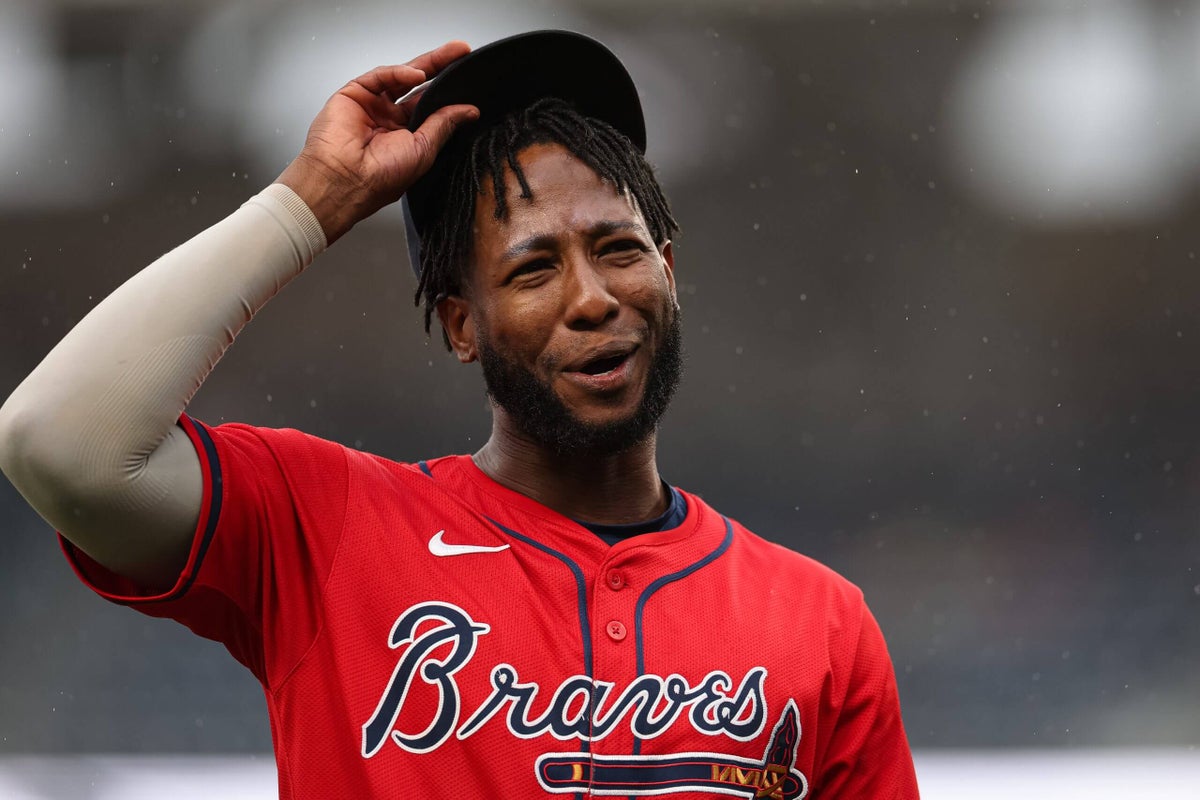
With all due respect to the baseball gods, sometimes two strikes are more than enough. In Jurickson Profar’s case, it certainly should be.
Profar, as you probably heard by now, has been suspended for a performance-enhancing drug violation for the second time in a year. The penalty for second-time offenders is a full-season suspension, meaning Profar won’t get any of his $15 million salary in 2026. But Profar’s contract with the Atlanta Braves runs through 2027, meaning he will be paid $15 million in 2027, whether he’s hurt or bad or traded or released. That’s how MLB contracts work.
The only way Profar wouldn’t get $15 million next year would be if he had a third violation after testing positive for two different banned substances in 2024 and ’25. In baseball’s drug program, it’s three strikes and you’re out in the form of a lifetime ban. Players get an average of 10 random tests a year, including in the offseason, under Major League Baseball’s Joint Drug Prevention and Treatment Program, which was established in an agreement between the Commissioner’s Office and the Players Association.
So while Profar’s mistakes have cost him tens of millions — he forfeited roughly $5.8 million of his $12 million salary last year for an 80-game ban — he still stands to make more than $20 million of the three-year, $42 million contract he signed with the Braves in January 2025.
Sure, Profar has to deal with the humiliation of being caught and the bad publicity that comes with it. But that all dies down eventually. The three-year deal he signed with Atlanta came after a career year in his age-31 season with the San Diego Padres. His salary then? A million dollars. Profar’s biggest payday before Atlanta was a three-year, $21 million deal with the Padres. The most he had ever made in a single season? Just under $8 million.
Whenever I see news regarding performance-enhancing drug violations, my mind instantly goes back to a conversation I had a dozen years ago with a veteran player inside the Baltimore Orioles’ clubhouse. I don’t remember how the talk turned to steroids, but I do remember asking why guys would put their entire lives and careers at risk.
He laughed. I had it all wrong. Guys didn’t take performance-enhancing drugs thinking they were risking their careers. Many of them did it so they could have careers — so they could elevate their stats, sign a big multiyear deal and set themselves and their families up for life. Sure, there was a risk of getting caught and forfeiting some pay. But baseball contracts are guaranteed. So as long as they didn’t get caught three times, teams were on the hook to pay them.
Big risk, big reward. And until that reward goes away, the risk will always be worth it to certain players.
Atlanta isn’t totally blameless in this mess. Profar’s deal, which could go down as one of the worst free-agent contracts in history, was met with a healthy dose of skepticism the moment it happened. There was a certain buyer-beware element. Still, it’s not like the Braves could have drug-tested him themselves before he inked it. They are as powerless now as they were when they signed him.
Any change to the current penalty system — 80 games for first-time offenders, a full season for second-time offenders and a lifetime ban for the third — would have to be collectively bargained for and agreed upon by the commissioner’s office and the players’ association. In previous CBA negotiations, commissioners tried to modify existing rules to allow teams with multiple offenders the ability to void contracts, particularly when the violating player had recently signed a multiyear deal.
One such proposal would have had violators earning the major-league minimum the following year. Another, which came in the wake of Marlins star Dee Gordon’s suspension a few months after signing a five-year, $50 million extension in 2016, would have allowed certain termination or renegotiation rights for teams when a player is suspended for at least 80 games (pitcher Ervin Santana had served an 80-game suspension in April 2015 after signing a four-year deal with Minnesota that offseason). In all cases, the union declined.
Baseball’s contracts are difficult to void as currently constructed, even when a player breaks the rules not once but twice, and even when one can reasonably argue that the drug violations directly impacted performance. There’s a clause in the CBA that allows teams to argue that drug policy violations caused a player under contract not to fulfill its terms, but that would be a tough grievance to win. No team has even tried.
Profar’s suspension starts Friday. His appeal, which will be handled by the players’ association, will be expedited. It’s been more than a decade since a drug violation has been overturned on appeal, meaning that despite nearly every athlete’s statement that his violation was accidental and the drug entered his system unknowingly, genuine mistakes are rare.
The current collective bargaining agreement expires at the end of 2026, and while there will be many more contentious issues discussed, it’s past time to tighten up drug violations, which have been in effect since 2014. I’m all for players’ rights but wonder if we’ve gone too far. If punishments don’t adequately fit the crime, if there’s a way to make life-changing money after a second failed drug test, how do you actually clean up the game?
Pitcher Justin Verlander has said first-time offenders shouldn’t be allowed to play in and impact games while they wait for an appeal. Veteran pitcher Miles Mikolas said on Thursday’s episode of the “Foul Territory” podcast that he’s against the union, which is player-funded, going to bat for Profar. “He’s got plenty of money and time now to defend himself without the need of the players’ association,” Mikolas said. “I don’t think the PA should be doing anything.”
Profar, who abruptly left Team Netherlands ahead of the World Baseball Classic when news of his suspension came out, will eventually have to take responsibility for his actions. He’ll explain why, on the heels of one drug violation and financial security, he failed another test. But what will it matter? He will be a much richer man after the drug policy violations than he was before.
The sport has come a long way since the juiced glory days of the 1990s and early 2000s, enacting frequent testing, punishment and public shame. You want to give players one mulligan? Fine. But second-time offenders should be out of the game. At the very least, any multi-year contract should be able to be voided or reworked by teams. Players awaiting appeals should not be allowed to play.
Concerned about being overly harsh, I texted a few current and former players, expecting some pushback. I got none.
“I don’t condone any of this,” said one player, “But the way the system is set up, it’s not hard to see how it happens.”