
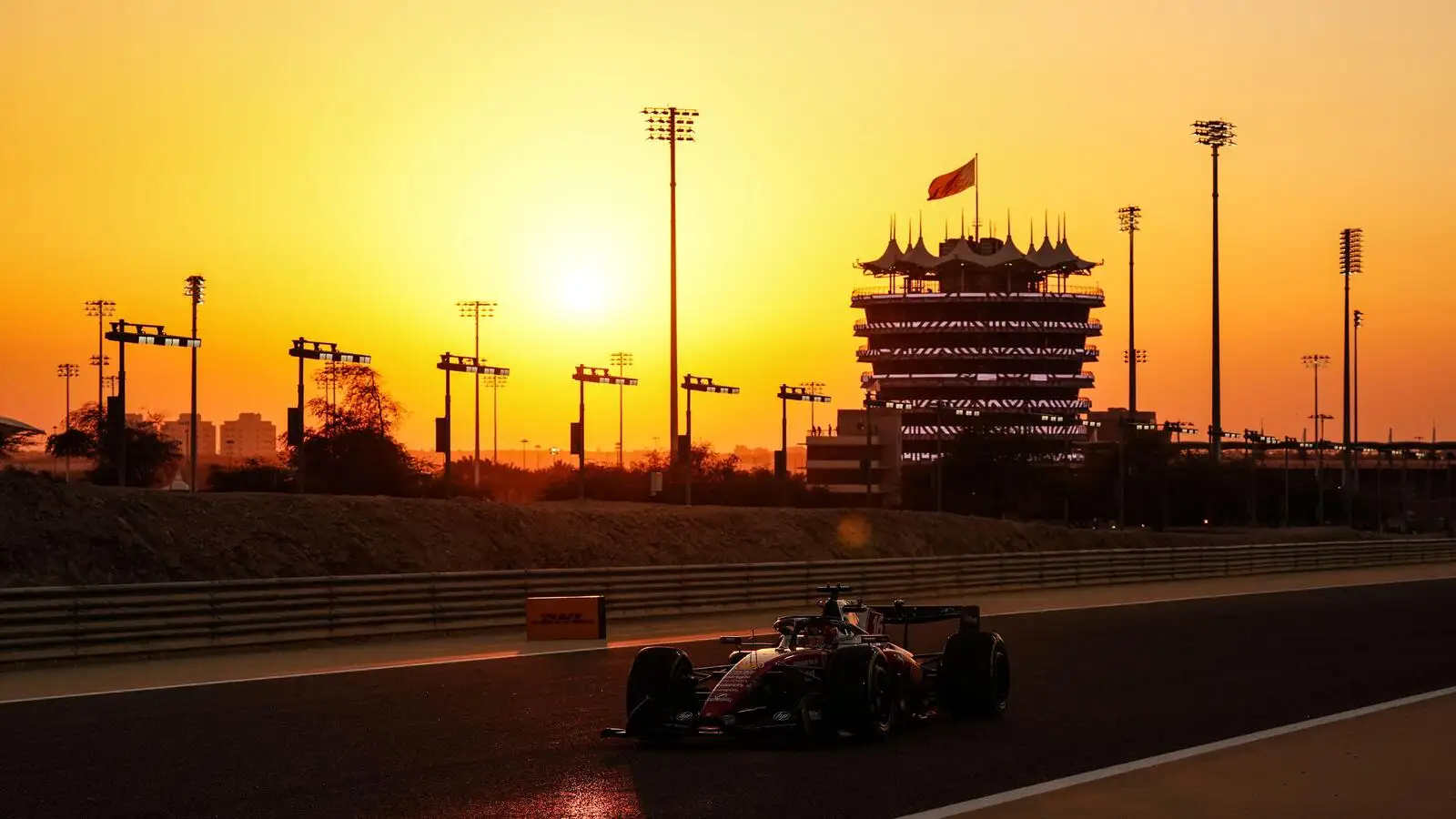
A decision on the fate of the Bahrain and Saudi Arabian Grands Prix is not imminent but is growing nearer as Formula One Management continues to monitor the situation.
Conflict in the region has cast doubt over the events, Rounds 4 and 5 of the championship, respectively, prompting speculation to swirl around the Albert Park paddock.
Explaining F1’s position on Bahrain and Saudi Arabian races
Want more PlanetF1.com coverage? Add us as a preferred source on Google for news you can trust.
The F1 circus arrived in Melbourne ahead of the opening round against a backdrop of hostilities in the Middle East.
That saw much of the travelling circus rerouted through Asia as airspace closures meant the usual passages, though Doha or Dubai were unavailable.
It is therefore unsurprising that the ongoing conflict in that region has been a key talking point.
With Bahrain scheduled to host F1 on April 10-12, Formula One Management has insisted there is no urgency in making a decision, and that it has time to monitor how the situation plays out.
A defining element in the fate of the Bahrain and Saudi Arabian Grands Prix is freight.
Decision timeline
Teams have several sets of equipment which leapfrog from event to event. Freight from China is scheduled to travel via boat to Bahrain, a journey which includes traversing the Strait of Hormuz.
That is slated to leave in the days immediately after the Shanghai race, though in reality alternate plans need to be locked in ahead of that point.
While the decision ultimately lies on Formula One Management as to whether the circus heads, initially, to Bahrain, the FIA also has a voice in that conversation as the sport’s regulator.
From all involved, safety is the primary consideration, above the more than $100 million Formula One Management is expected to bring in through race hosting fees.
Both the Bahrain and Saudi Arabian Grands Prix are underwritten by their respective national governments, both of whom are long-term partners of F1.
While Saudi Arabia is contracted only until 2027, there is a deep relationship with state-based oil company Aramco. There’s are plans to move the event to the all-new Qiddiya Speed Park Track from 2028.
In 2022, Formula One Management inked a new contract with organisers in Bahrain that will see the event remain on the calendar until at least 2036.
Combined, the that could make for well over $700 million in potential race hosting fees over the coming years.
The events therefore have strong value, not just in terms of the current season but deep into the future. A loss this year could in many ways be seen as an investment in the future of both relationships.
Financial impact
That loss of income has a knock on to teams, as their prize money payments are directly linked to FOM’s own financial performance.
Teams receive 45 percent of FOM’s total revenue (though performance bonuses do impact that figure), which in 2025 came to $3.87 billion, entitled teams to a share of around $1.4 billion.
Using 2025’s financial figures, a $100 million drop in revenue would translate to a prize money pool only $4 million smaller than it was last season.
Hence McLaren boss Zak Brown was non-plussed by the financial ramifications for his team.
Of the two countries, Bahrain remains the most heavily impacted by the current conflict.
However, optics are such that bypassing Bahrain only to race in Saudi Arabia could be seen as a slap in the face.
There are also practical considerations such that, in all probability, should one event be cancelled, both would be.
Within the paddock, that has prompted speculation surrounding possible replacement events.
Will Bahrain and Saudi Arabian Grands Prix be replaced?
During the pandemic, Formula One Management worked miracles to stand up a championship season, at short notice, though in that instance the circumstances were vastly different.
Then, it was incentivised to meet a minimum number of events from a broadcast obligation perspective. In this instance, that is not applicable.
As such, it’s believed there is resistance to concepts such as a double-header in Japan.
The three-week gap after Japan does create a window of opportunity, with another race a week after the Japanese Grand Prix a logical suggestion.
However, it fails to take into account the human element, dragging out a long start to the 2025 season for those in the paddock – some of whom will be away from home for more than a month under the current schedule.
To add another event in Japan therefore isn’t viewed as a realistic option, and there are concerns there’s not enough time to prepare another venue – be that Portimao, Imola, or Istanbul – to step in.
Further to that, given those promoters would likely contribute very little, while increasing freight costs to teams and the human toll, there’s little to incentivise teams to agree to replacing the two cancelled events.
More on F1 and the current Middle East tensions
Australian Grand Prix to go ahead as CEO addresses Middle East travel fears
FIA postpones WEC Qatar 1812km as Formula 1 monitors Gulf situation
And should the gap left between Japan and the Miami Grand Prix not be filled, there are no other alternatives; there is no desire to create a mid-season triple-header, or race through the mid-season break.
It’s therefore entirely plausible, if not highly probably, that the Bahrain and Saudi Arabia Grands Prix would not be replaced, should they be cancelled.
That scenario sits well within the paddock, much of which is already tired following a busy pre-season schedule which has fed almost immediately into the start of the season proper.
A final decision on the fate of the Bahrain and Saudi Arabian Grands Prix is not imminent, though conversations among the sport’s power brokers continue.
That includes not only the FIA and the teams, but officials in Bahrain and Saudi Arabia.
Want to be the first to know exclusive information from the F1 paddock? Join our broadcast channel on WhatsApp to get the scoop on the latest developments from our team of accredited journalists.
You can also subscribe to the PlanetF1 YouTube channel for exclusive features, hear from our paddock journalists with stories from the heart of Formula 1 and much more!
Read Next: F1 and FIA closely monitor Bahrain and Saudi Grands Prix amid Middle East conflict