
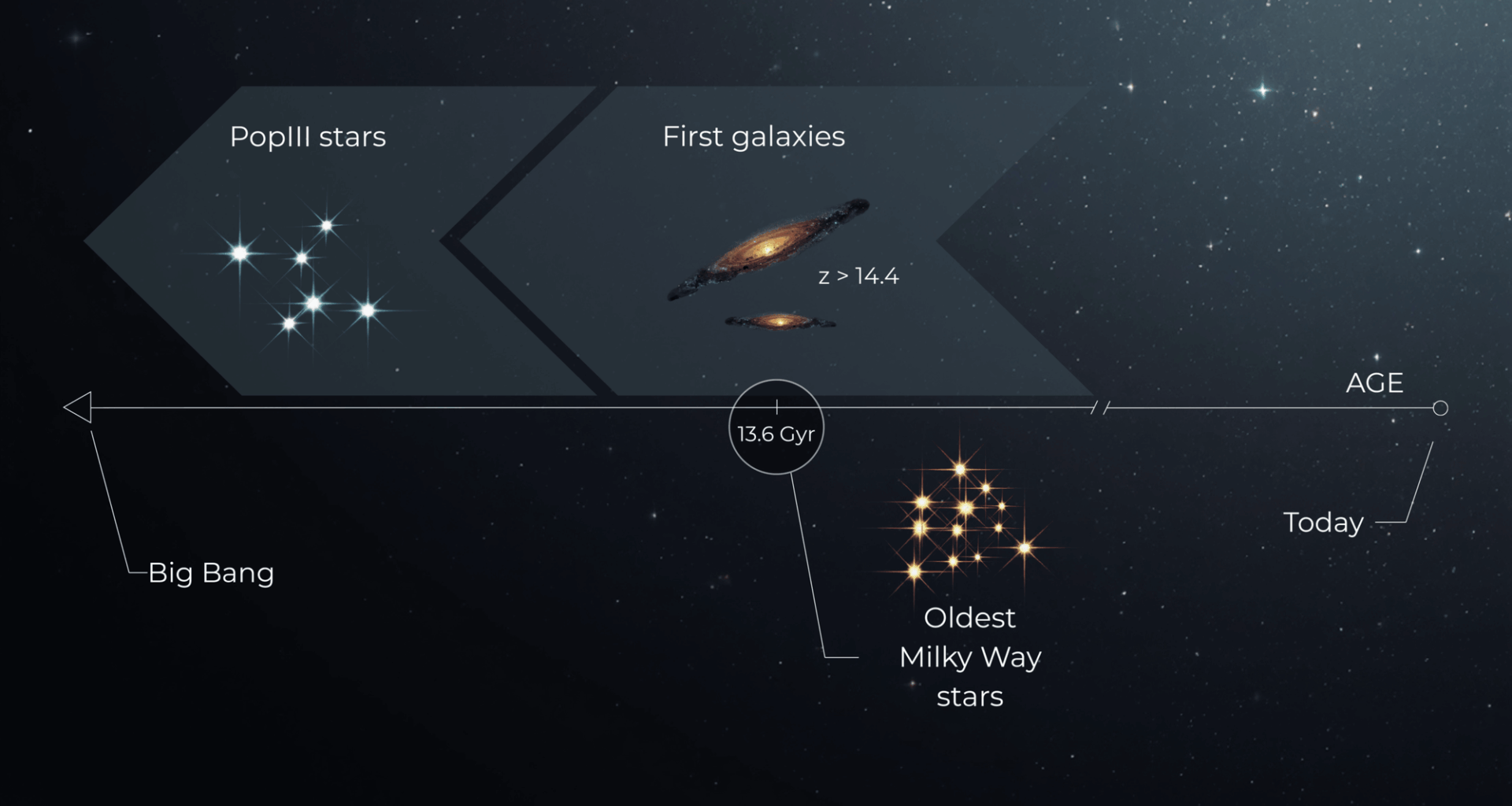
The oldest stars in the Milky Way are forcing a fresh look at one of cosmology’s biggest arguments. If some of them are about 13.6 billion years old, as a new analysis suggests, then the universe itself cannot be younger than that.
That matters because astronomers still disagree on how fast the universe is expanding, a dispute known as the Hubble tension. One set of measurements, based on Cepheid stars and supernovae, points to a faster expansion rate and a younger universe, roughly 12.9 billion years old. Another, based on the cosmic microwave background, points to a slower expansion rate and an older universe, around 14.0 billion years old.
The new study, published in Astronomy & Astrophysics, does not try to settle that argument by measuring expansion directly. Instead, researchers from the University of Bologna, the Leibniz Institute for Astrophysics Potsdam, and other institutes turned the problem into an age question: how old are the oldest stars close to home?
Reading time in the Milky Way
The logic is simple. The universe cannot be younger than the oldest stars inside it.
Age distribution (left), Kiel diagram (centre), and age-metallicity coverage (right) for each step of the selection process, before visual inspection. (CREDIT: Astronomy & Astrophysics)
To test that idea, the team used a catalog of about 202,384 Milky Way stars whose ages had been estimated with the StarHorse code, a Bayesian isochrone-fitting tool. The ages were based on a mix of stellar properties, including brightness, distance, and atmospheric data. A key ingredient came from the European Space Agency’s Gaia mission, especially its third data release, which provided highly precise parallaxes and spectra.
The researchers focused on main-sequence turn-off and subgiant branch stars, which are especially useful for age dating. These stages are a kind of sweet spot because their properties shift in ways that make age estimates more sensitive. From the much larger catalog, the team selected stars older than 12.5 billion years with uncertainties below 1 billion years, then kept narrowing the sample.
That trimming process was strict. The researchers removed likely contaminants, including stars in the wrong evolutionary stage, stars affected by parameter degeneracies, and stars with suspicious probability distributions. After a final visual inspection, they were left with 185 stars. Then they identified and excluded a likely contaminant group, including possible mass-stripped stars and binaries that could appear older than they really are. The final reference sample contained 160 stars.
Its cumulative age distribution peaked at 13.6 billion years, with a statistical uncertainty of 1.0 billion years and a systematic uncertainty of 1.4 billion years.
A new angle on the Hubble tension
That age fits comfortably with the older universe implied by the cosmic microwave background. It does not sit as easily with the younger universe implied by Cepheid and supernova measurements, unless other ingredients in the cosmological model are changed.
Under the assumptions used in the study, the stellar ages imply a lower limit for the age of the universe of about 13.8 to 14.0 billion years, once the team added the minimum time needed for the first stars to form after the Big Bang. The researchers estimated that delay at about 0.2 to 0.4 billion years, based on models of early star formation and observations of very distant galaxies.
Cumulative posterior distribution in age for the final and golden samples. The distributions including the systematic component of the error are shown as solid lines in the same colours. (CREDIT: Astronomy & Astrophysics)
They also translated that result into an upper limit on the Hubble constant: 68.3 kilometers per second per megaparsec, with wide statistical and systematic uncertainties. That is much closer to the lower value inferred from Planck observations of the cosmic microwave background, 67.4 ± 0.5 km/s/Mpc, than to the higher local value of 73.04 ± 1.04 km/s/Mpc from Riess and colleagues.
Still, the paper is careful not to overclaim. The authors note that the relation between the universe’s age and the Hubble constant depends on the cosmological model and on assumptions such as the matter density parameter. In some configurations, the tension softens. In others, it does not.
Where the uncertainty still sits
The biggest weakness is not the size of the sample, but the difficulty of measuring stellar ages accurately.
The researchers say current data allow very high precision, but accuracy is harder because of systematic effects. In this study, those included possible biases in alpha-element abundances and uncertainties tied to stellar models, such as assumptions about mixing length and the initial helium fraction. Together, those systematics added up to 1.4 billion years.
There is also the issue of contamination. The team found evidence for a second, older-looking group of stars centered near 14.8 billion years, broader than the main peak. They treated that group with caution and estimated that about 11 percent of the sample could be contaminants.
Even so, the result stands out because it comes from single stars, not globular clusters, and from a sample large enough to carry some statistical weight. Elena Tomasetti of the University of Bologna, the study’s first author, said the work shows how improved data now allow “for the first time, statistically significant results.” Cristina Chiappini of AIP said Gaia has turned the Milky Way into a “near-field cosmology laboratory.”
Distribution of the 10th percentile in age for the clean final (green) and golden (gold) samples. In each panel, the top axis shows the corresponding H0 values assuming a flat ΛCDM and a different value of Ωm and zf. (CREDIT: Astronomy & Astrophysics)
More Gaia data could sharpen the picture. High-resolution spectroscopy could also reduce one of the main sources of systematic error.
Practical implications of the research
This work gives astronomers another way to test the Hubble tension without relying only on traditional expansion measurements.
If future stellar age estimates become more accurate, the oldest stars in the Milky Way could serve as an independent check on competing models of the universe.
That would not just refine the universe’s age. It could also help reveal whether the tension comes from hidden errors in existing methods, or from new physics that current cosmology does not yet explain.
Related Stories