
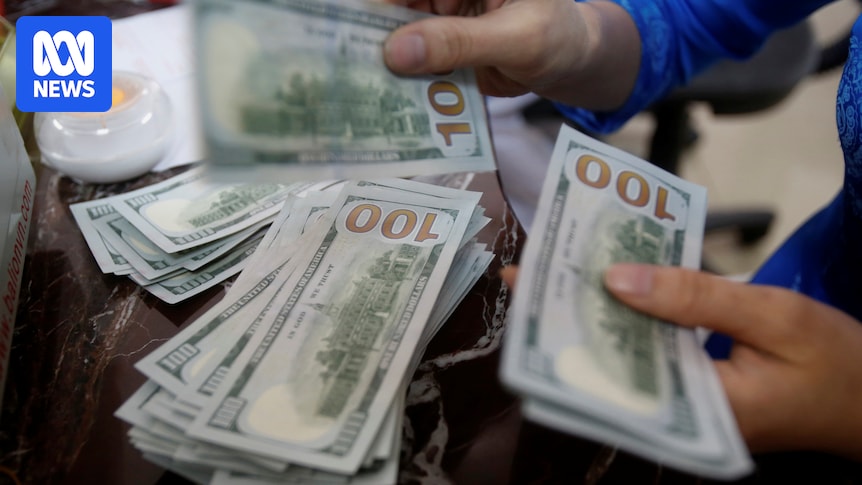
The Reserve Bank has questioned whether the US dollar is losing its status as the world’s safe-haven currency.
The greenback has been considered the world’s reserve currency for decades, or at least since the early 1970s.
Speaking at a gathering in New York City, RBA deputy governor Andrew Hauser told a room of academics, market economists, and policy makers, that even defining an asset’s safe-haven status was treacherous territory.

Andrew Hauser says the US dollar has been depreciating in the face of widespread uncertainty over US policy. (AAP: Lukas Coch)
“As Captain Cook found when, heading home at the end of his famous voyage in 1770, he grounded his ship HMS Endeavour on the Great Barrier Reef,” Hauser told the gathering.
“In mortal danger, the crew found a promising river estuary — known as Waalumbaal Birri by the local Guugu Yimidhirr people — in which to conduct repairs.
“But the winds were so fierce, and the water so crocodile-infested, that it took them another week to stagger far enough inland to beach their leaking boat on a mudbank.”
“Defining a safe-haven asset,” he quipped, “can be equally challenging.”
Hauser’s speech noted that market participants typically identify three main characteristics of such assets: security (minimal credit risk); an inverse correlation with the value of risky assets; and liquidity.
On the first point, he said, “There is little sign yet of a persistent decline in perceived security [of the US dollar].”
The second point, according to Hauser, can be challenged.
“The US dollar has obviously not played what some claim to be its ‘usual’ role in key periods over the past 12–18 months — depreciating, rather than appreciating, in the face of widespread uncertainty over US policy, and a sharp fall in equity prices last April,” he said.
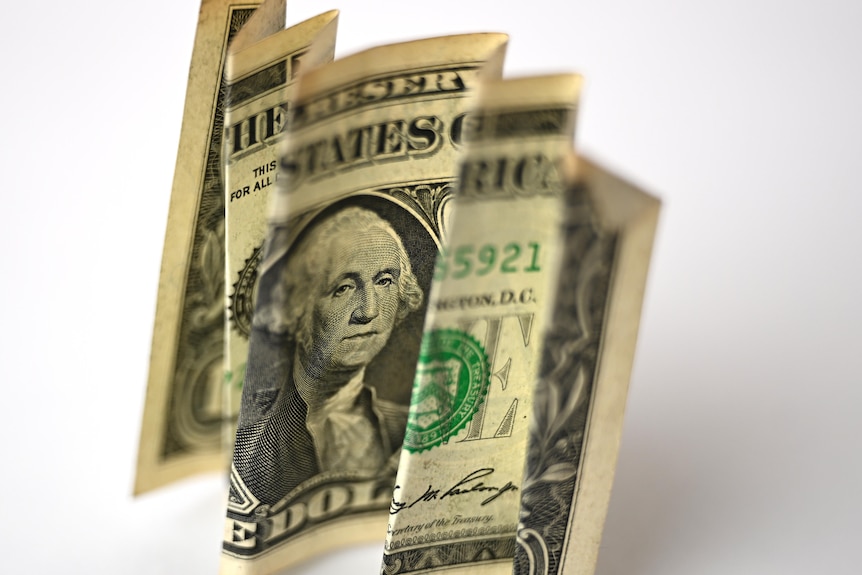
The US dollar remains close to half of all reserves. (AAP: Lukas Coch)
On “liquidity”, or the ease of which US-denominated assets can be easily converted to cash, Hauser also raised some concerns.
“The feature that matters most for many, including us central bank reserves managers, is liquidity,” he said.
“The pre-eminent role of the US dollar in cross-border payments and invoicing, banking claims and debt issuance has long allowed US sovereign assets to command a liquidity premium (or ‘convenience yield’).
“On some measures, that ‘specialness’ deteriorated in 2025 compared with earlier years, leading some commentators to make the eye-catching claim that it may presage the end of the dollar as a reserve currency.”
New trend emerging
But, he argued, “Here too it is worth keeping our feet on the ground.”
“US [foreign exchange] fx and treasuries remain by far the most liquid of the ‘traditional’ safe-haven markets,” he said.
Australian dollar at a critical crossroads
But another trend is emerging which, some analysts argue, does point to less interest in the US dollar as a safe-haven asset.
And in Hauser’s speech, he lays it bare.
“In aggregate, official reserves [central bank reserves] have diversified away from the US dollar, principally towards gold and ‘non-traditional’ currencies, according to International Monetary Fund (IMF) data,” he noted.
“And reserve managers told last year’s OMFIF survey that that diversification could go further in the near term, reporting geopolitics to be their top long-term investment challenge.”
However, the dollar remains close to half of all reserves, similar to, or even a little higher, than in the early 1990s.
Demand from foreign investors
The past 11 months have seen an extraordinary run-up in stock markets, especially in the United States.
And, this, Andrew Hauser said, has moved money away from debt markets, and the US dollar, and towards shares.
This, he argued, has deflated the US dollar.
China wants renminbi to become a global reserve currency
“Predominantly all the pick-up in portfolio capital inflows into the United States over the past year reflects purchases of equity rather than debt,” he said.
This, in turn, leads to less purchases of the US dollar because it’s needed to buy the US-dollar-denominated debt.
“And the huge valuation gains in US equity prices relative to debt in recent years,” Hauser added, “have dramatically changed the composition of US external liabilities, expressed as a share of nominal GDP.”
The demand for US shares, he said, is coming from foreign investors.
“First, it means [they] may be keener to protect themselves against signs of possible breakdown in what (rightly or wrongly) they see as the dollar’s historical risk-off properties,” he said.
‘Nothing is safe’ on global financial markets
He said it was hard to know how far this had gone, because comprehensive data was not available.
“But some countries’ pension funds, including in Denmark — the country of my fellow panellist — have reported increasing their hedge ratios in 2025,” he said.
“Even Australian superannuation funds (which have historically relied heavily on the Australian dollar’s inherent risk-on properties) have increased their cover very slightly, with some funds saying they are likely to go further,” he said.
This is a reference to major institutional investors buying insurance to protect themselves from a depreciating US dollar.
Experts at odds
Local currency experts are divided over whether the US dollar is in structural decline or losing its status as the world’s reserve currency.
The National Australia Bank’s head of FX strategy, Ray Attrill, said, “So far this year, including since the April 2 Trump tariff announcements, the US dollar has behaved much in line with traditional (cyclical) fundamental drivers, suggesting no strong evidence to date of a loss of safe-haven status.”
However, independent economist Saul Eslake said you can begin to build a case that the greenback is losing its safe-haven status.
“The answer is, yes, it has been on and off since the breakdown of Bretton Woods in the early 1970s,” he said.
“But it has accelerated over the past 10 years, partly because of the US’s weaponisation of financial sanctions.”
This is because the financial sanctions rely, for their effectiveness, on the role of the US dollar as the major currency in which transactions are conducted and wealth is held.
“More recently,” Eslake added, “because of the way in which Trump has been trashing America’s ‘brand’, including through threats to the independence of the Federal Reserve, which has historically been the principal guardian of the US dollar’s ‘safe-haven’ status.”