
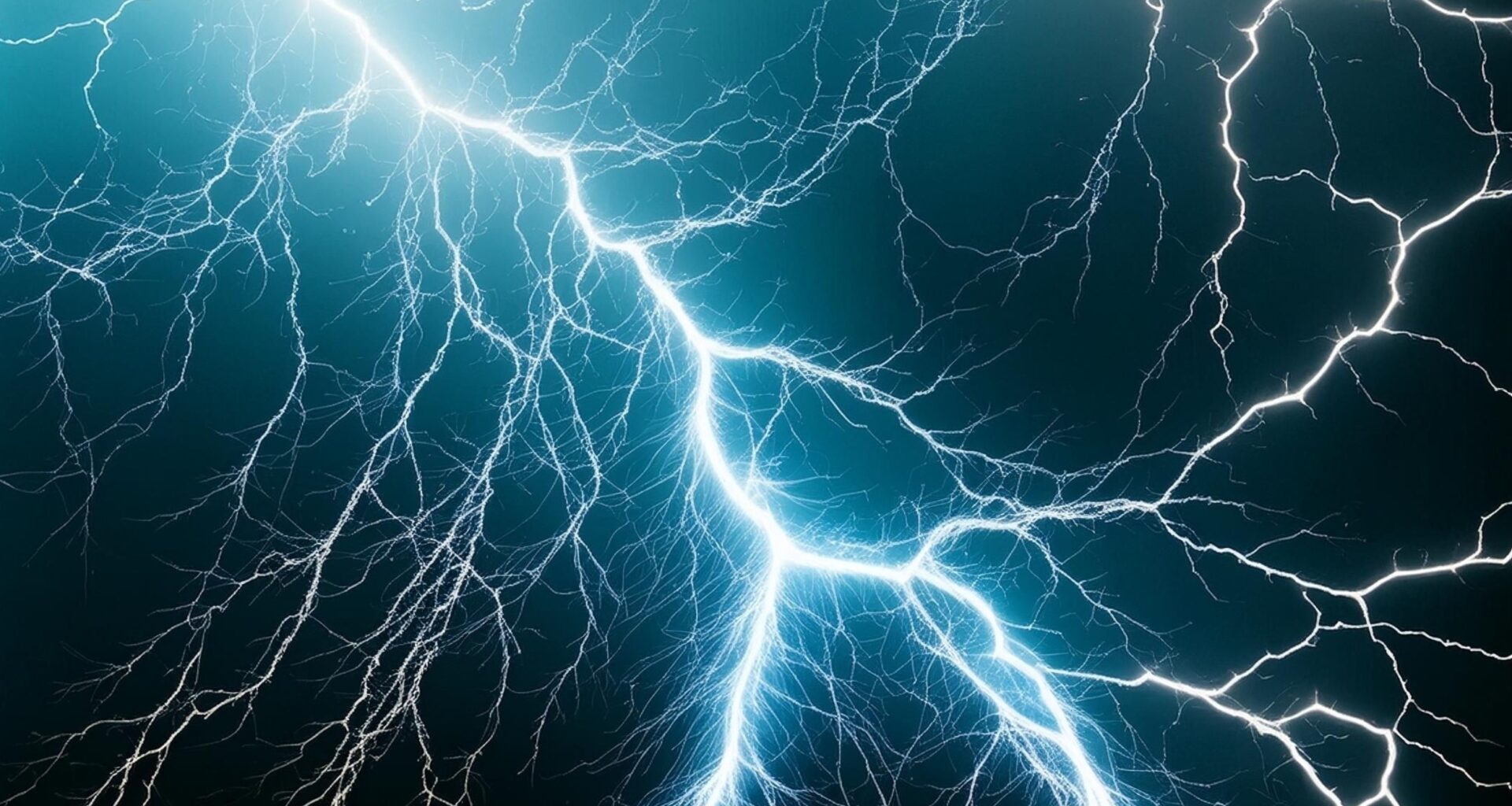
Lightning has always felt like one of those things that only nature can pull off: miles-wide storm clouds, crazy voltages, and sudden flashes that are still hard to predict.
But a new theoretical study suggests something wild: lightning-like discharges might be possible inside ordinary solid materials – think glass, acrylic, or quartz – on a lab bench.

The research was led by scientists at Penn State. Using mathematical models and detailed simulations, the team found that under the right conditions, dense insulating materials could build up the same kind of extreme electric fields that trigger lightning in the atmosphere.
“We applied the same exact models that we use for lightning research but shrunk down the scale to slightly larger than a deck of cards,” said study lead author Victor Pasko, a professor of electrical engineering.
“We calculated that when supplied with a high-powered electron source, lightning can be triggered in everyday insulating materials like glass, acrylic, and quartz.”
Desktop version of a monster phenomenon
The team didn’t create lightning in the lab yet. What they did was show, with numerical simulations, that the physics should work.
If experiments confirm it, the implications could be big. Researchers could study lightning in controlled conditions without chasing storms, launching rockets, or flying planes into thunderclouds.
This mini version relies on a process called a photoelectric feedback discharge. The basic idea is that electrons accelerate, produce high-energy radiation, and that radiation then knocks loose more electrons, creating a runaway chain reaction.
That chain reaction is usually associated with thunderstorms. The new claim is that it doesn’t have to be.
“We were amazed because we were able to model the same phenomena in a material one thousand times denser than air, and strike a thousand times faster than in thunder clouds – one-billionth of a second,” Pasko said.
How can a solid imitate a thundercloud?
In a real storm, lightning is linked to huge electric potentials – on the order of about 100 million volts – spread over distances that can stretch for kilometers. That scale is one reason lightning feels untouchable in lab research.
But the new work argues that solid materials can reach “thunderstorm-like” electric conditions over much shorter distances.
Dense materials like acrylic, quartz, and bismuth germanate are about a thousand times denser than air. That density changes how electrons and radiation behave inside them.
If you pump the material with an energetic electron beam, charge can build up in a tiny volume and create extreme electric fields very quickly.
According to Pasko, the team’s calculations suggest those lightning-level potentials could be reached over just a few centimeters, possibly even in a space smaller than a thumb.
Acrylic and quartz are familiar materials. Bismuth germanate is less common in everyday life, but it’s widely used in labs for detecting X-rays and in space-related experiments.
The researchers focused on these materials because their density and electrical behavior make them good candidates for reaching the required conditions.
The process at the heart of lightning
A big part of the team’s work builds on something known as a relativistic runaway electron avalanche. It sounds dramatic because it is.
In thunderstorms, electrons can get accelerated by strong electric fields. Instead of being slowed down quickly, some electrons “run away,” gaining huge energies. When they crash into air molecules, they can generate X-rays and gamma rays.
In rare cases, these bursts become terrestrial gamma-ray flashes – extremely powerful blasts that can send radiation hundreds of miles into space.
The researchers have studied these emissions for years. They’ve shown that thunderstorms can produce not only visible lightning but also X-rays and radio waves as electrons collide with molecules in the clouds. Those collisions trigger the avalanche that helps initiate lightning.
The new work takes that same runaway idea and asks: can it happen inside something solid?
The simulations say yes – at least in principle. In the solid version, accelerated electrons would generate high-energy photons, which then bounce backward and knock loose more electrons, feeding the chain reaction. That’s the photoelectric feedback loop.
The key point is that the loop doesn’t fundamentally require air or a cloud. It requires the right electric field and a material where the physics supports the feedback.
Implications beyond lightning research
If this holds up experimentally, the most obvious benefit is scientific. Lightning is expensive and messy to study in the real world.
Researchers often need to observe enormous volumes of storm clouds – hundreds of cubic kilometers – and use balloons, aircraft, and rockets to probe what’s happening inside.
“If you’re able to experiment with lightning-like conditions on a desktop under controlled conditions, it would be wonderful – much more cost-effective and could answer so many questions,” Pasko said.
But there could be practical spinoffs too. The team notes that lightning-like discharges involve bursts of radiation.
If those bursts can be produced reliably and safely in small solid devices, they could potentially lead to more compact X-ray sources for medical clinics or security checkpoints. That’s still speculative, but it’s part of why the idea is getting attention.
Inspiration for the new model
Pasko noted that the work was partly motivated by recent results from another research group. That team reported electrical discharges that looked surprisingly lightning-like, propagating through a small volume of certain materials.
That raised a tempting question: could the same feedback mechanism that triggers lightning in thunderstorms also explain these miniature discharges?
Pasko decided to see whether the thundercloud models could be scaled down and still work. The answer, based on the simulations, was yes.
“It just needs to be a kind of insulating material – theoretically you can reproduce this large-scale phenomena that we see in lightning in a very small volume,” he said.
“For us to realize that these voltages and electric fields, generated inside of these materials that are theoretically the same as in thunder clouds, was a real breakthrough.”
The next step is the hard one: actually doing it in the lab. But if the experiments match the math, lightning may turn out to be less “sky-only” than we’ve always assumed.
The study is published in the journal Physical Review Letters.
—–
Like what you read? Subscribe to our newsletter for engaging articles, exclusive content, and the latest updates.
Check us out on EarthSnap, a free app brought to you by Eric Ralls and Earth.com.
—–