
The head of Papua New Guinea’s military fears the country does not have the capacity to safely store 3,500 rifles Australia plans to ship to the nation, raising concerns they could end up in the hands of tribal warlords.
It comes after the ABC revealed children as young as eight years old were being taught to handle military-grade weapons, including M16 assault rifles, that are smuggled to tribal gangs.
Australia plans to furnish the Papua New Guinea Defence Force (PNGDF) with 3,500 purpose-made rifles after the two countries inked a landmark defence treaty in October last year.
Last week, the special envoy for defence and veterans’ affairs and Northern Australia, Luke Gosling, announced Thales as the contractor chosen to manufacture the Australian Combat Assault Rifles.
“These rifles are an excellent example of sovereign industrial defence capability and our ability to make high-quality manufactured export goods right here in Australia,” he said in a social media post.
Australia, PNG sign new defence treaty
However, PNG’s chief of defence, Philip Polewara, said he was concerned the PNGDF currently did not have the facilities to safely store the new weapons.
“Lethal items like weapons and ammunition, we have to be honest with ourselves and be realistic, whether we have the capacity or we have the facilities to keep all these items that we bring in,” he told the ABC.
“We want them, but is it safe? Are we able to keep them away from our civilian population?”
He added that creating a surplus of weapons and ammunition in the nation’s military increased the risk of these items being trafficked into the community.
“When you have more than enough, things can go the wrong way,” he said.
Modern weapons are changing PNG tribal warfare
Rear Admiral Polewara acknowledged that some of the weapons used in tribal conflicts in PNG had come from the military.
Violence between warring clans has been supercharged with access to illegal weapons, killing hundreds and displacing thousands across multiple provinces in recent years.
The PNG government says a nationwide gun amnesty will be held to encourage civilians to surrender their illegal weapons without facing criminal charges.
Rear Admiral Polewara said several high-powered guns had recently been seized at checkpoints in Enga province, a hotspot for gun violence.
“From this, we can ascertain that some of the weapons from the military have changed hands into the warlords’,” he said.
Australian-made gun stolen from armoured vehicle
An Australian government spokesperson said Australia is working to support Papua New Guinea’s efforts to strengthen weapons management.
“Australia acts in accordance with its international obligations, including those under the Arms Trade Treaty,” the spokesperson said.
Australia has previously supplied firearms to the PNGDF, most notably around 7,000 self-loading rifles (SLRs), the majority of which are now unaccounted-for, according to a 2005 report.
The study said the number of weapons smuggled from the PNGDF dropped dramatically after Australia built seven new armouries for PNG in 2002.
Rear Admiral Polewara told the ABC there were no current plans for Australia to help the PNGDF upgrade or increase their weapons storage facilities to accommodate the new rifles they plan to send.
The defence chief suggested the guns would not be brought to PNG until they could be stored safely.
“It’s not just a ‘yes, give it to us’ and they give it to us,” he said.
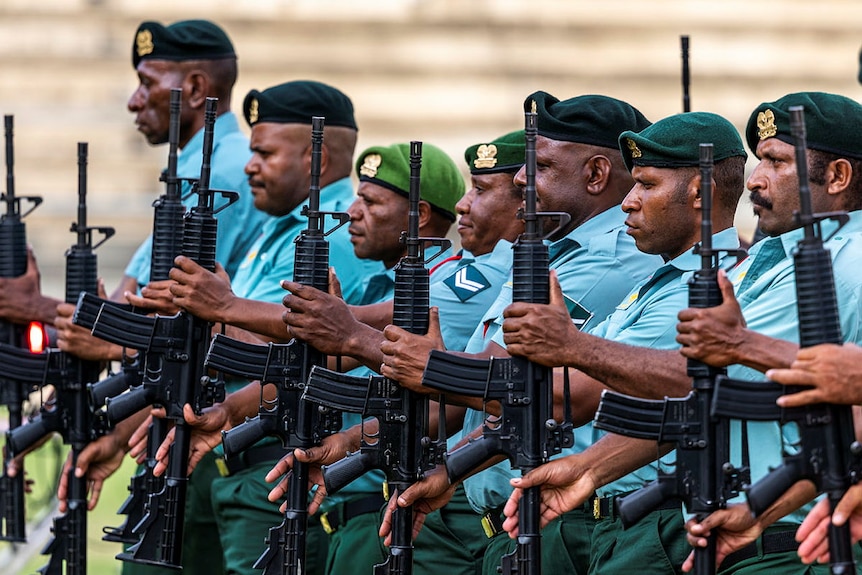
There have been issues in PNG over gun smuggling for decades. (Supplied: Department of Defence/CPL Jack Pearce)
A large-scale audit is now underway to determine how many firearms, ammunition and other controlled items have been lost from the PNGDF in recent years.
The military was also implementing new systems to secure these items and cracking down on personnel, Rear Admiral Polewara said.
“We can put in the best system. We can put in the best warehouses, the armoury, or the magazine … but it has to be the best people. Everything revolves around the people,” he said.
He confirmed an Australian-made gun was recently stolen from an armoured vehicle at the PNGDF’s Murray Barracks in Port Moresby.
Four PNGF members have been placed under house arrest in relation to the incident, and the weapon has been recovered.
Weapons smuggling an ongoing issue in PNG
Former PNGDF commander Jerry Singirok said the PNG government had “absolutely lost control” of illegal weapons over the past two decades.
“We’ve got to take control … with severe penalties,” he said.
Rear Admiral Polewara acknowledged the problem had not been adequately addressed and said the PNGDF was working to rectify issues.
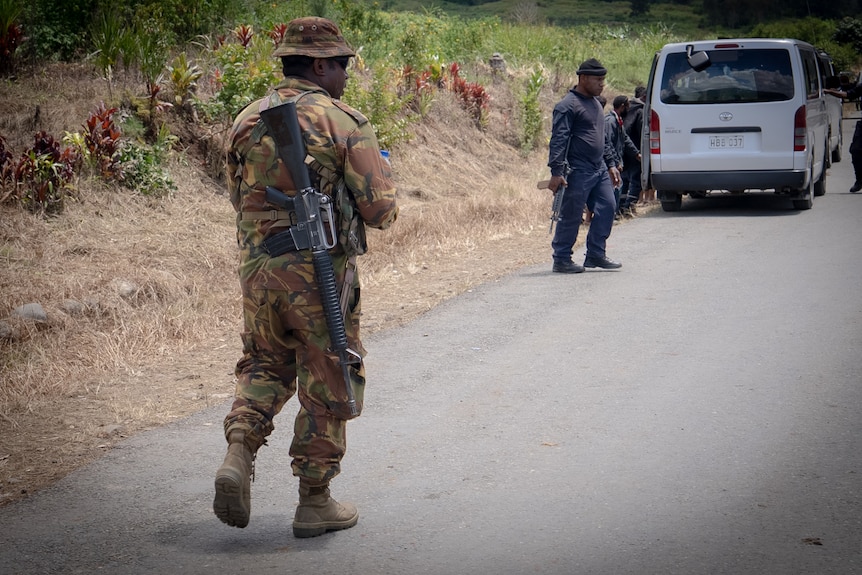
PNG soldiers carry automatic weapons. (ABC News: Marian Faa)
“I’m in the seat now, so I take responsibility for what has happened and put the things back in order,” he said.
But he said it was not just soldiers and the military to blame.
“It is also being supported by well-to-do [individuals] with networks and money,” he said.
New research sponsored by the UN suggests dangerous weapons are often trafficked and purchased with the backing of politicians and powerful elites.
A draft report, co-authored by Mr Singirok, said these elites — often distanced from direct conflict — buy illegal guns to be used in tribal wars to protect land, mining interests and political seats.