
It is more than five years since Trump’s first architectural decree which, as of December 21, 2020, required all new public buildings in the federal capital to deploy “classical and traditional architecture”. “Beauty” was already one of Trump’s go-to words, attached to everything from the United States–Mexico border wall to anti-abortion law. This decree was no exception – framed as a pursuit of “beauty and visual embodiment of America’s ideals”. Incoming president Joe Biden repealed it, but a flurry of new edicts starting from the day of Trump’s second inauguration demanded that architecture help “Make America Beautiful Again”. MABA. It would be silly if it weren’t so dangerous.
Beauty, of course, is a good thing, even if demanded rather than suggested. The danger arises when the issuer gets not only to require beauty but to define it; a delicate distinction that dictators typically fudge. Even then, it seemed more harmless buffoonery than genuine censorship until the moment the wreckers moved on the White House’s historic East Wing.
It was modest, the old East Wing. Built by President Teddy Roosevelt in 1902 as a guest entrance to the White House, it was expanded by Franklin D. Roosevelt in 1945 to include an emergency bunker. Exemplifying what you might call polite (or dilute) classicism, it was designed by architect Lorenzo Winslow to support, not outshine, the house proper. Not surprisingly, perhaps, it became the traditional domain of the First Lady, was renovated by Jackie Kennedy and encompassed the memorial Jacqueline Kennedy Garden, also now erased.
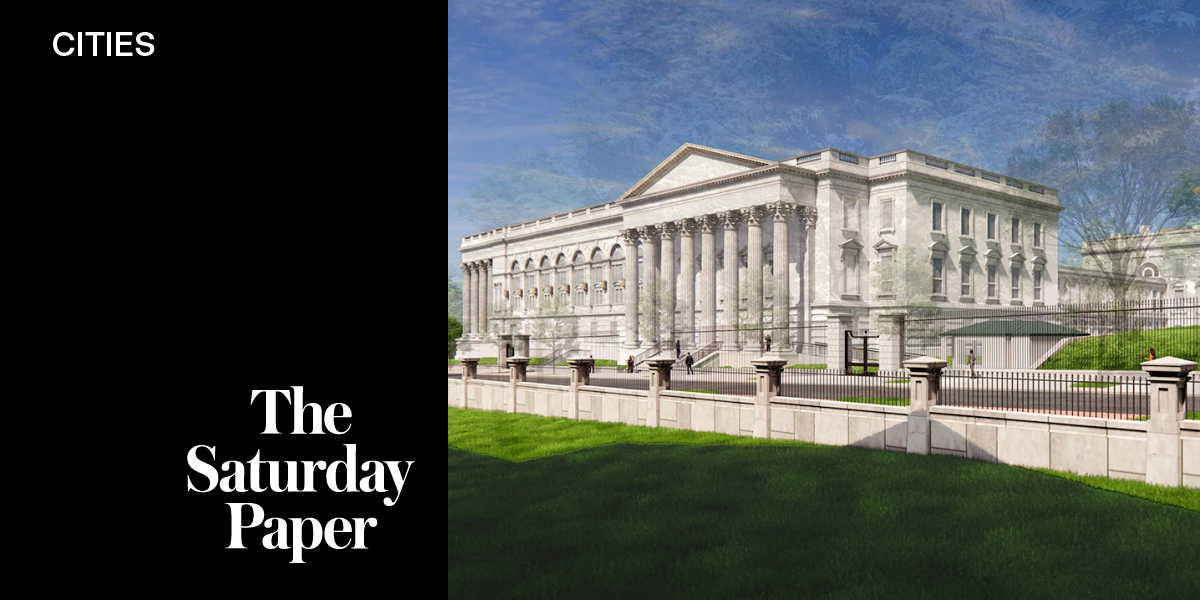
Trump’s new East Wing is considerably less polite. At some 8360 square metres and currently estimated to cost $400 million, it occupies more than three times the footprint of the former structure and is barely smaller than the White House and West Wing combined. Designed by architect Shalom Baranes and approved by a hand-picked panel, it sets the ballroom itself one floor above ground and sized to seat 650 guests at table.
The only published interior looks less like a ballroom than a forest of tables and chairs. Surrounded on three sides by full height arched windows, giant Corinthian colonnades and triangular pediments, it is neither scholarly nor charming – but probably no worse than most of the stuffy 19th century neoclassicism on which it is modelled and which, over a century ago, kicked modernism into life.
More than happy to foment social and political upheaval, Trump nevertheless wants the world – his world – to look stable.
This ancient-versus-modern culture war is where Trumpitecture consciously positions itself. What is the war about? Not about the substance of architecture – spatial delight, existential foothold or environmental engagement. It’s a war about messaging, about what architecture means.
Fifty years ago this question, whether form could convey meaning, triggered an avalanche of academic deliberation – semiotics, French theory, postmodern revivalism, deconstructivism and the rest. That’s all gone now. No one talks about signification anymore, but the resulting discourse vacuum only gives wings to our casual assumptions that classical architecture implies moral and political conservatism and, conversely, that modernism is inherently progressive. These assumptions warrant scrutiny.
Modernism is not our subject here. Suffice to say that although, more than a century ago, it originated in freedom, spareness, egalitarianism and a yearning for honesty, modernism was quickly co-opted by capitalism as a cheap means to accommodate the plebs.
On the classical side, too, the truth is complicated. Over the aeons, the classical orders have represented values as diverse as fascism, commercialism, education and democracy. There are obvious parallels between Trump and various mid-century dictators with classical predilections. Mussolini, for example, between 1926 and 1942, developed plans for the L’Esposizione Universale di Roma, or New Rome, in the “stripped classical” style. At the same time Hitler, ably assisted by Albert Speer, designed Germania as the new Welthauptstadt (world capital) to be realised upon a Nazi victory.
Both were massive statements of imperial dominance replete with triumphal arches, broad avenues and out-scale domes. The 1939 Pact of Steel between Hitler and Mussolini emphasised this dominance, envisaging an axis of greatness between Rome and Berlin, both rebuilt on the classical model.
In 1937 the infamous Nazi Entartete Kunst (Degenerate Art) exhibition in Munich manifested the same desire to censor artistic expression to political ends. Visited by more than two million people, this show was an astonishing piece of propaganda in which anything modern, cubist, abstract or satirical was seen as deranged, subversive and an offence to German decency. Indeed, so intent was Hitler on stifling modernism that works by Paul Klee, Marc Chagall, Wassily Kandinsky and many others were hung deliberately askew on graffiti-covered walls, with actors hired as pseudo-critics to mingle in the crowds and denounce the work.
Then there’s Nicolae Ceaușescu, whose ornate neoclassical palace, built between 1984-97 by a team of some 700 architects (headed by Anca Petrescu) has a floor area of nearly four million square metres and is now considered the world’s heaviest building. Rumour has it that Rupert Murdoch once offered $1 billion for this monstrosity that now houses the Romanian parliament.
Of course, classicism – even fake classicism – isn’t necessarily fascist. It originated in Periclean Athens, the home (we like to think) of Western democracy. In 1984 the then Prince of Wales regaled a Royal Institute of British Architects dinner at Hampton Court with a headline-making attack on the modernist competition-winning National Gallery extension as “a monstrous carbuncle on the face of a much-loved and elegant friend”. Charles’s chosen replacement, which fronts Trafalgar Square to this day, was an exercise in trashy joke classicism by American theorist Robert Venturi. It’s a bad building – but it’s not fascist.
So where does Trumpitecture fit? The totalitarian parallels are hard to miss. The new ballroom, smaller and more elegant than Ceaușescu’s mammoth pile but still grandiose to the point of pomposity, manifests exactly the kind of academic classicism against which modernism deliberately rebelled.
Trump’s edicts on architecture – with titles such as “Fact sheet: President Donald J. Trump Works to Make Our Nation’s Capital Safe and Beautiful” and illustrated with images not of buildings but of himself, looking purposeful – similarly revile particular styles as “subversive” and promote classicism as healthy, noble and socially desirable.
Classicism is said to encompass “such styles as Neoclassical, Georgian, Federal, Greek Revival, Beaux-Arts, and Art Deco” but is otherwise defined by example – from Renaissance architects Alberti and Palladio through Georgian Brits such as Robert Adam to 19th century Americans including Charles McKim and Julia Morgan.
Modernist whipping boys, by contrast, include brutalism (“a massive and block-like appearance with a rigid geometric style and large-scale use of exposed poured concrete”) and deconstructivism which, although it went out of style 40 years ago, still apparently “subverts the traditional values of architecture through such features as fragmentation, disorder … and the appearance of instability”.
More than happy to foment social and political upheaval, Trump nevertheless wants the world – his world – to look stable. And compositionally, what gives the appearance of stability is symmetry. Theorists argue that we’re hardwired to like symmetry, just as the toddler draws a house: two windows, door, roof. It’s self-reflection: the house is a face.
True, many beloved civic buildings and spaces arose from autocratic regimes, but that neither confers taste on the autocrat nor justifies dumping democracy. Classicism may not be fascist, but it is about power, and when that power focuses on a single ego, we’re in trouble. We should demand from our leaders a greater level of maturity than that of a four-year-old.
All of which gives new layers of meaning to the 91-storey Trump Tower currently proposed for the Gold Coast. If it’s actually built (which some doubt, given that developer David Young has already been twice bankrupt), it will be Australia’s tallest building. Offering some 500-odd bedrooms – rather more than the White House but fewer than Ceaușescu’s palace – it’s big, but it’s not classical. Not even close. More in the bronzed-glass bronzed-nymphs fake-tan arena. I guess that’s the price of being a mere outpost of empire, not the heart.
This article was first published in the print edition of The Saturday Paper on
March 7, 2026 as “Ballroom blitz”.
For almost a decade, The Saturday Paper has published Australia’s leading writers and thinkers.
We have pursued stories that are ignored elsewhere, covering them with sensitivity and depth.
We have done this on refugee policy, on government integrity, on robo-debt, on aged care,
on climate change, on the pandemic.
All our journalism is fiercely independent. It relies on the support of readers.
By subscribing to The Saturday Paper, you are ensuring that we can continue to produce essential,
issue-defining coverage, to dig out stories that take time, to doggedly hold to account
politicians and the political class.
There are very few titles that have the freedom and the space to produce journalism like this.
In a country with a concentration of media ownership unlike anything else in the world,
it is vitally important. Your subscription helps make it possible.
Send this article to a friend for free.
Share this subscriber exclusive article with a friend or family member using share credits.

Used 1 of … credits
use share credits to share this article with friend or family.
You’ve shared all of your credits for this month. They will refresh on April 1. If you would like to share more, you can buy a gift subscription for a friend.
SHARE WITH A FRIEND
? CREDITS REMAIN
SHARE WITH A SUBSCRIBER
UNLIMITED
Loading…