
In 2004, the French sociologist Eve Chiapello argued that the power of “artist critique” – the tradition of artists challenging bourgeois and capitalist values – had ebbed since its 19th century origins. She traced this decline to the absorption of radical art into institutional and market structures and to the corporate co-option of creativity, turning critique into a management tool. Yet Chiapello maintained that artist critique remained vital, revealing capitalism’s limits and affirming the value of human creativity and the desire for a richer, more authentic world.
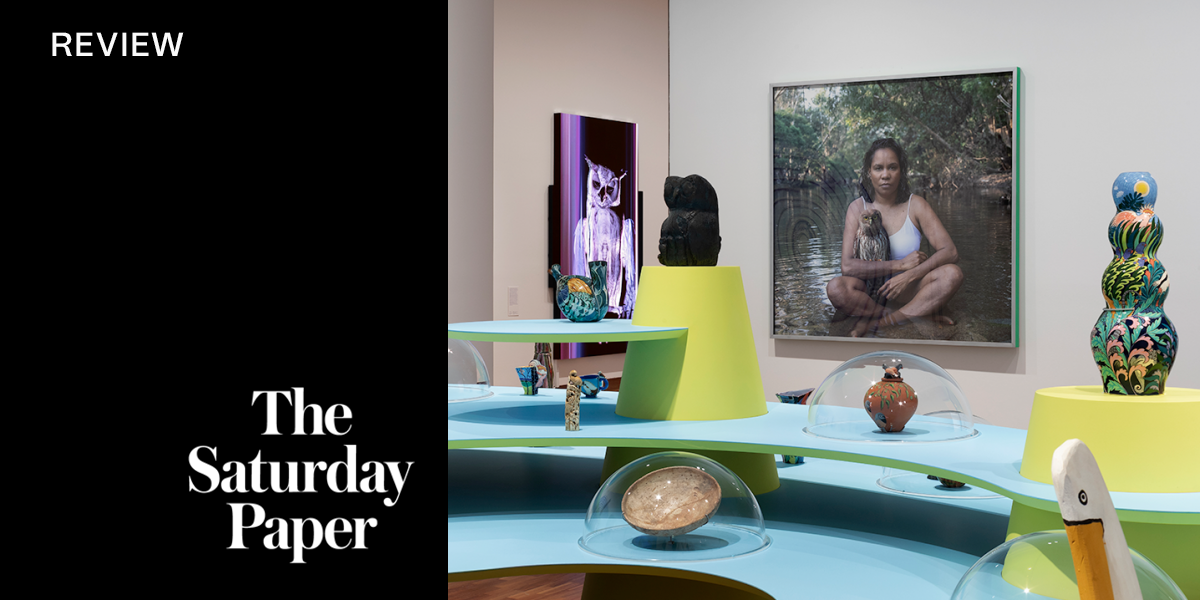
The Potter Museum of Art’s major new exhibition, A velvet ant, a flower and a bird, directly addresses this proposition. Curated by Chus Martínez, it harnesses the university gallery as a space for culturally and socially significant experimentation. Martínez, whose curatorial work includes Documenta 13 and the 2025 Ljubljana Biennale, uses the exhibition to amplify artists’ critical voices and to explore the intersections of creative practice and social and ethical concerns, framing art as a way of thinking, feeling and acting differently.
Martínez brings an outsider’s perspective to Australian histories, cultures and knowledge systems and places them in an international conversation. She assembles a thought-provoking selection of material from the University of Melbourne’s classics, biology and art collections alongside works by Australian and international artists. Representing more than 60 artists, the exhibition spans the museum’s three floors, each distinguished by a central motif. Inspired by medieval bestiaries, the motifs imagine plants and animals as political and moral agents that point to an ecological intelligence and more-than-human ways of seeing in a digital age.
The velvet ant exemplifies material intelligence and ecological innovation, highlighting non-human agency and its role in inspiring scientific and technological curiosity. The flower represents regenerative intelligence and adaptive environmental awareness, inviting reflection on cycles of growth and renewal. The bird embodies collective intelligence and emergent cognition, exploring how relational systems exceed the capacities of individuals.
In an accompanying essay, Martínez draws on cognitive science and decolonial thought to argue for coexistence between human and non-human realms. Indigenous, vernacular and embodied knowledge systems are foregrounded as strategic responses to technological domination and AI futures, emphasising an intelligence grounded in place, memory, ritual and ecological continuity without denying the potential of automation and computation.
The works form an intense visual and material field, where aesthetic encounter encourages focused attention, slows perception and sharpens the senses to reveal the subtle intelligence and relational depth of natural forms and human making.
Materiality, craft and aesthetic experience play crucial roles. The works form an intense visual and material field, where aesthetic encounter encourages focused attention, slows perception and sharpens the senses to reveal the subtle intelligence and relational depth of natural forms and human making.
Anouk Tschanz’s luminous orchid photographs explore plant intelligence through the alchemy of analogue process, light and chemistry. Rosslynd Piggott’s atmospheric paintings dissolve form into tonal shifts, encouraging contemplative looking. Daphne Mohajer va Pesaran’s soaring paper installation links the museum’s three levels, evoking growth and metamorphosis through its fragile forms.
Tessa Laird’s ceramic renditions of iconic children’s books restore tactility to the act of reading in a dematerialised age. Noriko Nakamura explores continuity, resilience and renewal through both subject and material. Her mural, inspired by an ancient magnolia tree, evokes the plant’s deep history, while in her sculptures, botanical and bodily forms relate natural cycles and the enduring qualities of stone to human experience.
Melbourne’s network of gardens and plant collections has long fostered a public culture in which scientific research and popular interest merge – each flowering of the Sumatran titan arum, or corpse flower, draws large crowds to the Botanic Gardens. In the exhibition, Swedish artist Ingela Ihrman taps into an allied sensibility, transforming botanical anomalies including the arum into handcrafted textiles and papier-mâché forms that she wears in uncanny performances. By embodying flowers with unusual life cycles or reproductive strategies – species that trap their pollinators or lure them with putrid scents – Ihrman unsettles conventional images of plants as passive, decorative or benign.
Derek Tumala’s Treasures of the Philippines (2025–26) also includes a corpse flower, the elephant foot yam. Animating Philippine endemic plants, Tumala’s large-scale digital landscape, driven by real-time climate data from Manila, makes nature a co-creator, blending code and ecology to show how our physical and digital environments are now deeply intertwined.
The show’s plant-based works engage ecological complexity and interconnection. This includes a group of 1930s images of Victorian fungi by the botanical illustrator Malcolm Howie that documents their fleeting beauty and astonishing variety, while hinting at the vast mycelium networks beneath, symbols of ecological interdependence. The inclusion of ancient objects likewise reflects longstanding cultural traditions of looking to plants and animals for knowledge, symbolism and moral insight.
The artists approach animals as equals and co-authors of multispecies futures. Mel O’Callaghan’s video The Source (2023) examines termite architecture as a form of distributed ecological intelligence. Rivane Neuenschwander and Cao Guimarães’s video Ash Wednesday (2006) captures ants carrying confetti below ground, foregrounding their collective ecological labour in nutrient recycling and seed distribution.
Birds inhabit the exhibition as symbols of insight and transcendence but possess darker associations. Ann Lislegaard’s 3D animation Oracles, Owls… Some Animals Never Sleep (2012–18) explores how owls are linked to watchfulness and prophecy, while Naomi Hobson’s 2025 self-portrait with a barking owl highlights Indigenous knowledge rooted in her homeland, where the owl, as companion and guide, is equally the bearer of knowledge. In a 2021 sculpture, Heather B. Swann highlights the violence in the myth of Zeus, as a swan overpowering Leda, to reflect on power and gender. In Marian Tubbs’s lenticular photograph the sincerest thing i could do was to use words (2025), the collage of brightly coloured birds suggests how the circulation of natural history specimens and images, increasingly shaped by digital processes, transforms ecological life into data, spectacle and commodity.
Eve Chiapello linked the rise of artistic critique to three conditions: artists’ experience of injustice and societal constraints, cultural authority and a coherent doctrine grounded in ideals of freedom. A velvet ant, a flower and a bird enacts all three, as contemporary artists confront institutional norms, technological domination and epistemic hierarchies to foster co-existence between humans and the non-human world.
A velvet ant, a flower and a bird is showing at the Pott
This article was first published in the print edition of The Saturday Paper on
March 7, 2026 as “Natural rhythms”.
For almost a decade, The Saturday Paper has published Australia’s leading writers and thinkers.
We have pursued stories that are ignored elsewhere, covering them with sensitivity and depth.
We have done this on refugee policy, on government integrity, on robo-debt, on aged care,
on climate change, on the pandemic.
All our journalism is fiercely independent. It relies on the support of readers.
By subscribing to The Saturday Paper, you are ensuring that we can continue to produce essential,
issue-defining coverage, to dig out stories that take time, to doggedly hold to account
politicians and the political class.
There are very few titles that have the freedom and the space to produce journalism like this.
In a country with a concentration of media ownership unlike anything else in the world,
it is vitally important. Your subscription helps make it possible.
Send this article to a friend for free.
Share this subscriber exclusive article with a friend or family member using share credits.

Used 1 of … credits
use share credits to share this article with friend or family.
You’ve shared all of your credits for this month. They will refresh on April 1. If you would like to share more, you can buy a gift subscription for a friend.
SHARE WITH A FRIEND
? CREDITS REMAIN
SHARE WITH A SUBSCRIBER
UNLIMITED
Loading…