
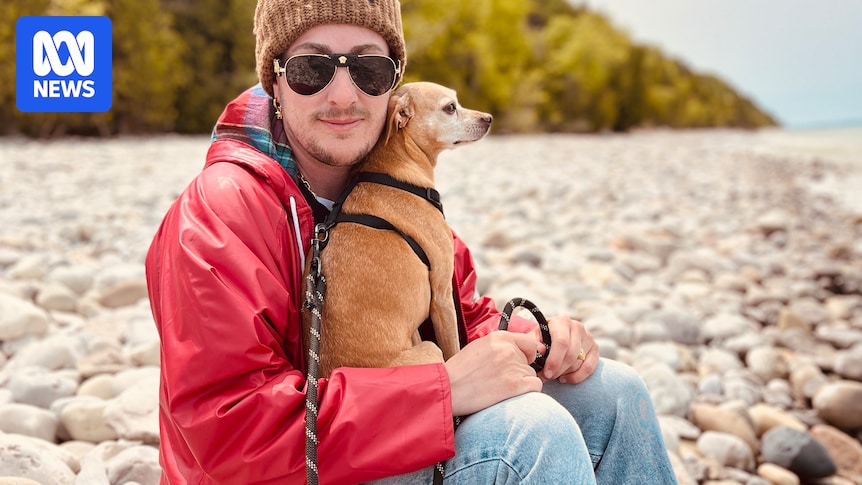
When driving across his home state of Indiana, there are certain towns Leo Caldwell will not stop for a break.
“There’s places I will not stop to go to the bathroom, I’ll just keep going until it’s more populated just because I don’t know what’s going to go on,” he says.
Despite transitioning 20 years ago, Leo says he often doesn’t feel safe, as Donald Trump begins the second year of his second term as president.
“I feel a sense that people are emboldened now to say things or act on things … because it’s being acted on at a national level,” he says. “So they’re comfortable to do it.”
Trump used the inaugural speech of his second presidency in January 2025 to rule out the existence of trans people, excluding them from all official documents. Since then, 134 anti-trans bills have passed, which target a group of people who make up about 1 per cent of the total American population.
As America continues down a path of political polarisation, transgender Americans have found themselves at the centre of many debates, with experts arguing they are being used as a scapegoat to undermine democracy.
“What do authoritarians do? They construct out-groups in order to consolidate control … and transgender people end up becoming a group that you can do that with,” says distinguished scholar Dr Andrew Flores at the Williams Institute, UCLA School of Law.
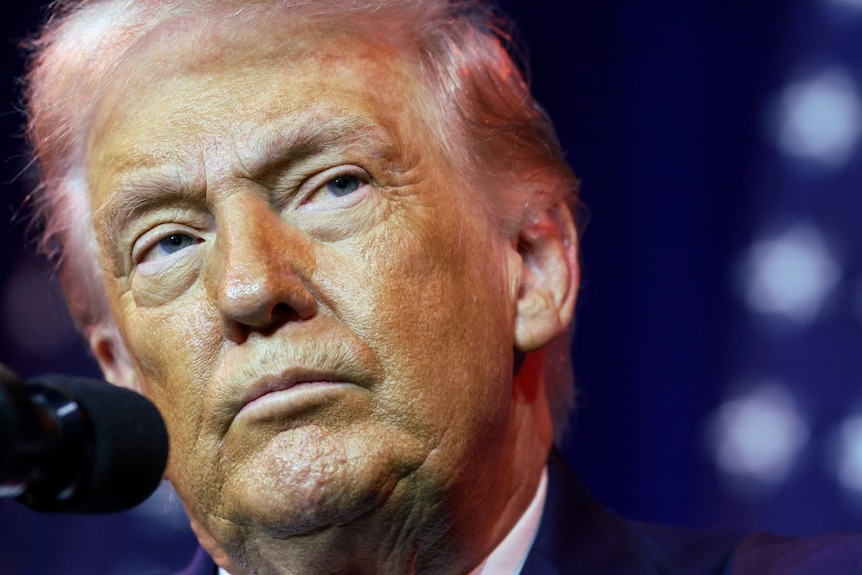
US President Donald Trump used his inaugural speech to exclude trans people from official documents. (Reuters: Kevin Lamarque)
Over the past three months, ABC News has spoken to dozens of transgender Americans from both Democratic and Republican states affected by these bills, who say that since Trump returned to power, they feel dehumanised, unsafe, and isolated from public spaces and experiences.
“Even in the cities and bigger spaces, I don’t feel as comfortable … it’s definitely made me feel lonely, but it’s made me feel even more unsafe,” says Leo, who is a university teacher and advocate for trans rights on campus.
Since Trump’s return to office, pro-trans events organised by Leo have been cancelled, or stripped right back, he says.
What is DEI and why is Trump trying to get rid of it?
“I transitioned on this campus 20 years ago and it’s where I received medical care and it was where I finally found a therapist,” he says. “I had literally become Leo on this campus. And so to be a student, come back, teach and then it kind of was just pulled completely out from under me … I just felt really heartbroken and kind of betrayed.”
Dr Andrew Flores, whose research focuses on prejudice and prejudice reduction of transgender people as well as trans rights, says in order for democracy to work, society cannot be so fractured.
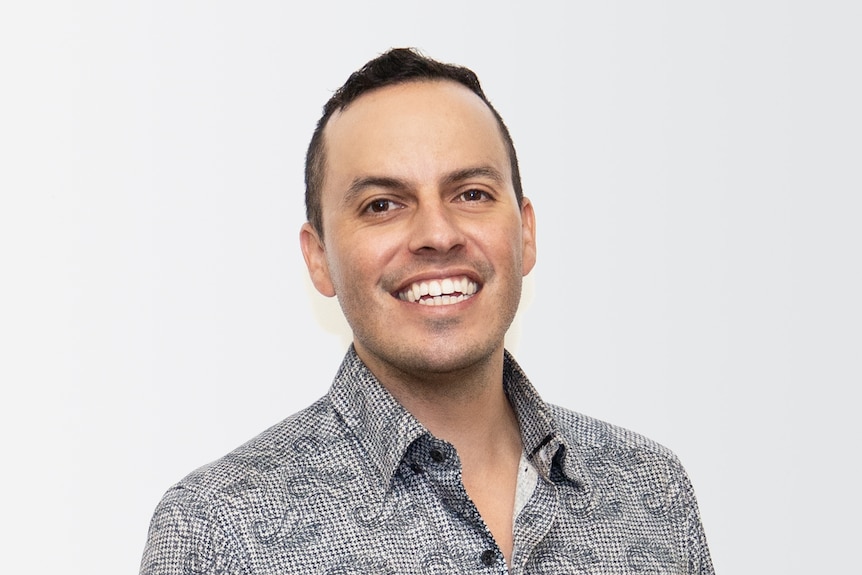
Dr Andrew Flores’s work focuses on trans rights and prejudice impacting transgender people. (Supplied: UCLA)
“[When] neither side is able to give a little bit to one another, then that polarisation just undermines the ability for democracy to work, because if the minority wins, it’s hurting the full majority. If the majority wins, it’s really undermining the minority,” he says.
“There’s no safe out and so I reflect upon where we are right now [in the US], about how much of these political topics are thought of as ‘I win, you lose’, and the degree to which that creates a system that is not going to be sustainable.”
If this story has raised concerns for you, help is available:
Urgent help:
Lifeline — 13 11 14Kids Helpline — 1800 551 800
LGBT and mental health support:
Switchboard — 1800 729 367Qlife — 1800 184 527Headspace — 1800 650 890Beyond Blue — 1300 22 4636Fleeing the United States
Rachel Brammer, who grew up in a small town in Illinois, says they know first hand what it’s like for those nearby to now feel emboldened by Trump’s anti-trans rhetoric.
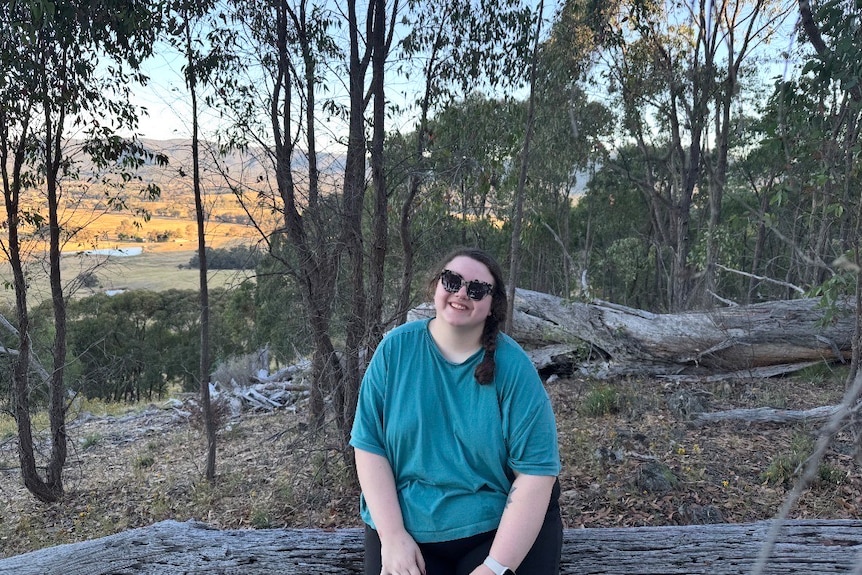
Rachel Brammer is from rural Illinois and moved to Victoria at the end of 2025. (Supplied: Rachel)
“There were many times I was concerned for my safety,” they say. “I’d be behind the counter and I’d hear somebody talking about how Trump’s going to take [trans people] out, he’s going to take out the trash and fix this country up.”
While transphobia has always existed, things changed following the 2024 election. Rachel noticed the language of their colleagues and some customers’ had started to shift at the hardware store where they worked.
“I’m just sitting there going, okay, I am queer, my partner’s a trans woman, I am not very safe at the moment, and that happened repeatedly. People talking about stocking up on guns and ammo because they felt threatened by all the minorities in the country.”
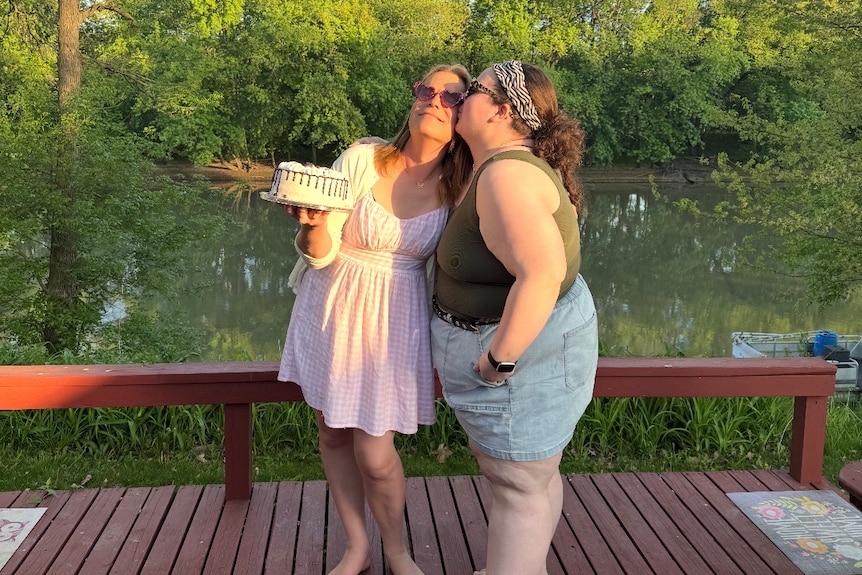
Rachel met Laura online and moved from the US to Victoria last year. (Supplied: Laura Mitchell )
Rachel met their now partner Laura Mitchell online. Laura has been living in Australia for the past 20 years and in September of last year, Rachel made the decision to move to Victoria’s Mornington Peninsula to be with her.
“It got to the point where I kept saying I want to quit earlier and earlier … I’m not just going to sit here and actively get killed by a government who can’t give less of a crap about what’s going on with the people under it,” says Rachel.
“People were more forthcoming with their hatred because they were under the impression of … I can say whatever I want because Trump’s back in power and he’ll back me up … they don’t fear consequence of what’s going to happen.”
But for others in America, getting out isn’t so easy.
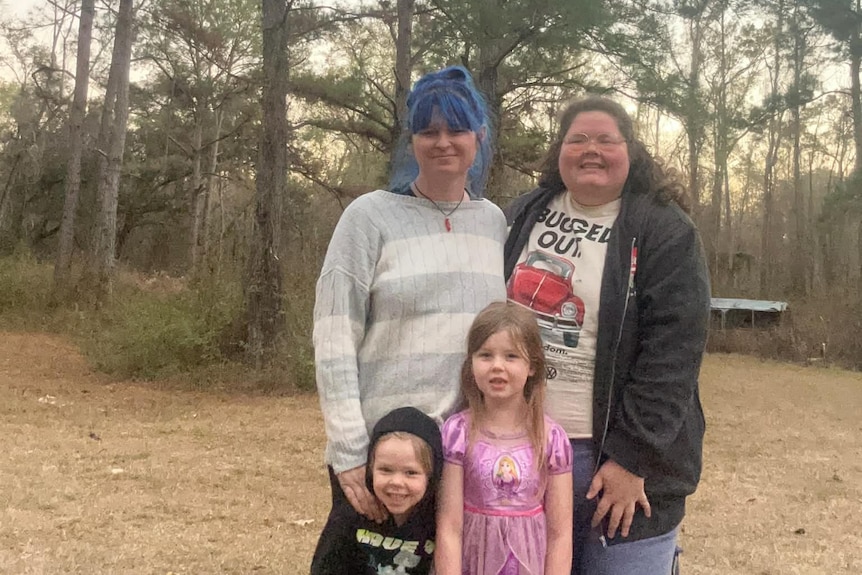
Kiley Haselden (top left) transitioned two years ago and says her family has been very supportive. (Supplied: Kiley Haselden)
Kiley Haselden transitioned two years ago, acknowledging she couldn’t have done it without the support of her partner and kids.
“I’ve really got my wife to thank, within a few months of us dating, she told me ‘I think you’re trans and you won’t tell me’ and it just kind of kept going from there until I was comfortable enough to just finally be me.”
Prior to this, it was hard for Kiley to talk about being a woman.
“I mentioned something I think three times in my childhood … and all three times I ended up in the hospital because I was nearly beaten to death,” she recalls.
It’s been two years since Kiley transitioned, something the 27-year-old has been navigating from her home in Florida. It’s been stressful and at times scary, she says, to start life as woman while trans rights are under the microscope.
“My wife has really been trying to figure out how to get us out of the country,” she says.
“She’s called embassies trying to get us out of here, but they’re all just like, ‘it’s not that bad over there’, and I’m just like it’s pretty bad.”
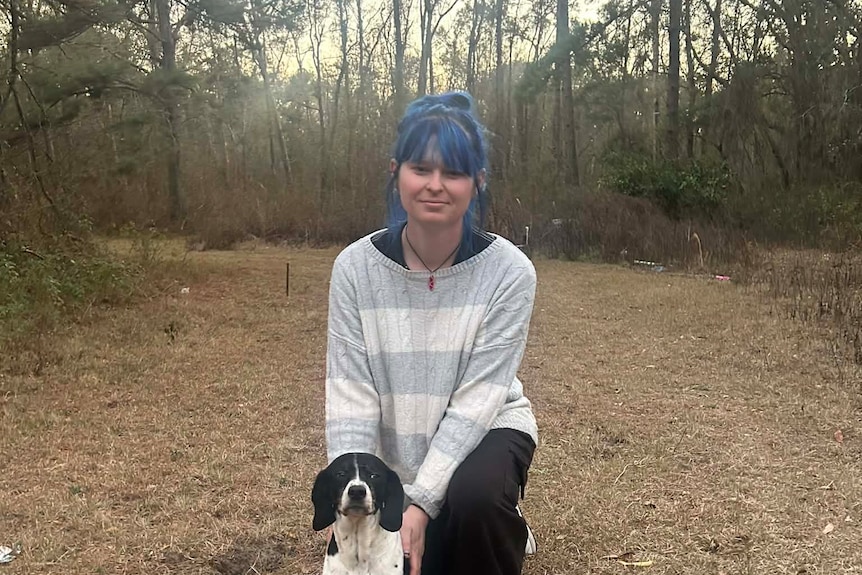
Kiley lives in Florida with her wife, two children, and her dog. (Supplied: Kiley Haselden )
In order to access her medication, Kiley drives across state lines into Georgia. She fears access in her home state is too uncertain.
“I’d have to be on an insanely long waiting list in Florida and might or might not get it after a meeting with a doctor even though I’ve got all the correct diagnosis and everything, it doesn’t matter to them,” she says.
Anti-trans rhetoric impacting other marginalised groups
The moral panic around transgender Americans has created such a divide that Dr Andrew Flores says it’s started seeping into the way America sees other marginalised groups.
“It’s the beginning of the idea that you can feel free to be less tolerant toward a group and then it starts to travel really quickly,” he says.
WorldPride Washington strikes a protest note
“Even though right now, according to the data, a majority of the American people still think that marriage equality should be the law of the land, support for that issue has actually dropped quite a bit in the last few years.”
According to data from Gallup, Republican support for same sex marriage, which peaked at 55 per cent in 2021 and 2022, has decreased to 41 per cent. Democrat support stands at 88 per cent — a rise of 1 per cent over the same time period.
The 47 point gap between Republicans and Democrats is the largest since the analytics and advisory company began conducting this data 29 years ago.
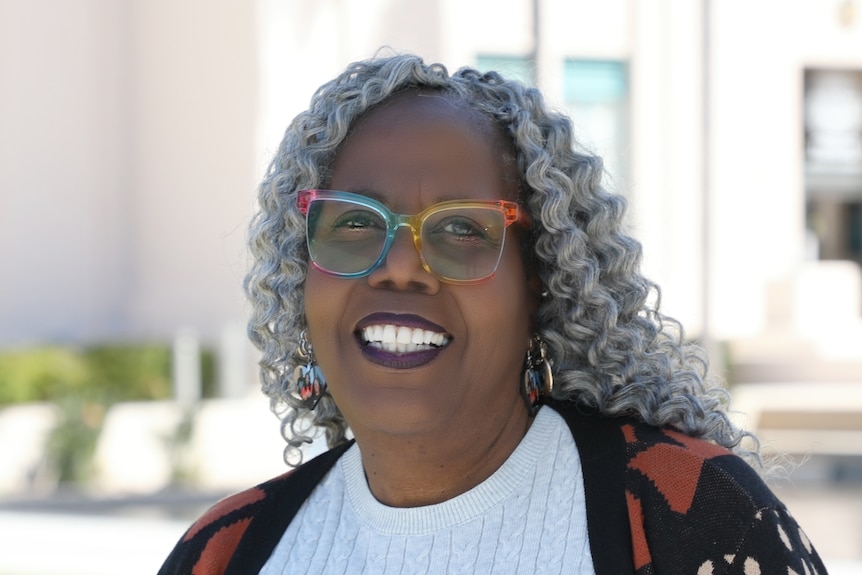
Vanessa Green is the co-creator of Call BlackLine. (Supplied: Vanessa Green)
Vanessa Green, co-creator of Call BlackLine, a hotline geared towards the Black, Black LGBTQI, Brown, Native and Muslim community in America, says while there’s been an increase in trans youth callers over the past year, she’s also seen the numbers rise for queer youth more broadly.
“We’re getting calls from kids who are in junior high or in high school, who identify as being queer, who don’t feel like they want to even live anymore,” she says. “They’re getting younger, as far as hopelessness. So we spend a lot of time telling them how valuable they are and we say we can’t see you, but we love you.”
She worries America’s queer youth are having their human rights debated just as they are trying to figure out who they are.
Loading…
Ms Green says some children avoid telling their parents: “They’re not telling their parents because of fear of whatever the repercussions could be,” she says.
“These kids are navigating adult stuff that they shouldn’t have to navigate because of this anti-trans rhetoric that is going around,” she says. “So even that is so sad to me that for their safety and to have a roof over their head, they’re just basically living a lie.”
Dr Andrew Flores echoes this, arguing many trans youth are all of a sudden, being “thrust into the limelight”.
“There are some trans youth who probably never really thought about their identities as being so central or controversial, and some who may have come from rural America, red America, and may not necessarily thought of themselves as progressives or Democrats, but they just know that this is who their identities are,” he says.
“Some of these youth … didn’t really make being LGBTQ or trans a central component of who they are and are now seeing because of policy, how much their trans identity and trans self is actually affecting their lived experience.”Transitioning both joyous and heartbreaking
Despite knowing since she was a child, Lisa Sicard waited until 2024 to began her transition, which she says has been one of the best and worst things to happen to her.
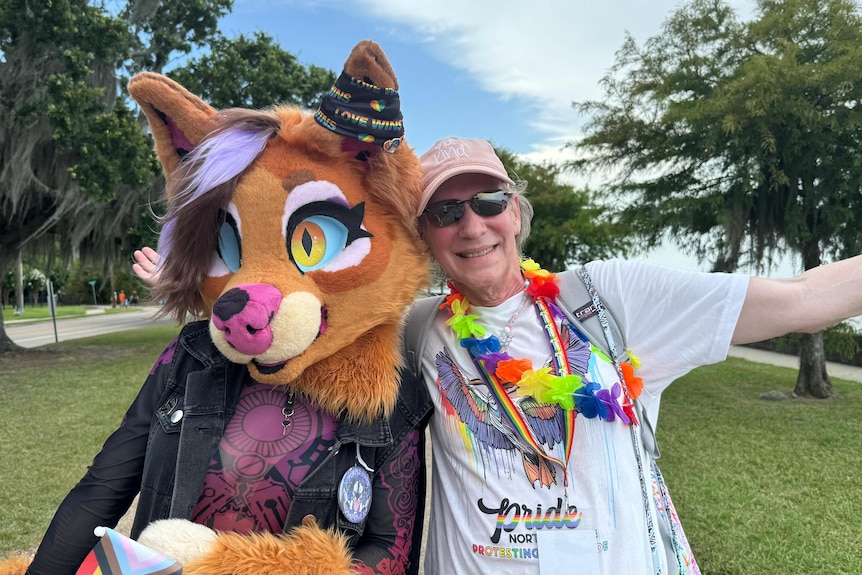
Lisa Sicard at her first Pride parade in Mandeville, Louisiana in June 2024. (Supplied: Lisa Sicard)
The 50-year-old petrochemical business administrator, who lives in Louisiana, hasn’t spoken to her family since she told them she is Lisa.
“I remember it vividly, we were at my daughter’s apartment, and my son was staying with her while he was attending school. I felt cautiously optimistic about how they would respond, we were a very liberal family after all,” she recalls.
“My daughter was I think 25 when I told her, my son was 22, he was in college … and yeah, they haven’t talked to me since then.”
Lisa says while this has been devastating to come to terms with, she has to acknowledge the weight that has been lifted.
“Since I’ve come out as trans and started living as Lisa and started living as a woman I’m a different person. Not because I was reborn or anything, it’s just that I don’t have that weight on me, I don’t have that filter that I’ve been living through all my life.
“Christmas morning I got up, I cried a little bit because it was sad, I miss my family,” she says. “And then I met my friend and his family for Christmas dinner, that they invited me to, and I felt very joyful for that.”
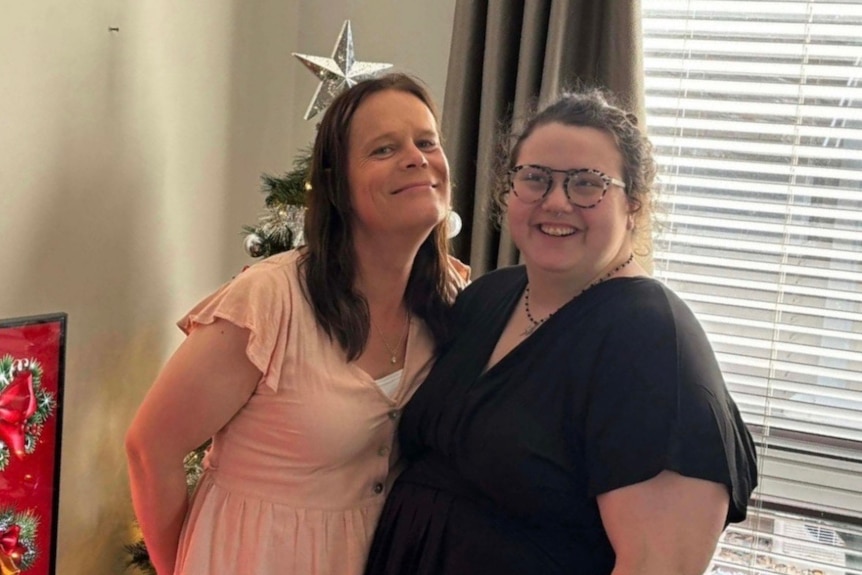
Rachel Brammer and Laura Mitchell celebrate their first Christmas together in Australia. (Supplied: Laura Mitchell)
Laura and Rachel also acknowledge the light and the darkness, particularly after building their online community, Trans Women Society.
“There’s a lot of good stuff and a lot of comments come [that say] ‘Thank God for this page, thank goodness you’re here, this is providing me the connections, this is providing me with community’,” says Laura Mitchell.
Loading…
Laura created the Trans Women Society soon after transitioning in 2024. The group now has more than 12,500 members from all over the world.
“It’s a very special thing, it’s not something that I expected to find … I wasn’t ready for it, I didn’t expect it, but I put it out in the universe, and that’s what I got,” she says.
After building the online community, Laura and Rachel started organising monthly meet ups in Melbourne. This has expanded to Sydney, Brisbane, Adelaide and soon to be Perth.
“We just started consistently meeting the same day each month, and then we found the queer friendly place … and now we’ve got a really good group of people,” says Laura.
For Rachel, who fled her home in America, they say it’s helped to build a safe community in Australia.
“I got to meet awesome people and there’s a lot of people who are really scared to come to stuff like that for the first time and I’m sitting there going well, we’re the most welcoming excepting bunch of people,” they say.
Both express how important it is to have this community, particularly when the hate online is so loud. They want people to remember that behind all the public discourse, trans people are also human.
“You’re sitting there villain-ising this group of people that are human beings, they have families, they have feelings, they have emotions,” says Rachel.
“These are real human beings who lead real lives.”