
NFL free agencybegins March 9 with the legal negotiating window, but the action has already started.
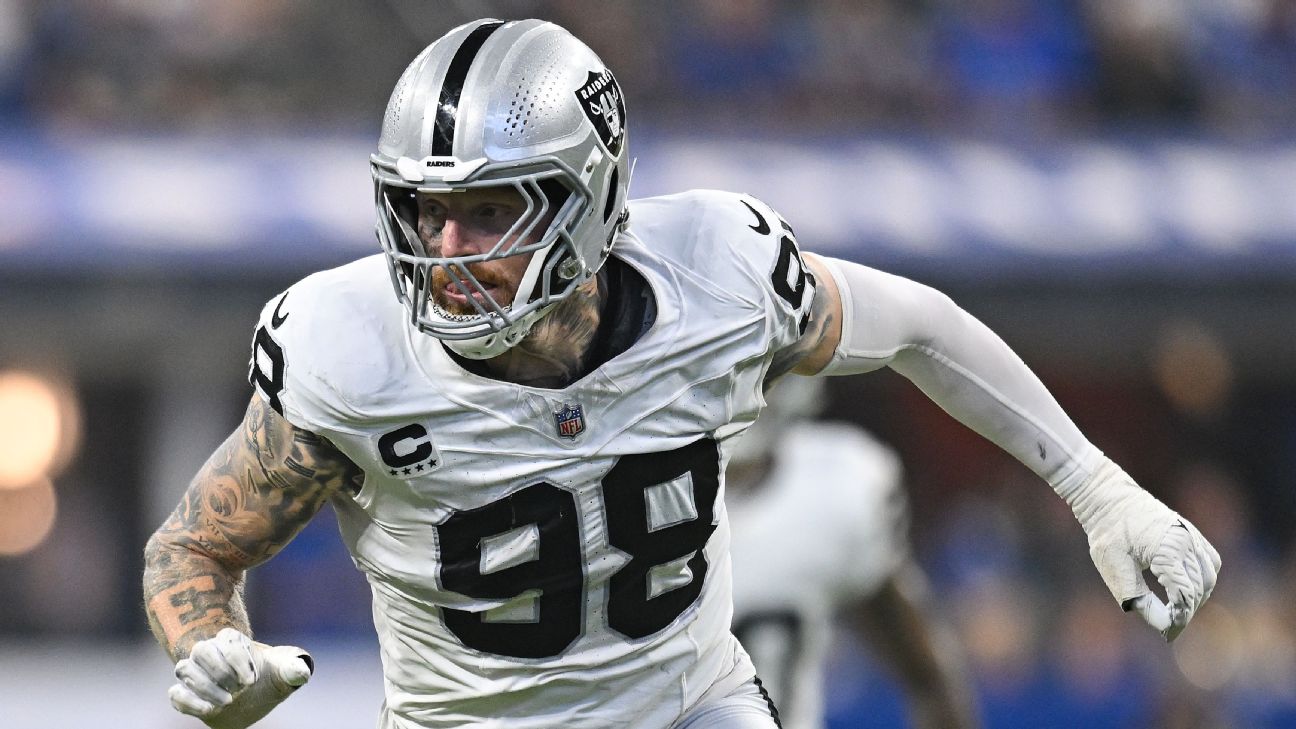
The Rams sent four draft picks to the Chiefs for star cornerback Trent McDuffie, and the Bills landed a standout WR in DJ Moore in a deal with the Bears. The biggest trade so far? The Ravens sent two first-round picks to the Raiders for edge rusherMaxx Crosby. Signings have started, too, with the Chargers inking former Commanders centerTyler Biadaszto a three-year deal.
ESPN analytics writer Seth Walder is grading the biggest signings and trades of the offseason, putting each deal into perspective for teams and players. To determine each grade, Walder is evaluating moves based on multiple factors, including on-field impact, salary cap implications, compensation, player value/age, and the context of a team’s short- and long-term outlooks. How large is the effect of this decision, and how sure are we it’s a good or bad choice? How does this affect a team’s chance to win the Super Bowl, this season or in the future?
Follow along as Walder evaluates and grades each move, with the most recent grades at the top. Let’s start with the Crosby deal.
More coverage:
Free agency primer | Top 100 free agents
Jump to a notable deal:
Crosby |Bradbury |Biadasz | Moore |
McDuffie|Montgomery| Johnson-Sweat



Ravens get:Edge Maxx Crosby
Raiders get:2026 first-round pick, 2027 first-round pick
Ravens grade: C
Raiders grade: A
I did not think the Ravens would be the team that dealt for Crosby. And I also did not think it was going to cost this much.
I want to be clear about this: Crosby is an exceptional player who, even though he is considered a star, is perhaps even a little underrated. He has recorded double-digit sacks in three of the past four years, is a five-time Pro Bowler and has played in 110 career regular-season games out of a possible 117 over his seven-year career.
His pass rush win rate is slightly lower than one might expect for a star: 17.2% over the past four years at edge, which is in the 79th percentile. But at the same time, he has 222 pass-rush wins over that span — the fourth most in the league — because he never comes off the field. Crosby has played at least 94% of defensive snaps in games played over the past four years. He is also excellent against the run, which is part of the reason he never leaves the field and also what makes him remarkable given his aforementioned pass-rushing chops.
The Ravens evidently felt they had to do something to try to break through and take advantage of their time with Lamar Jackson at quarterback. But it’s a surprise on two fronts. First, it’s unlike the usually restrained Ravens, who are known for compensatory picks rather than dealing away first-round draft capital. It’s also a team that hasn’t typically prioritized star edge rushers, choosing instead to focus on the secondary and rotate in talent at edge through the years. But Crosby fills a clear need.
Kyle Van Noy, Dre’Mont Jones and David Ojabo are pending free agents. That had leftMike Green and Tavius Robinson at the top of the depth chart at edge. Clearly, Baltimore had to add someone. And the Ravens opted for an elite player in Crosby.
So was it worth it? Despite everything I wrote above, I don’t think so. Crosby is a star who might be worth around $40 million per year on the open market. His salary-laden contract that has four years left will cost Baltimore $30 million in 2026 and $29 million in 2027. That surplus value — the difference between his market value and what Baltimore has to pay him — is real and helps the Ravens’ cause here. But the surplus value of two first-round picks is almost certainly higher. First-round picks are no guarantee to hit, but when they do, they result in plus-players at highly discounted prices for four years (with a fifth year of team control). And Baltimore’s first-round pick that they just dealt is earlier than normal at No. 14.
Crosby will turn 29 prior to next season. That means we should expect he’s in the tail end of his prime; he should have a couple very good years left but decline could start to set in soon. He won’t be the same forever for Baltimore. The Ravens are better today than they were yesterday, and the fact that they are Super Bowl contenders — and increased their chance to win it by making this move — helps. But there is a cost here that they’ll pay for years to come.
And the history of teams trading two first-round picks for non-quarterbacks is not great.Khalil Mack, Laremy Tunsil and Jamal Adams come to mind there. Jalen Ramsey worked out better. Micah Parsons and Sauce Gardner remain to be seen, but the team that traded each away is probably feeling better about those deals at the moment. As tempting a move as it is to make — and fully understanding Crosby could be the player who puts the Ravens over the top — I have a hard time thinking this is the optimal move for Baltimore.
For the Raiders, this is about the best result they could have imagined. Their time with Crosby had run its course, and I truly thought they had missed their opportunity to maximize their return for him. I thought they might get a first- and a third-round pick. Instead, it’s two firsts (including No. 14 this year) — a superb return. And the fact that Crosby’s deal is almost all salary means they get to offload the money owed to Baltimore.
Even with Crosby andFernando Mendoza,whom the Raiders are expected to select with the No. 1 pick in the draft, Las Vegas was not going to be contending this season. But by dealing Crosby now, the Raiders can jump-start their rebuild to create a roster around Mendoza that can support the rookie QB. It’s a worthwhile move and then some.


Bears get: C Garrett Bradbury
Patriots get: 2027 fifth-round pick
Bears grade: B-
Patriots grade: B+
When Drew Dalman suddenly retired earlier this week, the Bears were thrust into the center market. They opted to address the need via trade instead of waiting to see how the free agent market would shake out.
Bradbury is an experienced center, albeit one with a middling track record. Over the past two seasons combined between the Vikings and Patriots, Bradbury ranked in the 41st percentile in pass block win rate at center and 52nd percentile in run block win rate. That’s fine, but a step down from Dalman.
Bradbury is cheap — he’ll cost $4.7 million this year but is a free agent after 2026. But for the Bears to give up a fifth-round pick for a single season of him is not trivial and seems like a slight overpay. I can understand not wanting to dish out $20 million plus for Tyler Linderbaum in free agency, but could Chicago have afforded Connor McGovern? Or Cade Mays? Those players would not have cost a draft pick.
This trade likely means 2025 third-round pick Jared Wilson will take over at center for the Patriots. In 13 games at left guard last season, Wilson recorded a pass block win rate in the 58th percentile and a run block win rate in the 16th percentile. Having a young successor already in place makes this a nice return for Bradbury, especially since he is on the last year of his deal.

The deal: Three years, $30 million
Grade: B
It was a bit of a surprise when the Commanders cut Biadasz in late February. He had been a good player for them and was slated to make only $8.3 million. It turns out the market thought he was worth a little more than that.
Our metrics indicate that Biadasz was solid last season, ranking in the 57th and 52nd percentile in pass block win rate and run block win rate, respectively. But that was down from the season before, when he was in the 57th (PBWR) and 77th (RBWR) percentiles.
Biadasz fills a clear need for the Chargers. Their previous center, Bradley Bozeman, recently announced his retirement but even if he hadn’t, Los Angeles was going to need to find a replacement after Bozeman ranked second-to-last in pass block win rate at the position.
This does close the door on what seemed like a fun and logical free agent-team pairing — Tyler Linderbaum to the Chargers. But from Los Angeles’ perspective, there’s no guarantee that Linderbaum will be available come Monday, and spending $10 million per year on Biadasz — instead of somewhere in the mid-$20 millions that Linderbaum might require — is probably more responsible given that center is a non-premium position. Signing Biadasz now ensures the Chargers don’t find themselves without a seat in a game of center musical chairs later.

Bills get:WR DJ Moore, 2026 fifth-round pick
Bears get: 2026 second-round pick
Bills grade: D
Bears grade:A
A year ago, Brandon Beane got testy and mocked critics of the Bills’ lack of wide receiver investment in a radio appearance. Eleven months later, it seems he has changed his mind given his choice to overpay for Moore with a two-five swap.
Moore looked like a likely trade candidate heading into the offseason after he had failed to really produce in Ben Johnson’s offense and appeared to show lackadaisical route-running effort on what ended up being Chicago’s last offensive play of the season, a Caleb Williams overtime interception in Chicago’s divisional-round loss to the Rams.
In his first season as a Bear in 2023, Moore looked like one of the NFL’s best receivers. He delivered 2.5 yards per route run, which increased to an almost unbelievable 3.4 yards per route run vs. man coverage. His 85 overall score in ESPN’s receiver scoreswas tied for fourth among all wide receivers. His play earned him an extension with Chicago. But since that season, the production has not been close to the same.
His yards per route run and overall score dropped to 1.6 and 57, respectively, in 2024. And then in 2025, his first season with Johnson, those numbers fell even further, to 1.3 and 45. Essentially Moore, who turns 29 next month, produced like a below-average player.
Moore’s aforementioned extension is just getting started, and he will cost the Bills $24.5 million in cash this year if the deal is not altered. Plus, remaining on the roster will fully guarantee $15.5 million of his 2027 salary, per OverTheCap.com. Then, in a bizarre decision, the Bills opted to also fully guarantee $15.5 million of Moore’s 2028 salary, per ESPN’s Adam Schefter.
Dealing Moore was probably a pretty easy choice for Chicago. Their future in the receiving game is Rome Odunze, Luther Burden III and Colston Loveland. And they get to offload a substantial amount of guaranteed money that they can redistribute to other parts of the roster that need help.
Assuming the Bears didn’t take on any additional money, I think this part is sort of remarkable: Moore’s stock seems to have fallen precipitously since signing his extension that had a $27.5 million average per year. Despite that, the Bills will be taking on only a slightly cheaper contract: $90 million over four years ($22.5 million APY) though with all the guarantees this will be a one-year deal for $40 million, two years for $64.5 million or three for $73.5 million if they choose to end it early. Not only that, but the Bills gave up what ESPN’s draft pick values would consider a late-third round pick to do it.
In my view, that makes this a much better result for the Bears than I would have expected heading into the offseason and makes the deal worth criticizing for the Bills.
You can understand how the Bills got to this point. They have an all-world quarterback but have failed to surround him with enough receiving talent and wanted to rectify that issue. And there’s some history here: Moore played for Joe Brady in Carolina in 2020 and 2021 and was fairly productive, with 2.4 and 1.9 yards per route run in those seasons, respectively.
There are alternative options in free agency like Mike Evans, Alec Pierce, Rashid Shaheed or Romeo Doubs that would not have immediately cost Buffalo a pick (though with the Bills’ tight cap situation and some pending free agents, signings like that might have cost them a comp pick). There’s also no guarantee on how much those free agents would have cost, though Moore is pricey himself.
Ultimately I think the Bills’ instinct at wide receiver is correct. But to pay real draft capital for the right to take on what is likely an overpriced contract and add extra guarantees is far from optimal.


Rams get: CB Trent McDuffie
Chiefs get: Rams’ 2026 first-round pick (No. 29), 2026 fifth-round pick, 2026 sixth-round pick, 2027 third-round pick
Rams grade: C+
Chiefs grade: A-
Cornerback was the weakness of the Rams’ defense last season. So Les Snead did what Les Snead does — address the problem by adding a star via trade.
And McDuffie is a star. When I sought feedback for my 100-player MVP ballot a year ago, folks in the league told me that McDuffie was in the mix for the best cornerback in the NFL that season. Over the course of his four-year career he has allowed 0.9 yards per coverage snap, per NFL Next Gen Stats, and has never had a season where he fared worse than the average for a cornerback in that category (1.1). That high-level consistency is rare at corner, a notoriously volatile position.
McDuffie, 25, allowed 1.0 yards per coverage snap last season along with a 16.9% target rate (slightly higher than average and the highest of McDuffie’s career). He comes with inside-out flexibility, having spent most of the past two seasons out wide but a substantial amount of time in 2023 at nickel.
You can understand why the Rams are making this deal. They have a 38-year-old quarterback in Matthew Stafford coming off an MVP season and don’t want to waste their current championship window. They saw the opportunity to add a star in the prime of his career to fill a major need and took it. Obviously, they are better now with McDuffie on the team. And there is no shutdown corner available in free agency.
But the cost is substantial. The addition of the other picks to the late first-rounder move the value up to a mid first-rounder at minimum (and there’s a good argument they gave up more than that), depending on the relative valuation of those picks.
The surplus value going back to Kansas City is large. Draft picks are never a guarantee, but when teams hit on them they end up with players on undervalued contracts with four (or five) years of team control.
By contrast, while McDuffie is currently a value for 2026 at $13.6 million, my assumption is that the Rams will extend him at something akin to a market rate for a player among the top cornerbacks. In that case, they are giving up a package that includes a first-round pick for the right to pay McDuffie. This format of trade is always hard to justify for the acquiring team given that fact. And a trade like this for a cornerback is particularly scary given how wild the swings at that position can be from season to season.
I am more sympathetic to the acquiring team than I usually, though, given the closing-window argument and the lack of an obvious alternative. But I would not have made this deal if I was running the Rams.
For the Chiefs, this continues a pattern of letting corners walk out the door under the assumption that they’ll be able to draft and develop players who can perform under defensive coordinator Steve Spagnuolo. The history here — most notablyL’Jarius Sneed‘slack of success in Tennessee and the Chiefs’ ability to be fine without the departed corners — is another reason for the Rams to be wary. Any Chiefs cornerback probably comes with a drop-off risk once they leave Spagnuolo. We’ll see how far they want to push that strategy with impending free agent Jaylen Watson — will they let him walk, too?
Either way, Kansas City must reload its roster. As of this writing the Chiefs are more than $6 million over the 2026 cap and are below average in terms of 2027 cap room. But they need a new infusion of talent, particularly to help an offense which has been quixotically stuck in the mud considering that Patrick Mahomes is their quarterback.
The extra draft capital will let the team get younger and add players while keeping costs low. And if the Chiefs truly believe in their ability to keep replenishing at corner, then that makes a deal like this even more rational.


Texans get: RB David Montgomery
Lions get: G Juice Scruggs, 2026 fourth-round draft pick, 2027 seventh-round pick
Texans grade: D
Lions grade: A
At some point this offseason, the Texans needed to add a running back to team up with second-year manWoody Marks. They opted to do that early by acquiring Montgomery. Houston’s running game was abysmal in 2025, ranking 31st in EPA per designed carry. Their running back play wasn’t ideal, but the biggest culprit of that poor performance was an offensive line that ranked 32nd in run block win rate. Though Marks averaged only 3.6 yards per carry, he still recorded 31 rush yards over expected, another sign that the offensive line was the problem.
In Montgomery, the Texans acquire a reliable veteran who recorded 125 rush yards over expected with Detroit in 2025, per NFL Next Gen Stats. But his role has steadily decreased in recent years with the emergence ofJahmyr Gibbs. In the 14 games Montgomery played in 2023, he was featured on 48% of snaps and carried the ball 219 games. By 2025, those numbers dropped to 37% and 158, respectively, despite playing in 17 games. Montgomery’s receiving work was also limited because of Gibbs — as his 24 receptions last season were nowhere close to the 54 he once caught with the Bears in 2020.
Montgomery’s contract is reasonable: It’ll cost Houston $6 million in cash this year (and $9 million nonguaranteed next year) if left untouched. But that does not mean this was a smart acquisition. An aging (29 years old in June), early-down back whose prior team had been phasing him out is not worth spending real resources on. It surprises me that Detroit was able to lure a four-seven swap here since the Texans could have found comparable expected production for far less.
Scruggs is a reclamation project throw-in for Detroit. The 2023 second-round pick has bounced around the interior of Houston’s offensive line. At guard, he has been in the 24th and 26th percentiles in pass block win rate and run block win rate, respectively. The results at center in 2024 were even worse, as he was third percentile in both metrics. Scruggs has one year left on his rookie deal, but the draft picks should be more than enough here for the Lions. They can use that capital to find another running back to complement Gibbs late in the draft or find a low-cost veteran in free agency. It’s as easy a win as the Lions will find all offseason.

Browns get: OT Tytus Howard
Texans get: 2026 fifth-round pick
Browns grade: D+
Texans grade: A-
One starting offensive lineman down, four more to go for the Browns. In acquiring Howard, an offensive tackle who has occasionally kicked inside to guard in his seven NFL seasons, Cleveland starts the massive rebuild of its offensive line. But was it worth it? I have a hard time seeing how.
With six offensive line free agents, the Browns are going to look significantly different in the trenches in 2026, and they’re right to jump on this right away. There’s a good chance the Browns will have a young, developing player at quarterback — be it Shedeur Sanders or someone else — and it’s critical to keep that player upright.
Howard’s exact role is unknown due to his flexibility and how the Browns’ address their other holes upfront, but right tackle seems like the safest bet since it’s where he has most frequently played.
Howard ranked in the 24th percentile in pass block win rate at tackle and the 31st percentile in run block win rate at tackle last season. He was also below average in both in 2024. That hasn’t always been the case — Howard ranked in the top 10 overall in pass block win rate at tackle in 2021 and 2022. But we’re several seasons removed from that, and he scored poorly in run blocking in each of those seasons.
So the Browns are likely getting a below-average starter. And he isn’t cheap. Howard is slated to make $17.5 million in 2026 (the final year of his deal) and is now signing a two-year, $45 million extension, per ESPN’s Adam Schefter.
The Browns sat at less than $1 million under the 2026 cap prior to this deal, per OverTheCap.com, though their cap obligations lighten quite a bit in 2027. But is this where they want to spend their resources, dealing a fifth-round pick to pay what might be an over-market deal for a below-average starter? That’s not how I’d want to kick off the offseason.
This continues a recent pattern of offensive line turnover for the Texans, but I don’t mind this move for them. Houston needs better blocking, both to protect quarterback C.J. Stroud and generate a running game to support him. It was last in the NFL (32nd) in run block win rate, 30th in pass block win rate and 26th in yards gained before contact on running back rushes last season.
Howard played both right tackle and left guard for the Texans, who have plenty of open spots along the offensive line, with both Ed Ingram and Trent Brown set to be free agents. They’ll need to add offensive line help at some point and must set aside money to pay edge rusher Will Anderson Jr — and probably Stroud, too. So getting a fifth-round pick to not pay Howard seems like good business.


Jets get:DT T’Vondre Sweat
Titans get: Edge Jermaine Johnson
Jets grade:A-
Titans grade:C-
For all their faults, the Jets came out of last year’s trade deadline with two of the very best deals in that period. While hardly on the same scale, they kicked off the 2026 trade season with another shrewd move in swapping out Johnson for Sweat in a one-for-one swap.
The last of the Jets’ three 2022 first-round picks, Johnson put together one decent sack season in 2023, with 7.5 sacks en route to a Pro Bowl nod. That came while playing for current Titans head coach Robert Saleh, which I assume is a critical factor in why this deal was made.
But Johnson managed only 5.5 sacks over his other three seasons in New York, though he played just three games in 2024 due to an Achilles injury. Advanced pass-rushing metrics have not been kind to Johnson in his four-year career. His career pass rush win rate is only 8.4% (8.9% last season), while the average for a starting edge in that span is 15.6%.
Sweat, a 2024 second-round pick, has been a solid starting nose tackle for Tennessee. He should help the Jets’ run defense and provide some pass rush from the nose. While his 6.5% pass rush win rate at defensive tackle is below average for the position, it’s not bad considering where he lines up. He’ll join a Jets interior group that includes Harrison Phillips and Jowon Briggs.
As for Johnson, the Titans need help at edge. But that need doesn’t make it worth the cost.
Johnson is playing on his fifth-year option and will cost Tennessee $13.4 million, per OverTheCap. By contrast, Sweat has two years left on his rookie deal and will cost the Jets just $1.6 and $2.1 million in each of those years, respectively. Sweat is also younger and, in my view, has a better chance to be a plus contributor than Johnson. That makes this deal well worth it for New York, especially considering the Jets will get a player with another year of team control for less money.
]
Copyright © 2026 ESPN Internet Ventures. All rights reserved.