

Australians in their 30s are being warned not to ignore subtle symptoms after doctors revealed a worrying rise in bowel cancer diagnoses among young people.
Sydney dad-of-two Ben Duffin was just 34 when he was told he had stage three colorectal cancer in 2024 — despite having no family history of the disease.
It’s the same disease that recently killed 48-year-old actor James Van Der Beek.
Health data shows cases among Australians aged 30 to 39 have more than tripled in the past 25 years, leaving experts scrambling to understand why.
RELATED:
“It’s still a massive shock to have that confirmed, especially having a young family,” Ben told Yahoo Lifestyle.
“All those ramifications go through your head of worst-case scenario stuff.”
Do you have a story? Email stew.perrie@yahooinc.com
‘Rollercoaster’: Mild symptoms before shock diagnosis
Six months before he was diagnosed, Ben said he only had very mild symptoms.
It was only bloating and increased gassiness, but it persisted for weeks.
But by June and July, he started seeing blood in his stool — something doctors say should never be ignored.
Ben asked his GP to run tests, but when nothing unusual appeared, his doctor suggested a colonoscopy.
The procedure revealed he likely had colorectal cancer.
Follow-up CT and MRI scans confirmed the diagnosis.
At first, Ben believed the cancer was stage two.
But further testing revealed it had already progressed to stage three.
“It was definitely a rollercoaster in that first month,” he said.
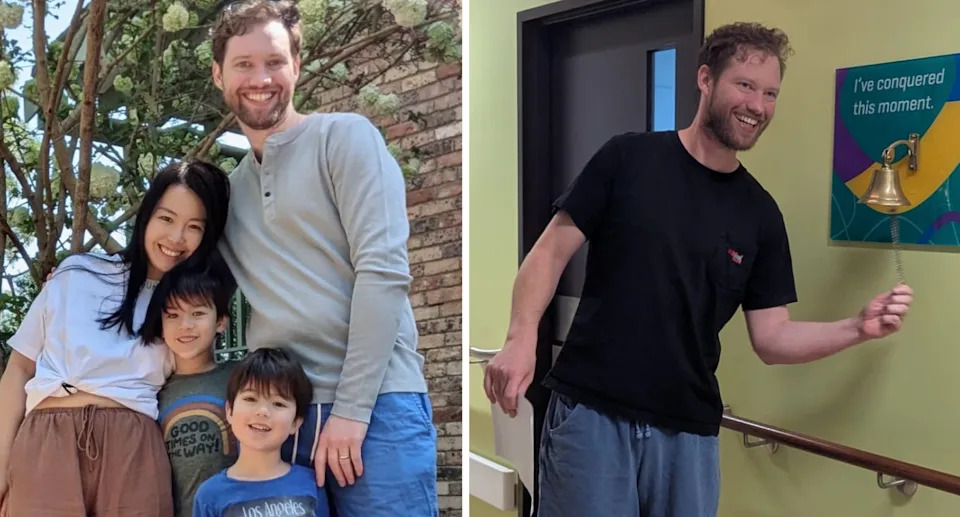
Ben was diagnosed with bowel cancer at 34 and he said his story should serve as a warning not to dismiss your symptoms. Source: Ben Duffin/Supplied
“You’re just downloading all this information and then having that diagnosis classified as a stage worse than what you thought.”
Ben underwent several months of chemotherapy and radiotherapy.
While the start of it was “extremely overwhelming”, it ended up being “better than expected” once he settled into the treatment.
Incredibly, for Ben and his family, the cancer was eradicated.
Now, he hopes his story will encourage others not to dismiss warning signs simply because they’re young.
“If something doesn’t feel right, don’t let age be a reason to dismiss it,” he said.
Sharp rise in bowel cancer among young Australians
While deaths from bowel cancer have been declining overall, diagnoses among younger Australians have been rising.
According to Cancer Australia, there were 19 cases of early-onset colorectal cancer per 100,000 Australians aged 30 to 39 in 2025.
That’s more than triple the 6.3 cases recorded in 2000.
The increase is also being seen in other younger age groups.
Among Australians aged 20 to 29, diagnoses rose from 2.2 cases per 100,000 people in 2000 to 4.6 cases in 2025.

Professor Viraj Kariyawasam said the rates of bowel cancer in people 30 to 39 have spiked. Source: Viraj Kariyawasam/Supplied
For those aged 40 to 49, rates increased from 25 cases to 31 per 100,000 people over the same period.
The 30-to-39 age group is also the only bracket where mortality has risen in the past 25 years, increasing from 1.8 deaths per 100,000 people to 2.8.
Ben’s gastroenterologist, Professor Viraj Kariyawasam, said doctors are still trying to understand what is driving the spike.
“Whether it’s driven by the gut microbiome, whether it’s driven by processed food, whether there are connections to other environmental changes or chemicals within the environment, we don’t know,” the Complete Health Australia expert told Yahoo Lifestyle.
Lifestyle factors linked to half of cases
Research from the University of Sydney suggests around half of bowel cancer cases are linked to lifestyle factors, including:
high intake of processed foods
The remaining cases are linked to factors such as genetics, inflammatory bowel disease and aging.
Symptoms young Australians shouldn’t ignore
Professor Kariyawasam, who is registered with healthcare provider service Doctify, warned that younger patients sometimes delay seeking medical help because they assume cancer only affects older people.
“If you have any symptoms that persist for more than four to six weeks, you should see your GP,” he said.
“If you’re bleeding profusely or losing weight within a few weeks, you shouldn’t wait — go to the doctor.”
Symptoms doctors say should not be ignored include:
Changes in bowel habits, including persistent diarrhoea or constipation
Blood in the stool, often mistaken for haemorrhoids
Ongoing abdominal pain or bloating
Unexplained fatigue or iron deficiency
The consequences of waiting too long can be serious.
According to the National Cancer Control Indicators, the five-year survival rate for early-stage colorectal cancer is very high — 98 per cent for stage one and 88 per cent for stage two.
But survival drops significantly as the disease progresses.
Stage three cancers have a five-year survival rate of 71 per cent, while stage four falls to just 13 per cent.
Professor Kariyawasam said he has seen many patients who have convinced themselves the symptoms aren’t that serious, or their GP hasn’t explored the possibility that it could be cancer, because they’re not in that typical age period.
SHOP:
“Then they come back with ongoing symptoms for nearly one year or more, and they’ve got a cancer that cannot be cured,” he said.
“For most of those patients, it’s more than the trauma of the diagnosis, as they have a huge guilt trauma and an angry trauma of not doing something for 12 months to 18 months.”
Screening age lowered — but doctors want it lower again
Australia’s National Bowel Cancer Screening Program provides free tests every two years once people turn 45.
The eligibility age was lowered from 50 to 45 in 2024.
But Professor Kariyawasam believes the threshold should be reduced even further.
“Screening from age 40 would likely catch more cancers earlier,” he said.
Ben agrees.
“Bring the age down much lower,” he said.
“It’s only going to save people and the medical system a lot of money and pain.”
For people 50 and over, incidents of bowel cancer have been decreasing, which experts believe could be partly due to the program.
Want the latest lifestyle and entertainment news? Make sure to follow us on Facebook, Instagram, and TikTok.