
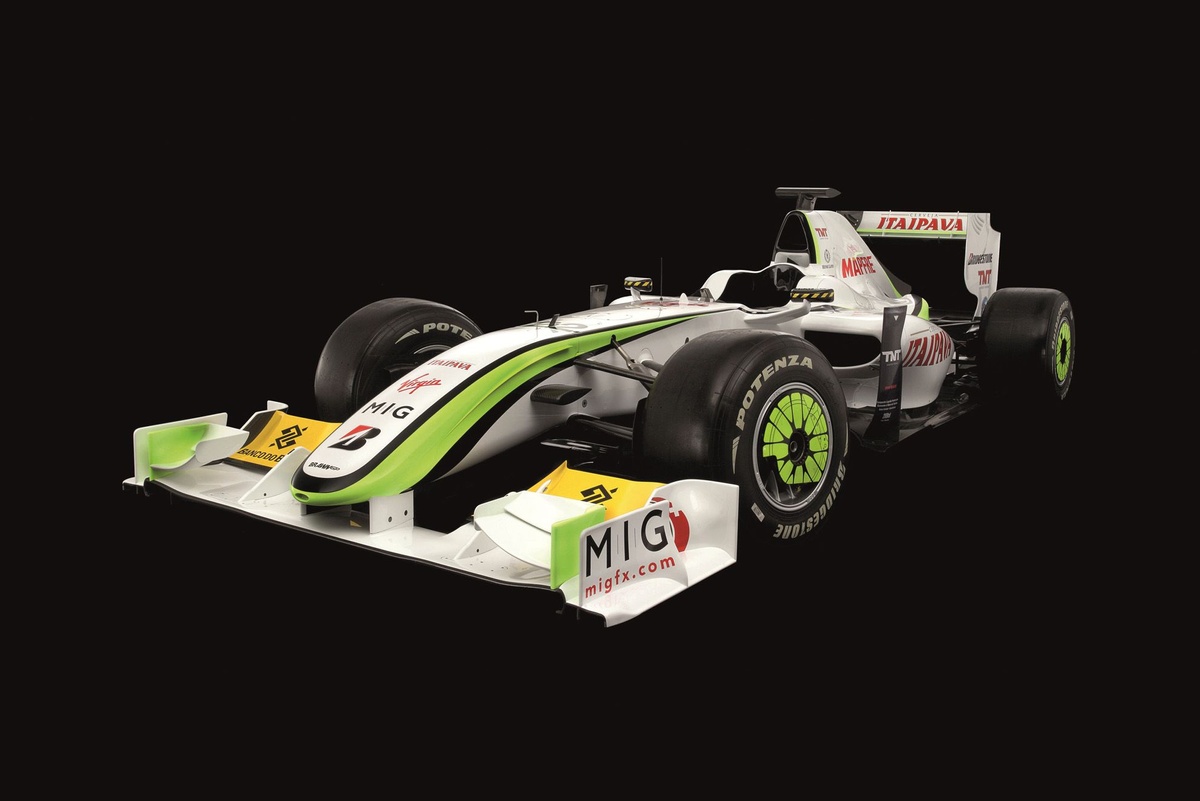
Radical technical changes, electrification, active aerodynamics – all in the name of improving ‘the show’ through providing more overtaking. Sound familiar?
In 2009 a new set of technical rules came into force in Formula 1, with the unanticipated consequence of one team running away with the world championship. Or, more accurately, escaping to such an extent in the first half of the season that it was able to stay out of reach as rivals caught up.
The standard optics through which to view the story of Jenson Button and Brawn GP’s world championship campaign are rose-tinted: an heroic odyssey, an irresistible epic of success against all odds. Almost as unlikely, indeed, as 60-odd-year-old Brad Pitt winning a grand prix; but Hollywood has already found the Brawn story so alluring it has visited it in a different form, via a multi-part documentary fronted by Keanu Reeves.
Of course, there’s a ‘but’ coming. The BGP 001 wasn’t an accidental flash of genius, or the product of a vastly experienced driver arriving in the design office, leaning over the technical director’s CAD terminal and suggesting a few tweaks to a hitherto uncompetitive machine. It was among the most expensive F1 cars of all time, a portmanteau of the work of three separate design teams working across three wind tunnels, with a consummate technical manager cherry-picking the smartest concepts. It almost never saw action but circumstances aligned for it to make a surprising competitive emergence.
Read Also:
The overtaking emergency
As the 2009 regulations came into force, the global economy was vanishing down the U-bend and F1 found itself plunged into crisis. But when the fundamentals of the new rules were first formulated in 2006, the majority view was that lack of overtaking was the critical problem rather than commercial sustainability. FIA president Max Mosley had long championed the cause of reducing costs but the competitors, flush with money as road car manufacturers replaced tobacco sponsors as key investors, had little appetite.
Indeed, during an interview with this author, BMW team principal Mario Theissen had responded to questions about the putative budget cap – another idea Mosley was trying to force through – with a dismissive shake of the head: “It’ll never happen…”
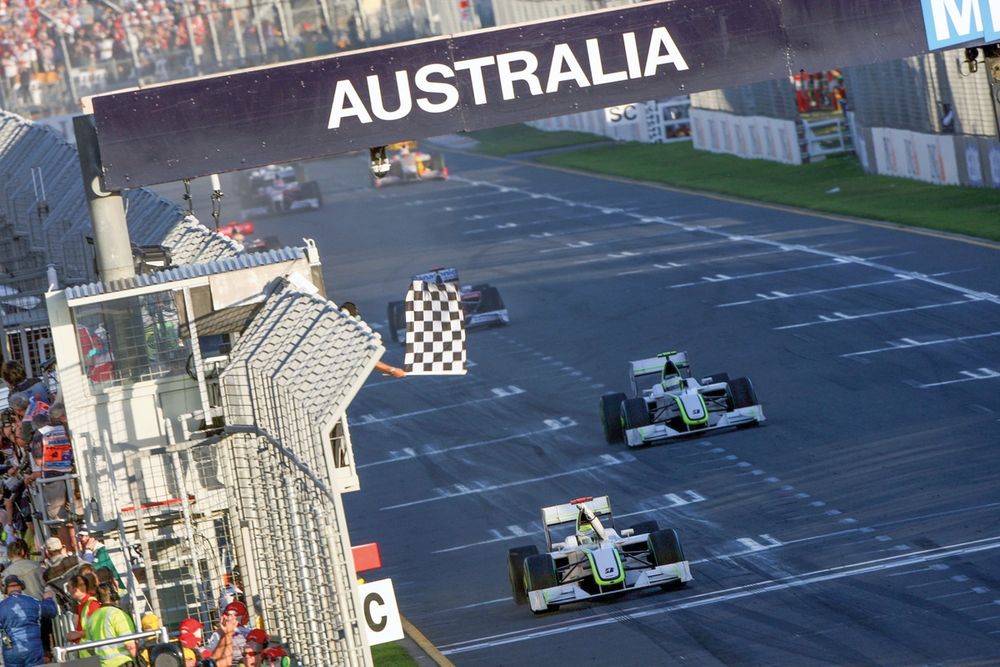
The 2009 regulations were a response to improve overtaking in F1 primarily, but they didn’t deliver as hoped
Photo by: Getty Images
Since Ayrton Senna’s death in 1994, the FIA under Mosley had consistently tried to put the brakes on car performance as a complement to its programme of improvements to car and circuit safety. But while the latter was underpinned by considerable scientific rigour, the attempts to limit speeds and lap times betrayed Mosley’s limited understanding of technical matters.
The 2009 regulations represented a tacit admission that many of the blunt-force instruments used to slow the cars down had damaged the spectacle: ‘grooved’ tyres were too prone to graining; and higher, narrower front wings were more sensitive to wake turbulence from the cars ahead, preventing drivers from getting close enough through corners to attack.
Not that this was the public message, of course. The narrative at the time was that excessive aerodynamic complication was the root of the problem, so the proposed solution – formulated by the newly created Overtaking Working Group – was to strip the cars of the elaborate flow conditioners that they were sprouting across seemingly every available surface.
KERS, meanwhile, had been inadequately thought through and at most circuits the additional performance – equivalent to 80bhp, limited to 6.6 seconds per lap – wasn’t worth the weight of the motor, batteries and associated hardware
In tandem, the front wings would be lower and wider, while the rear wings would be higher and narrower, and the diffusers smaller and simpler, the idea being to reduce wake turbulence as well as downforce. Flaps on the front wings could also be adjusted by the driver to reduce drag on the straights, while hybrid technology arrived for the first time in the form of Kinetic Energy Recovery Systems (KERS), which harvested energy from a motor on the rear axle and stored it in a battery for redeployment at the push of a button.
Ironically, perhaps, these attempts to eliminate the unforeseen consequences of previous interventions came with their own unexpected effects. In practice the adjustable front wings, limited to six degrees of articulation, were useless in terms of defeating drag, and only served the purpose of changing aero balance as the fuel load went down. KERS, meanwhile, had been inadequately thought through and at most circuits the additional performance – equivalent to 80bhp, limited to 6.6 seconds per lap – wasn’t worth the weight of the motor, batteries and associated hardware.
Those teams who had committed to KERS, either as a philosophy (BMW) or for pure technical reasons (Ferrari, for instance, buried the hardware deep within its chassis, so it couldn’t easily abandon the concept) therefore had a baked-in disadvantage. And this was all before the effects of the global financial meltdown, which had begun in mid-2007, finally crashed into F1 in December 2008.
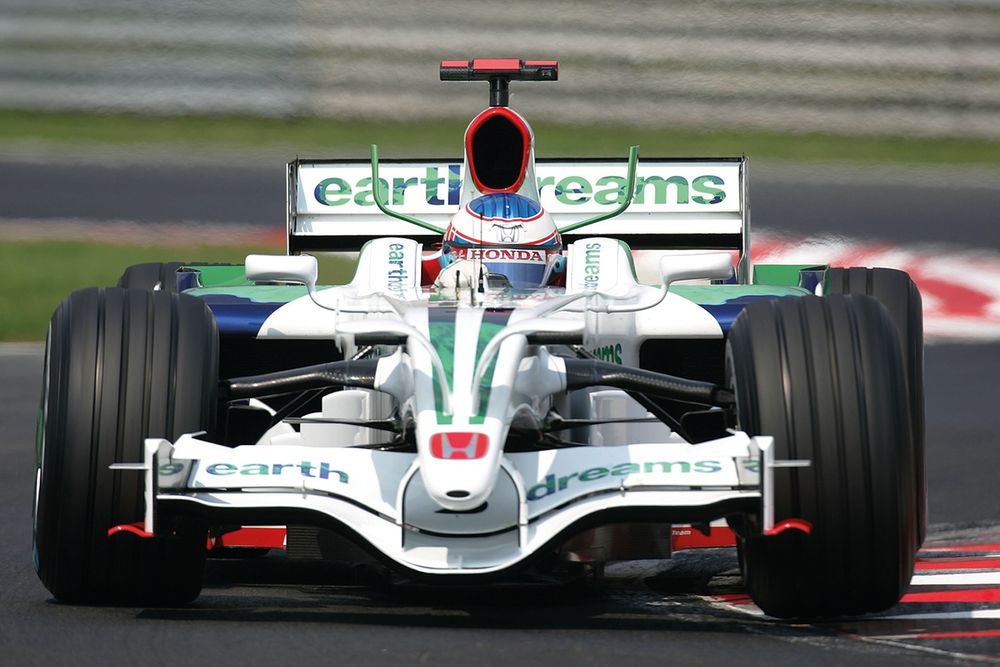
Honda has a disaster car and chose to sell – or close – its F1 team at the end of 2008 as the financial crisis hit
Photo by: Christopher Lee / Getty Images
The money emergency
In a complex series of transactions in the mid-2000s, Honda had first acquired a minority stake in the British American Racing team for a reported $180million, then converted it to a full shareholding. The complication was necessary because British American Tobacco, which had bankrolled the acquisition of the struggling Tyrrell team in 1998 as part of a consortium involving the Brackley-based race car constructor Reynard and Jacques Villeneuve’s manager Craig Pollock, wanted to divest itself of the other minor shareholders first, blaming them for the team’s competitive struggles and substantial debts. In 2001 it brought Prodrive magnate David Richards in to turn the team around, and by 2005 Honda was enthusiastic enough about the state of affairs that it was prepared to buy the team outright.
Thereafter, competitiveness slumped as it installed its own people in key technical positions despite their inexperience in F1 car engineering. Hiring former Ferrari technical director Ross Brawn as team principal ahead of the 2008 season was a prudent means of initiating a course-correction, but it was going to take time: a cursory glance over the 2008 car was all it took for Brawn to decide it was a basket case, and that resource would be better expended focusing on the incoming regulations for 2009.
The resource involved was huge. While the 2008 season unfolded miserably for Honda, requiring much expectation-management by Brawn, no fewer than three design teams were picking over the new rulebook in search of loopholes: Honda’s own engineers in Brackley; those of the former Super Aguri team, a satellite operation recently shuttered by Honda; and a third group at Honda’s Sakura R&D facility in Japan.
It was a young engineer at Sakura who identified the loophole in the wording of the diffuser regulations, at first thinking that because English was his second language he had simply made a mistake in translation. But no – the prescriptions were chiefly two-dimensional, describing the volume as viewed from below. It would be perfectly legal, according to the letter of the law, to have a secondary diffuser volume above the first, fed via gaps that were effectively invisible when examined from the position laid out in the rulebook.
But by late 2008 Honda, in common with many other car manufacturers, had a problem it couldn’t resolve easily: vast inventory of unsold stock as consumers, starved of credit – or now out of work – stopped buying. On Friday 5 December, at a press conference in Tokyo, Honda CEO Takeo Fukui announced that the company was withdrawing from F1 immediately. The team would be sold – or closed.
Three months of limbo then ensued as Brawn and CEO Nick Fry cast about for potential purchasers, of which there were many – but rather fewer were serious or had the money to keep the team going beyond the nominal £1 Honda was asking. Among the distressed-asset grifters circling was a potential investor who presented as the scion of a billionaire dynasty, and arrived in an ex-military helicopter; it turned out his father actually washed dishes in a restaurant in Hammersmith. Months later, BMW almost went down a similar route when it came close to selling its team to convicted fraudster Russell King.
Having kissed plenty of frogs, to no avail, Brawn and Fry engineered a management buy-out via a parachute payment from Honda and a tacit loan from F1 ‘ringmaster’ Bernie Ecclestone. McLaren COO Martin Whitmarsh, at the time organising the Formula One Teams Association (FOTA) to take on Mosley on the political front, facilitated a supply of Mercedes engines. He would come to rue his benevolence.
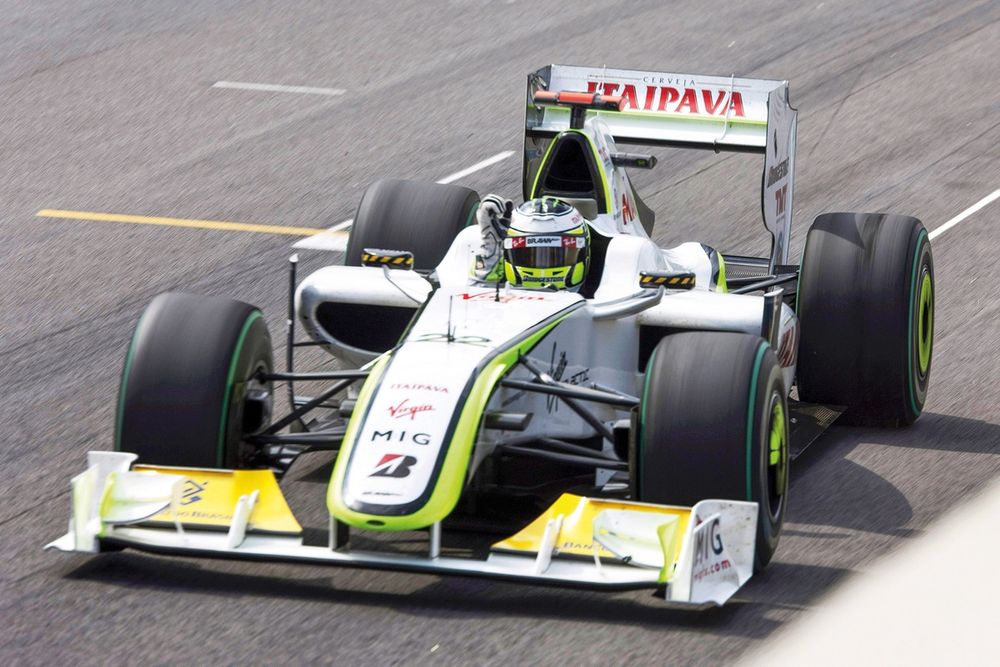
With Mercedes power and a rescue package, Brawn could seize its moment
Photo by: Darren Heath – Getty Images
Retrofitting the car, now known as the BGP 001, with the Mercedes V8 entailed a certain amount of engineering compromise around the rear – but perhaps was for the best, since the Honda engine it replaced was both heavier and thirstier. Then as now (since Aston Martin’s Honda power unit is reportedly up to 15kg overweight), the company’s engineers tended to focus on horsepower rather than taking a holistic view of performance.
Double-diffuser jeopardy
Brawn arrived late for testing and immediately blew away its rivals’ lap times. In hindsight it should have sandbagged, since its pace unleashed a furore. Williams and Toyota had also identified the loophole and their cars sported double-volume diffusers, but rivals had largely greeted these with a raise of the eyebrow. Now, though, it was not only a massive issue, it was very much the only show in town.
Amid much wailing and gnashing of teeth, the double-diffuser concept was ruled legal, albeit to be banned at a later date. Red Bull technical director Adrian Newey has said more than once that he believes this was simply a case of Mosley vindictively punishing McLaren and Ferrari for challenging his power via FOTA. Whatever – the other teams now had to imitate the development, a process made difficult or even impossible given the presence of hard points such as the gearbox in that area.
Having been forced to make large-scale redundancies, Brawn could add little development to the car through the season; Jenson Button won six of the seven opening rounds, then stood on the podium on only two further occasions as he frantically held on to his championship lead
Rose-tinted storytelling has tended to overstate the importance of the double diffuser. In itself it wasn’t a ‘magic bullet’ worth huge swathes of lap time, but what it did do was not only bring the downforce generated in that area closer to 2008 levels – and solve a problem created by the ‘legal’ diffusers being prone to stalling. This opened up a beneficial series of development opportunities all across the car. The BGP 001 also had a more mature front wing design, making the most of the new width to ‘outwash’ air around the front wheels.
Rivals quickly caught on and caught up, although it would be mid-season before a KERS-equipped car would win a grand prix, when McLaren introduced a new floor and Lewis Hamilton won in Hungary. Having been forced to make large-scale redundancies, Brawn could add little development to the car through the season; Jenson Button won six of the seven opening rounds, then stood on the podium on only two further occasions as he frantically held on to his championship lead.
Read Also:
The consequences of this season would ripple on and on. Although Brawn sold his eponymous team to Mercedes, it took several seasons to rebuild and restructure after its enforced downsizing, by which time the board had lost patience and Brawn was
forced out. Outwashing front wings, meanwhile, made overtaking harder rather than easier since the cars now left an even more turbulent wake. The 2009 formula, altogether, was an appalling bust.
This article is one of many in the monthly Autosport magazine. For more premium content, take a look at the April 2026 issue and subscribe today.
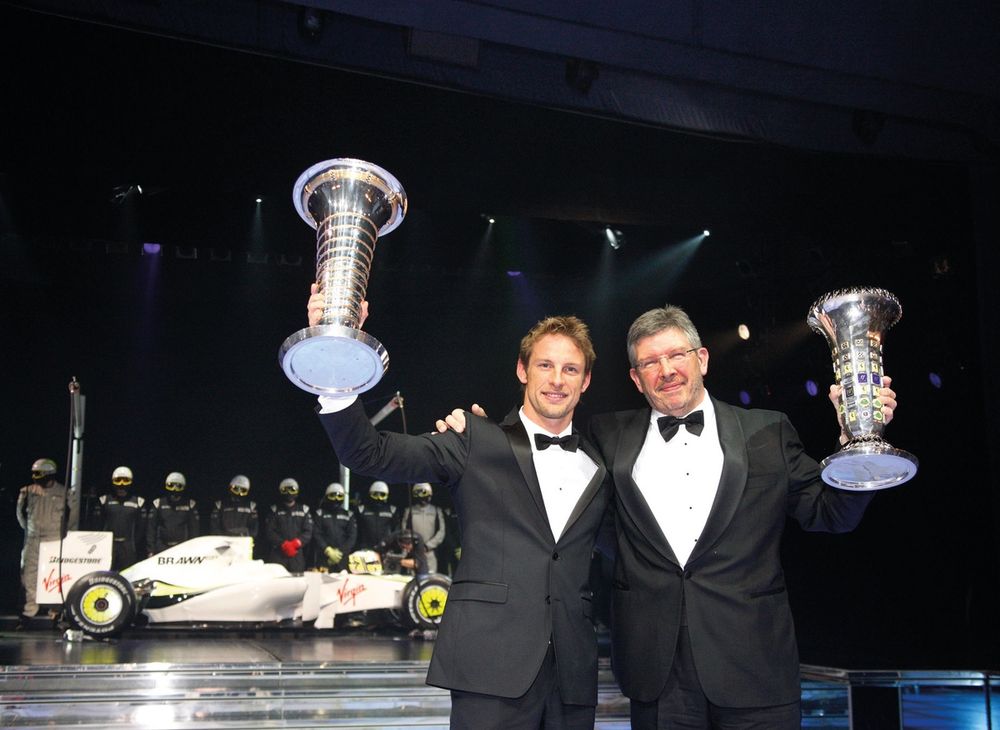
A drivers’ and constructors’ title double for a new team – unlikely to ever be repeated in F1 again
Photo by: FIA
We want to hear from you!
Let us know what you would like to see from us in the future.
– The Autosport.com Team