
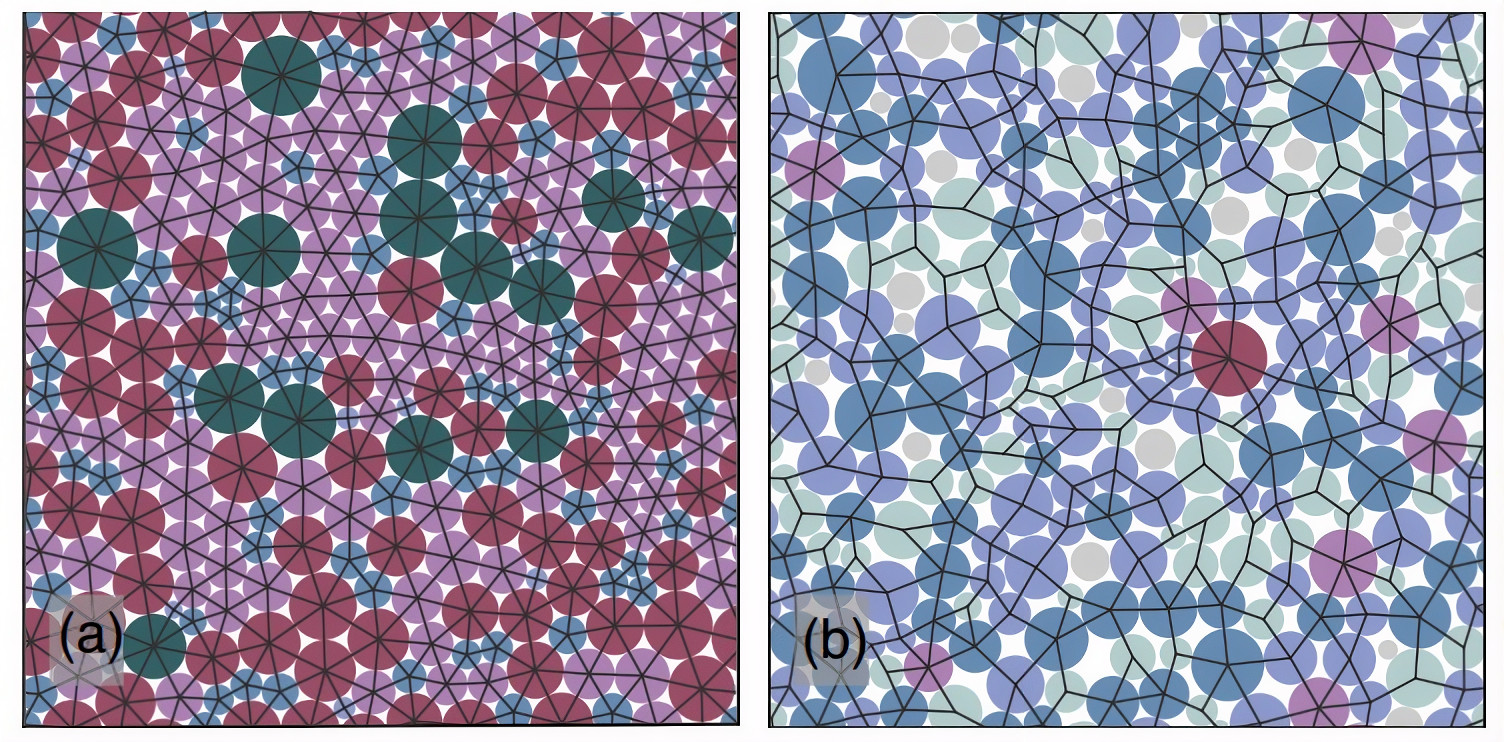
 An ideal glass (left) compared to a conventional glass (right). In the ideal glass, all the particles are packed together as tightly as possible. In the conventional glass, the particles have more gaps between them. Both packing arrangements are stable, but the one on the left is much stronger.Credit: Corwin Lab, University of Oregon.
Take a moment to look at the screen you are reading this on.
Whether it is a phone or a monitor, you are staring through a material that has baffled scientists for centuries. Glass is everywhere, but from a physics perspective, it really should not exist.
When you cool a liquid, it normally crystallizes. The molecules lock into a neat, repeating pattern, like water freezing into ice. But sometimes, a cooling liquid simply stops flowing without ever organizing itself. The molecules freeze in place, locked in a chaotic, amorphous jumble.
This is glass: a liquid in suspended animation. For this reason, technically, glass is called an amorphous liquid.
But what exactly forces these chaotic molecules to harden into a rigid structure? Why doesn’t it just squish like a normal liquid?
To answer this, researchers have spent decades hunting for a theoretical state of matter known as “ideal glass”. Now, a team of physicists from the University of Oregon has finally brought this mythical material to quasi-life inside a computer simulation.
Their breakthrough not only solves a long-standing paradox but also paves the way for a new era of manufacturing.
The Dark Art of Making Glass
When you cool a molten liquid, it naturally wants to crystallize. Its jiggling molecules try to lock themselves into a neat, repeating pattern. To make glass, you have to plunge those molecules into suspended animation, trapping them in their messy, free-flowing liquid state before they have a chance to organize.
×
Thank you! One more thing…
Please check your inbox and confirm your subscription.
This delicate race against nature makes manufacturing glass notoriously tricky. “Avoiding crystallization is a dark art,” said Paddy Royall, a glass physicist at the University of Bristol, in an interview with Quanta from 2020.
Cooling a liquid rapidly is the easiest way to trap its molecules in a messy, disorganized state before they have a chance to form crystals. But here is the catch: rushing the process creates a weaker, less stable glass.
If you want a denser, stronger material, you have to cool the liquid slowly. This gives the sluggish molecules just enough time to shuffle around and settle into tighter, lower-energy arrangements.
This is where the “dark art” of glassmaking comes in.
An Entropy Crisis and Ideal Glass
The slower you cool the liquid, the lower its internal disorder — or entropy — becomes, as chemist Walter Kauzmann first found out in 1948. But if you cool it too slowly, you give the molecules enough time to organize, and they will suddenly snap into an orderly crystal, ruining the glass phase entirely.
Kauzmann tracked this cooling trend and hit a mathematical wall. He calculated that if you could cool a liquid slowly enough, its entropy — its internal measure of disorder — would eventually plummet. At a specific, extreme chill now known as the Kauzmann temperature, the liquid’s disorder would drop so low that it would exactly match the entropy of a perfectly structured crystal.
This insight triggered a massive paradox. Crystals are highly ordered by definition, while glasses are fundamentally chaotic. How could a jumbled, random arrangement of molecules possess the exact same level of mathematical order as a flawless crystal lattice?
Kauzmann thought the idea was absurd, dismissing the possibility of such a material being possible.
Later physicists, however, realized this “entropy crisis” was not a mathematical glitch. It was a breadcrumb trailing toward an entirely undiscovered phase of matter: ideal glass. In this theoretical state, molecules are packed as densely as physically possible, yet remaining completely random.
There is just one monumental hurdle to proving this phase exists. To reach the ideal state, you have to cool the liquid so agonizingly slowly that the experiment becomes physically impossible. It would take longer than the age of the universe to see it happen.
Long before the material actually reaches the Kauzmann temperature, the liquid becomes unimaginably thick and viscous. The molecules simply grind to a halt and get stuck, totally arresting the process and stopping the ideal transition from ever happening in the real world.
Cheating the Physics With Code
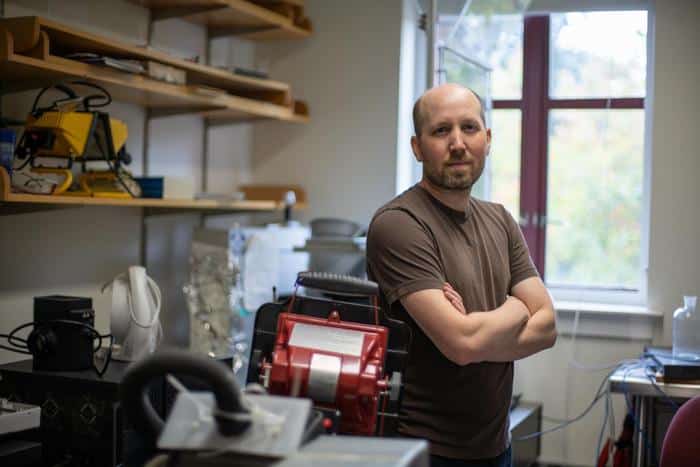 Eric Corwin, a physicist at the University of Oregon. Credit: University of Oregon.
Instead of waiting around for eternity, University of Oregon physicist Eric Corwin and his team decided to cheat. A bit.
“We thought maybe we can just jump to it,” Corwin said. “We can construct the best possible structure.”
Corwin’s team used a high-performance computer cluster to build a two-dimensional simulation. If nature would not let them reach the ideal state, they would simply hack the physics to build it themselves in a virtual world.
They started by scattering circular disks randomly across a digital space. Think about pushing a bunch of different-sized coins together on a table. No matter how hard you push, their mismatched curves will inevitably leave tiny, empty gaps between their edges. In the physics of glass, those microscopic gaps represent hidden disorder and instability.
To eliminate those gaps and reach the “ideal” state, the researchers had to improvise, which is where the “cheating” part comes in.
Glass as Stable as Diamond
They gave each disk an artificial superpower: a “mutable radius.”
Instead of having a fixed, rigid size, every disk in the simulation was allowed to dynamically grow or shrink. As the computer pushed the disks together, it constantly adjusted their sizes. The disks swelled or shrank just enough to perfectly plug every single empty void
They used a mathematical concept called the circle packing theorem to ensure every single disk touched exactly six neighbors. If you were to draw a straight line between the center of every touching disk in this simulation, you would see a seamless, fully connected web of triangles. Physicists call this a fully triangulated network.
By forcing this perfectly triangulated web, the team achieved the impossible. They had constructed a two-dimensional ideal glass.
Because there were absolutely no gaps left to fill, there was nowhere for the disks to shift or shuffle. In thermodynamic terms, the system hit “zero configurational entropy.” This means there is only one mathematically possible way for this specific web of disks to exist.
The resulting structure lacked any repeating, orderly patterns — it looked completely random and amorphous. Yet, the disks were locked together as tightly and stably as atoms in a flawless diamond.
A Crystal in Disguise
So, how does this phantom material actually behave?
When the researchers tested the mechanical properties of their simulated glass, they found something astonishing. It behaved exactly like a crystal.
“The conclusion is that our structure mechanically behaves identically to a crystal, even though it is completely amorphous,” Corwin said.
The simulated ideal glass demonstrated incredible stability. It strongly resisted shearing and bending forces. Furthermore, it lacked the “low frequency power law scaling” normally found in amorphous materials. Simply put, it did not wobble or deform the way normal glass does.
The researchers also found that this ideal glass melted at an unusually high temperature. It required a tremendous amount of thermal energy to break the densely packed structure apart.
Finally, the ideal glass displayed a property known as hyperuniformity. This means that if you look at the material on a large scale, its density is perfectly even, without any random clumps or empty voids.
Molding the Future
Why would scientists care so much about a two-dimensional computer simulation of imaginary disks?
If we understand the fundamental math behind ideal glass, we can engineer entirely new types of materials in the real world.
One of the most exciting applications is metallic glass. Conventional metals have orderly, crystalline structures. Metallic glasses, however, have the chaotic structure of a liquid frozen in place. They are incredibly strong, resistant to deformation, and can be easily injection-molded.
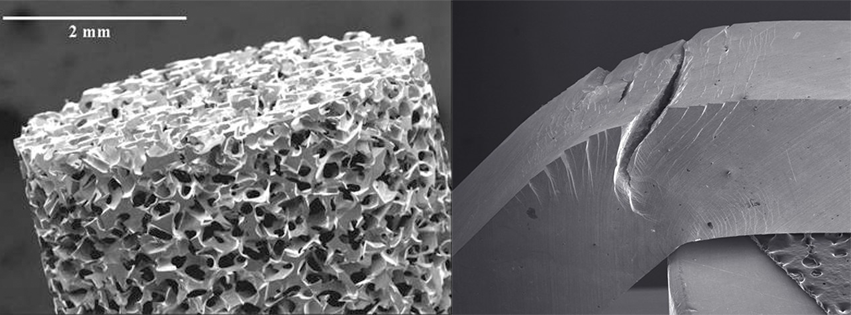 Scanning electron microscope images of metallic glass.
Currently, making metallic glass is difficult because the molten metal must be cooled at extreme speeds to prevent it from crystallizing. This rapid cooling severely limits what we can build.
By mapping the ideal glass transition, scientists hope to learn how to bypass this limitation.
“If we could develop a much better understanding of the glass transition and understand what makes an alloy (a combination of metals) better or worse at forming a metallic glass, we could design alloys that you could cool much more slowly,” Corwin said. “And then you could really do things. You could mold a car engine, you could mold a jet fighter. It would be revolutionary.”
For now, the team is working on expanding their ideal glass simulation into three dimensions. We are still a long way from injection-molding jet fighters, but after 75 years of mystery, the theoretical foundation of perfect glass has finally been laid.
The findings appeared in the Physical Review Letters.