
If a future catastrophe were to wipe out our civilization from the Earth’s surface, would there be a technological relic that would survive intact for billions of years?
One form of such relics would be satellites above the altitude of geostationary orbit at 35,786 kilometers. These relics will continue to orbit the Earth long after they stop operating, since they do not have significant drag on the Earth’s atmosphere. Given that we have not discovered any prehistoric satellites at these high altitudes, we can safely conclude that there was no SpaceX-like company on Earth for billions of years before Elon Musk founded SpaceX in 2002.
If the dinosaurs had launched a geostationary satellite, it could have remained in orbit until the present day. Similarly, if the Roman Empire had been able to launch a satellite with an orbital altitude as low as 1,200 kilometers, then this Roman satellite might have remained in orbit long enough to only be falling back to Earth and burning up in the Earth’s atmosphere just now. Space archaeology informs us, of course, that no space launch capabilities were available to the dinosaurs or the ancient Romans.
But with advanced technology comes responsibility. This does not only apply to artificial intelligence systems—a hot topic for today’s policy makers in Washington DC—but also to satellites around Earth. Let me explain.
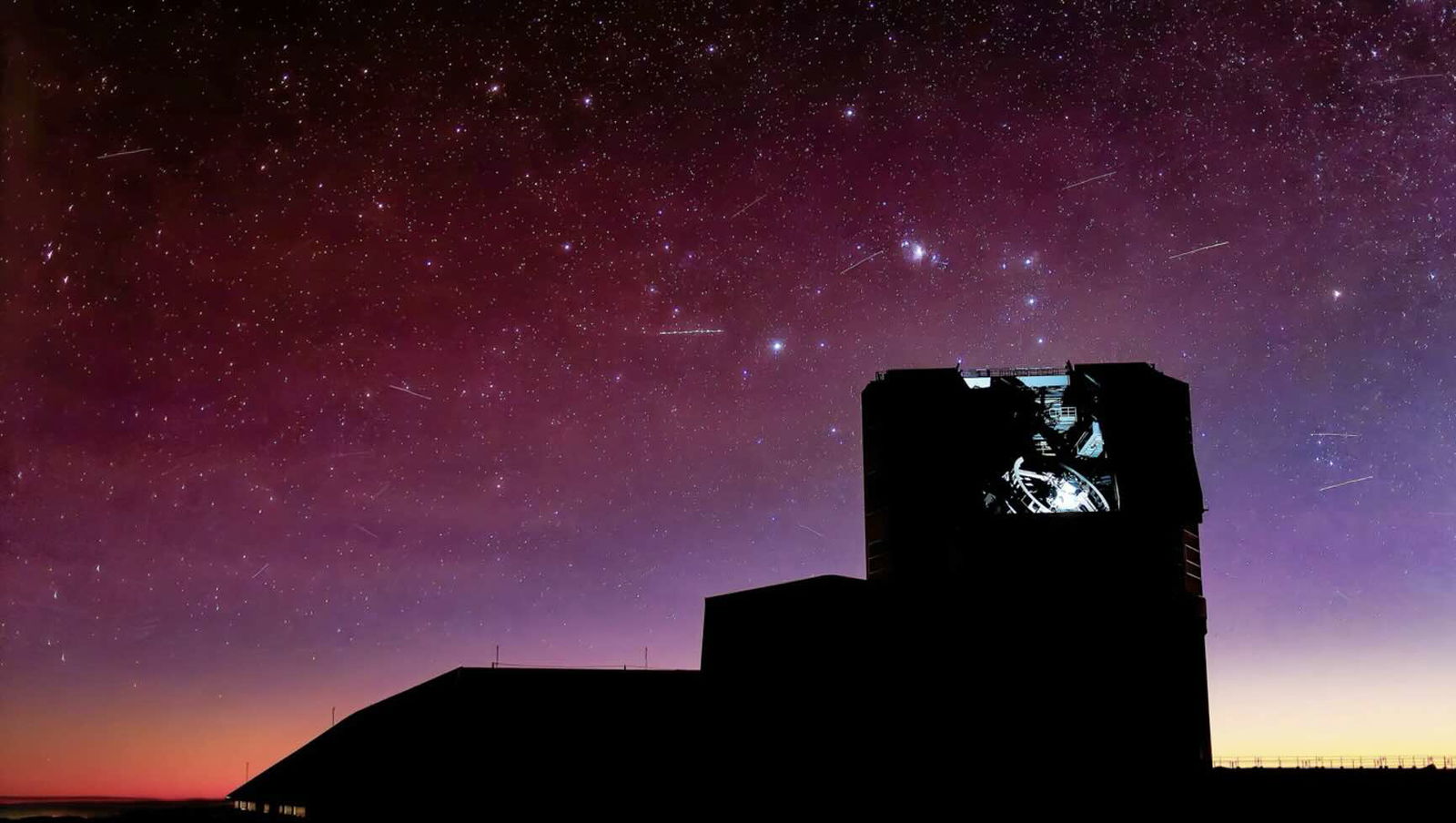
The lack of a large population of high-altitude prehistoric satellites allowed humans to study the Universe with ground-based telescopes and understand how we came to exist from the initial conditions set by the Big Bang, 13.8 billion years ago. This intellectual accomplishment started with Galileo Galilei, who spotted the moons of Jupiter through his telescope and realized that the Earth is not at the center of the Universe. Following his pioneering work, humanity’s best telescopes were placed on top of remote mountains, where they can effectively avoid the contamination of the night sky by light pollution from human-made activities. Largely because of SpaceX and other companies, this is no longer possible. Our space economy is now gearing up to fill the night sky with lights.
Communication satellites are already leaving unavoidable marks on the images obtained by ground-based telescopes, as they reflect sunlight outside the Earth’s shadow. Their motions around the Earth imprint prominent streaks in the (15+15) second exposures taken by the state-of-the-art NSF-DOE Rubin Observatory in Chile.
But the worst is yet to come. A new space-mirror company is requesting authorization to pollute the night sky intentionally.
Reflect Orbital is a start-up company proposing a constellation of up to 50,000 satellites by 2035, to provide a sunlight-on-demand service to consumers. This would involve reflecting beams of sunlight with a diameter of about 5 kilometers onto Earth’s surface to provide lighting or solar energy to the customers.
This potentially new source of light pollution could affect astronomical observations irrespective of their elevation or distance from city lights on the surface of Earth. Rayleigh scattering in the Earth’s atmosphere, both from the incoming beam and from reflected light, is ignored by the company and could result in an enormous skyglow from a brightly illuminated area, the size of 650 football stadiums. This technology will introduce sustained artificial dusk and dawn conditions across landscapes, in addition to hours-long bursts of daytime brightness.
Reflect Orbital has submitted an application to the Federal Communications Commission (FCC) to launch a testing satellite, EARENDIL-1. Their demonstration satellite would produce a beam about as bright as the full Moon, while the full constellation could produce illumination comparable to that of the Sun at high noon. The FCC has opened a public comment period until March 9th, 2026, allowing the public to voice their thoughts and concerns about federally approved projects.
If you care about the above-mentioned risk to the night sky, please sign and share the open letter opposing this initiative, written by DarkSky International, and consider submitting a public comment to the FCC by March 9th, 2026. More details, compiled by Sarah Thiele & Gaspar Bakos from Princeton University, are available here.

Past terrestrial civilizations did not pollute the night sky for billions of years, and space companies like Reflect Orbitalshould not be allowed to do so in the future.
The species of non-avian dinosaurs was extinguished as a result of a giant asteroid impact 66 million years ago. If consulted, these dinosaurs would have agreed with this sentiment. They dominated the Earth without looking up through telescopes. The lesson is simple: if our species will not be able to survey the dark sky in search for near Earth asteroids because of light pollution, it might not survive for long in cosmological terms.
We tend to arrogantly assume that we are more intelligent than any life form that ever existed on Earth, while at the same time we promote technologies that could lead to our demise. This suggests a new solution to Enrico Fermi’s paradox concerning extraterrestrials: “Where is everybody?” Extraterrestrial technological civilizations might have blinded their outward-looking Rubin-like telescopes with light pollution and went extinct in the same way that the dinosaurs did.
Extending the Darwinian “survival of the fittest” to the cosmos, suggests that only civilizations which were intelligent enough to block companies like Reflect Orbital survived. The FCC could decide whether our civilization has a chance of fulfilling the Vulcan salute from Star Trek: “live long and prosper”.
Avi Loeb is the head of the Galileo Project, founding director of Harvard University’s – Black Hole Initiative, director of the Institute for Theory and Computation at the Harvard-Smithsonian Center for Astrophysics, and the former chair of the astronomy department at Harvard University (2011-2020). He is a former member of the President’s Council of Advisors on Science and Technology and a former chair ofthe Board on Physics and Astronomy of the National Academies. He is the bestselling author of “Extraterrestrial: The First Sign ofIntelligent Life Beyond Earth” and a co-author of the textbook “Life in the Cosmos”, both published in 2021. The paperback edition of his new book, titled “Interstellar”, was published in August 2024. Follow Dr. Loeb’s work on his professional website, on his medium page, and on X.