
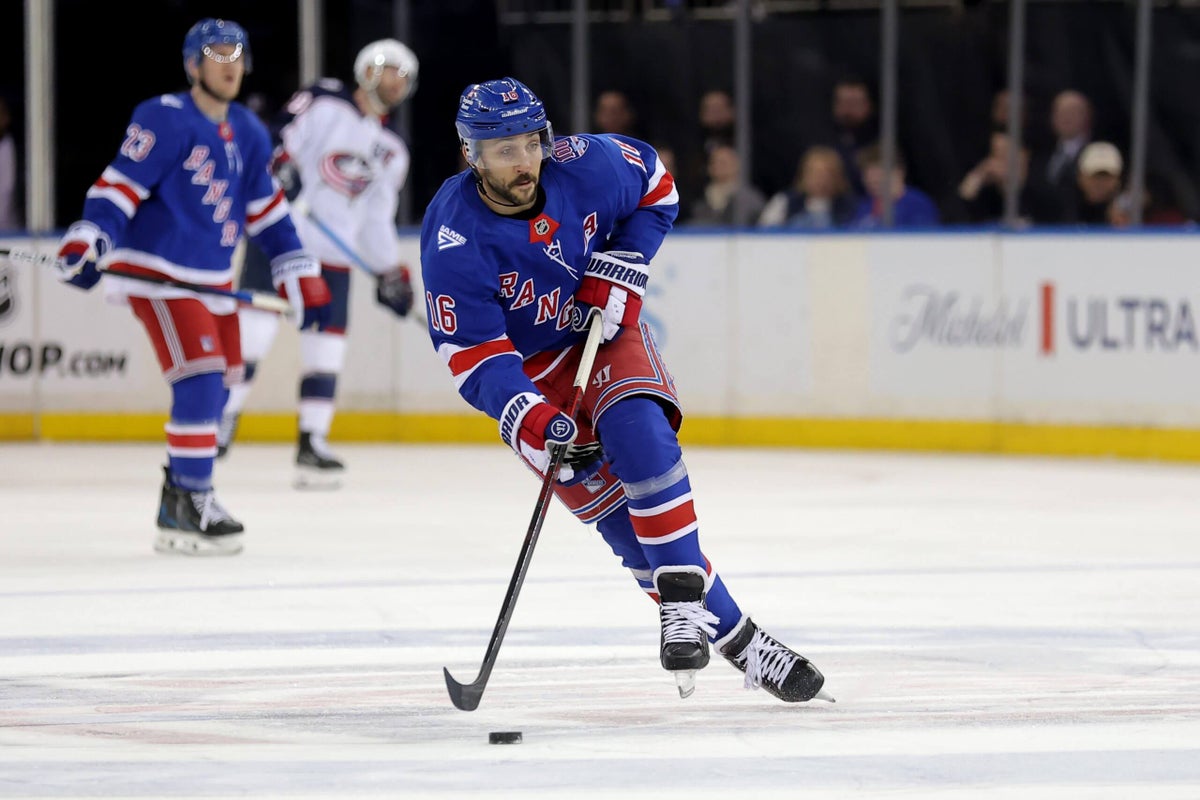
Shortly after the buzzer sounded on Friday’s NHL trade deadline, Minnesota Wild general manager Bill Guerin made an appearance on ESPN.
He was asked by reporter Emily Kaplan why it was so hard to pry away some of the top available centers, such as Vincent Trocheck of the New York Rangers, and offered a funny-but-telling response.
“I thought winning gold with Chris Drury would have gotten me a little bit of a discount,” the GM of the U.S. men’s Olympic team said, “but he wasn’t in that mood.”
Guerin was chuckling as he said it, but many around the league likely nodded in agreement.
The word for weeks has been that Drury, who serves as both Rangers president and GM, was driving a hard bargain for his most valuable trade chip and telling teams he wouldn’t budge if they didn’t meet his price. It was considered unreasonably high by multiple sources from interested parties, some of whom thought — or at least hoped — that Drury was posturing and would reduce his ask as the deadline approached.
He did not.
Drury stood his ground, and when the dust settled, Trocheck — who has three years remaining on his contract at a $5.625 million cap hit — was still a Ranger.
It’s both admirable and extremely risky. As one executive pointed out, caving in the final hours would have signaled to other GMs that Drury’s word was flimsy. But by misjudging the market and setting a price no one was willing to meet, he may have backed himself into a corner.
The Rangers had offers in hand. The Minnesota Wild are believed to have put their No. 2 prospect, center Charlie Stramel, on the table, plus a likely future first-round pick and a possible third piece. The Boston Bruins, Carolina Hurricanes, Detroit Red Wings and Pittsburgh Penguins are among the others who showed interest and had intriguing assets to dangle, but none were prepared to give up the necessary pieces to get Drury to say yes. The primary requirement was a forward with top-six potential who had either reached the NHL already or was on the verge.
Rather than take whatever amounted to the best available offer, Drury is rolling the dice that he can do better at a later date.
It’s not inconceivable. There was gridlock throughout the league at this deadline, with buyers hamstrung by CBA tweaks that introduced a playoff salary cap and eliminated third-party brokers. Many sellers elected to wait for better conditions, which may be coming. The cap is set to jump from $95.5 million to $104 million on July 1 and will presumably provide teams with extra room to enter the bidding. There could also be a wider field of GMs seeking an impact addition who can change their fortunes heading into next season. Two more will be eligible to enter the conversation for Trocheck, whose 12-team no-trade list will drop to 10 once the 2026-27 calendar begins.
But there’s also a chance more enticing center options will shift the market. The St. Louis Blues didn’t move 26-year-old Robert Thomas at the deadline, either, and are expected to continue shopping him over the summer. He’ll surely be ahead of Trocheck — who’s viewed as a strong middle-six center but not a true No. 1 — in the pecking order. The Vancouver Canucks’ Elias Pettersson, New Jersey Devils’ Nico Hischier, Nashville Predators’ Ryan O’Reilly and even Toronto Maple Leafs’ Auston Matthews could further crowd the picture.
It’s also unlikely that Trocheck’s value will improve from here. He’s still riding the high from winning a gold medal in Milan, where he showcased the intangibles and versatility that made him such an appealing target, but he’ll turn 33 in July. Between age and playing for a losing team that’s been gutted of its skill, it’s hard to imagine his production won’t continue to suffer. And we haven’t even mentioned the injury possibility. (Hopefully not, but all outcomes must be considered.)
Carrying Trocheck into next season feels like a non-starter if the Rangers are serious about rebuilding — excuse me, retooling — and getting younger. He’d be a quality add for any contender, but this is a last-place team that has a long way to go to get back to that perch. More importantly, he’s one of the very few assets they can use to attain the future play-drivers they so desperately need.
There’s little chance Drury will be able to get more for the 5-foot-11, 187-pounder at next year’s deadline, which leaves him at the mercy of whatever he can squeeze out of his GM counterparts this summer. Maybe Drury’s gamble will pay off and there will be a bullish market around draft time, but there’s understandable skepticism. Holding Trocheck may have been the right decision in a vacuum, but a shaky track record of asset management across five years at the helm has evaporated the benefit of the doubt.
The Rangers have said goodbye to 13 of the 22 players who appeared in games during their 2024 run to the Eastern Conference final, with little coming back to replace them. Less than two years later, they’re the worst team in the conference with a future as bleak as any in the NHL.
Drury has methodically dismantled that roster while receiving lackluster returns for many of the outgoing core pieces. That, coupled with a prospect pool that’s barren after years of shipping away draft picks and botching development — the latest example being 2021 first-rounder Brennan Othmann, who was traded to the Calgary Flames on Friday following a turbulent tenure — has left the organization in a similarly sorry state as that of the early-2000s Rangers.
All of those missteps intensified the pressure to maximize the return on Trocheck. Drury has promised fans — and ownership — a retool, not a rebuild, but all he has to show for it since his Jan. 16 letter is a solid prospect in Liam Greentree and a handful of marginal assets that are unlikely to move the needle. That’s not getting New York out of this mess — not even close.
Drury’s seat will grow even hotter this summer, when he’ll need to make some magic happen to restore any semblance of hope for a disenchanted fan base. Trocheck will be back on the trade block, as will Alexis Lafrenière, Braden Schneider and others, but who’s to say the offers will be better for a crop of players the league just told him they don’t value as much as he does? Oh, by the way, Drury still has to convince his best remaining players — namely Adam Fox, Igor Shesterkin and Mika Zibanejad — that he has a plan to salvage the prime of their careers.
He kicked the can down the road for a few months, but the moment of truth is coming. Maybe that’s why he was in no mood to help out his USA Hockey buddy.