
How can US President Donald Trump afford to start another war of choice by bombing Iran?
Didn’t he recently tell Americans that he had to slash the value of their food stamps (and kick millions of Americans off food stamps) because the food assistance program was too expensive for the US government?
Canadian PM Mark Carney and Albanese brush off calls for Middle East ceasefire
It’s another example of why politicians’ arguments about “affordability” are often a ruse, because they regularly and easily seem to find the money for things they really want to do, despite the cost.
It’s a question of values, not budgets.
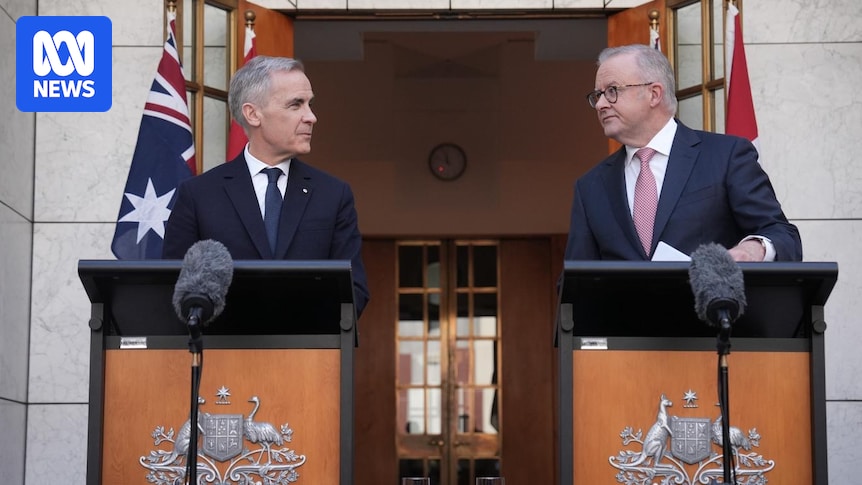
And when Canadian Prime Minister Mark Carney visited Australia last week, for the first bilateral visit of a Canadian PM to Australia in nearly two decades, he had a message about Australia’s and Canada’s shared values.
He said our values were worth defending, and they could be used to build a more prosperous and just future from the wreckage of the current moment.
What is Carney’s proposal?
Mr Carney warned Australians that if we tied ourselves too closely to a single hegemonic power, it would reduce our ability to control our own destiny.
He said Australia and Canada, as middle powers, should start working much more closely together to navigate the breakdown of the old global order.
Is this what AUKUS looks like in practice?
“The question for middle powers like us is whether we establish the conventions and write the new rules that will determine our security and prosperity or let the hegemons increasingly dictate outcomes,” he said.
“In the new global environment, the ability to form effective coalitions is becoming a central strategic capability.”
He explained why Australia and Canada should invest more in each other’s economies, and work more closely on defence, intelligence, and trade, and he put a heavy emphasis on our similar values.
“We [both] believe that people everywhere deserve to live freely, to govern themselves, and to determine their own futures — and that these values are worth defending even at great cost,” he said.
A joint statement was issued by Mr Carney and Prime Minister Anthony Albanese on Thursday, detailing how they plan to strengthen Canada’s and Australia’s relationship in multiple areas.
Do we all share the same values?
But it’s worth thinking more deeply about that question of values.
Australia and Canada are already part of the Five Eyes intelligence-sharing alliance with the United States, the United Kingdom, and New Zealand.
The question no-one in my town can answer
Some Americans have recently been raising self-critical questions about the durability of that alliance, given America’s behaviour in recent years, and there have been reports that senior figures in the Trump administration have wanted to kick Canada out of the alliance.
But is anyone willing to bet that the Five Eyes alliance will dissolve?
Pine Gap, the secretive joint Australia-United States satellite surveillance base in Alice Springs, plays a key role in US global surveillance and in supporting US military operations around the world, including drone strikes.
In recent years it has significantly increased its capabilities “to assist a US strike on China,” without Australians being told about it, as investigative journalist Peter Cronau has reported.
Protesters in the Northern Territory have also been trying to draw attention to the role that Pine Gap may have played in America’s and Israel’s relentless bombing of Palestinians in Gaza for the past two and a half years.
But is anyone willing to bet that Australia will sever its security relationship with the US and close Pine Gap?
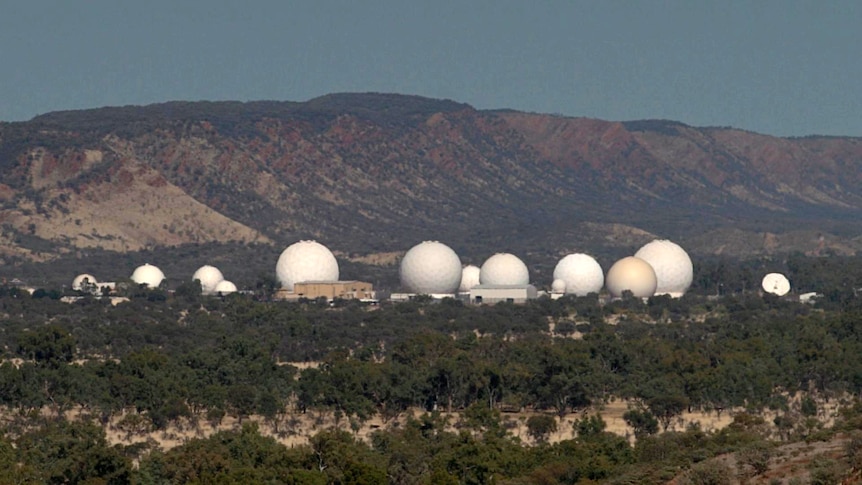
Pine Gap, the joint US and Australian spy base near Alice Springs. (Four Corners)
If countries insist on working with each other through thick and thin, regardless of how any of them behave, they’re demonstrating that they share similar values, aren’t they?
Either that, or they’re signalling that they’re willing to discard their professed values to maintain their relationships for other reasons, so they value having flexible values.
Let’s form a union to fight the fascists
Mr Carney’s attempt to convince middle powers to form new alliances to counter the destructive behaviour of regional hegemons today is reminiscent of an earlier time.
As with so many events in this era, it has parallels with the 1930s and 1940s.
In one of George Orwell’s lesser known essays (it had a deliberately provocative title, which I apologise for), which was published months before the outbreak of World War II in 1939, Orwell wrote about a proposal from an American journalist who said that the democracies of that era ought to form a hard union to “gang up against the dictatorships”.
George Orwell and the “native decency of the common man”
The journalist’s name was Clarence K. Streit. The title of his book that contained the proposal was Union Now.
Mr Streit’s proposal was far more radical than anything Mr Carney is proposing today.
He suggested that democratic nations in the 1940s should form a union with a common government, common money and complete internal free trade.
“The initial 15 states are, of course, the USA, France, Great Britain, the self-governing dominions of the British Empire, and the smaller European democracies, not including Czechoslovakia, which still existed when the book was written,” Orwell wrote.
“Later, other states could be admitted to the Union when and if they ‘proved themselves worthy’. It is implied all along that the state of peace and prosperity existing within the Union would be so enviable that everyone else would soon be pining to join it,” he wrote.
Orwell thought the scheme wouldn’t work. But he said it was worth interrogating because it revealed a lot about the values of people like Mr Streit.
“What it smells of, as usual, is hypocrisy and self-righteousness,” Orwell wrote.
“Like everyone of his school of thought, Mr Streit has coolly lumped the huge British and French empires — in essence nothing but mechanisms for exploiting cheap coloured labour — under the heading of democracies!
“Here and there in the book, though not often, there are references to the ‘dependencies’ of the democratic states. ‘Dependencies’ means subject races. It is explained that they are to go on being dependencies, that their resources are to be pooled among the states of the Union, and that their coloured inhabitants will lack the right to vote in Union affairs.
“Except where the tables of statistics bring it out, one would never for a moment guess what numbers of human beings are involved.
“India, for instance, which contains more inhabitants than the whole of the ‘fifteen democracies’ put together, gets just a page and a half in Mr Streit’s book, and that merely to explain that as India is not yet fit for self-government the status quo must continue.
“And here one begins to see what would really be happening if Mr Streit’s scheme were put into operation.
“The British and French empires, with their six hundred million disenfranchised human beings, would simply be receiving fresh police forces; the huge strength of the USA would be behind the robbery of India and Africa.
“Mr Streit is letting cats out of bags, but all phrases like ‘Peace Bloc’, ‘Peace Front’, etc contain some such implication; all imply a tightening-up of the existing structure.”
Orwell then reminded his readers that everyone in England lived on the proceeds of what occurred in name of the British empire, and it wasn’t decent to talk about it — especially then, when every effort had be put towards fighting fascism.
Values in theory, values in practice
Again, one is not saying that Mr Carney’s proposal today is anything like Mr Streit’s proposal from 87 years ago.
But Orwell’s insistence on interrogating the quiet values that are buried in different policy proposals remains relevant.
What values does Australia claim to believe in today? Are those values reflected in our actions and policies?
Police watchdog to probe violent clashes during Sydney protest
In its World Report 2026, Human Rights Watch noted what Australia has been getting up to recently.
“In January [2025], the United Nations Human Rights Committee found Australia remained responsible for violations against asylum seekers transferred to Nauru,” it said.
“Protest rights are increasingly under threat, with protesters risking criminalisation including fines and imprisonment. Climate protesters often face arrest.
“First Nations children are over 12 times more likely than other children to be separated from their families by child protection authorities.
“Australia has reiterated its support for international law, but has been inconsistent.”
Does Australia share those values with Canada?