
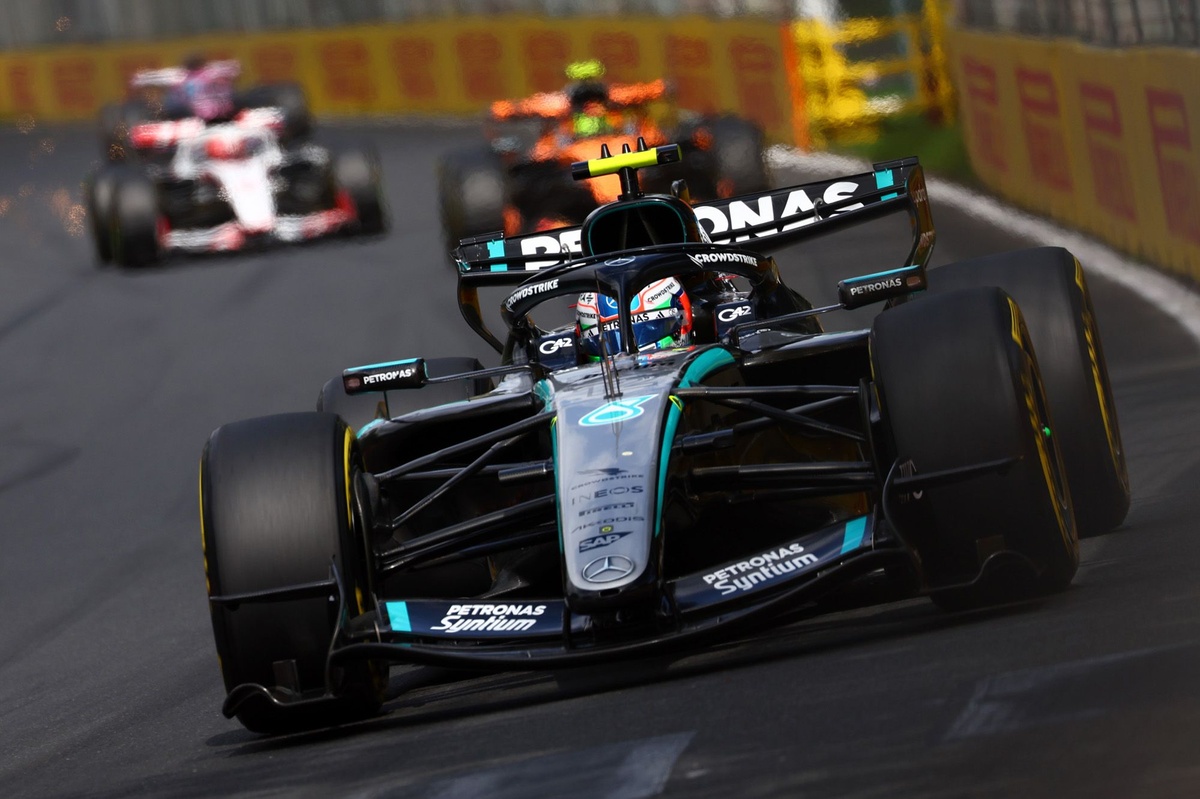
After the season opener in Melbourne, besides the complaints about the regulations, the discussions mainly centred around one other aspect: Mercedes finally showing its real strength. Toto Wolff said after George Russell’s victory that his team still “has a fight on our hands” with Ferrari, but under the radar there are several signals that Mercedes stood well above the rest at Albert Park.
The opening phase was probably closer than anticipated, but that had to do with the nature of the regulations as well. It has become a matter of yo-yoing in terms of energy management: if a driver overtakes an opponent, they often pay a price for it on the straights that follow, which makes the chance of being countered higher than ever before.
That is exactly why Lando Norris called the racing “even worse” than qualifying and added that it was “way too artificial” in his view. A second effect is that even with more pace in hand it is difficult to break free. Once Mercedes had clean air, the real advantage began to show – especially when Russell, after Ferrari’s pitstop, was still setting faster lap times on older tyres.
Read Also:
Mercedes is the benchmark and a key part of that lies in its very efficient energy deployment. This was already evident on Saturday when analysing the qualifying laps. In a direct comparison between Russell’s pole lap and the fastest qualifying lap from McLaren – set by Oscar Piastri – the GPS traces show that Mercedes was faster in almost every corner.
Normally a driver would pay a price for that on the straights, but that was not the case with Mercedes – and that is precisely where a key strength lies. Russell may not have been extremely high in the FIA speed traps, but across the board he still gained a lot of time on McLaren on the straights.
The difference was mainly made on the straight towards Turn 6 and in the section towards Turn 9. The way both things are connected is telling. Towards Turn 6, Piastri lifted off earlier, which can be seen in the image below. Russell stayed flat out for longer, which would normally result in less harvesting. Normally the Mercedes driver should have paid a price for that on the full-throttle section towards Turn 9, but the exact opposite happened. The delta time actually increased there and Piastri switched to super clipping considerably earlier than Russell.
It says a lot about the advantage Mercedes has over all its customer teams in terms of efficiency. The German manufacturer is faster in the corners, but still manages to recover enough energy – also partly by choosing lower gears more frequently – to not lose out on the straights, or in fact even gain speed compared to its rivals.
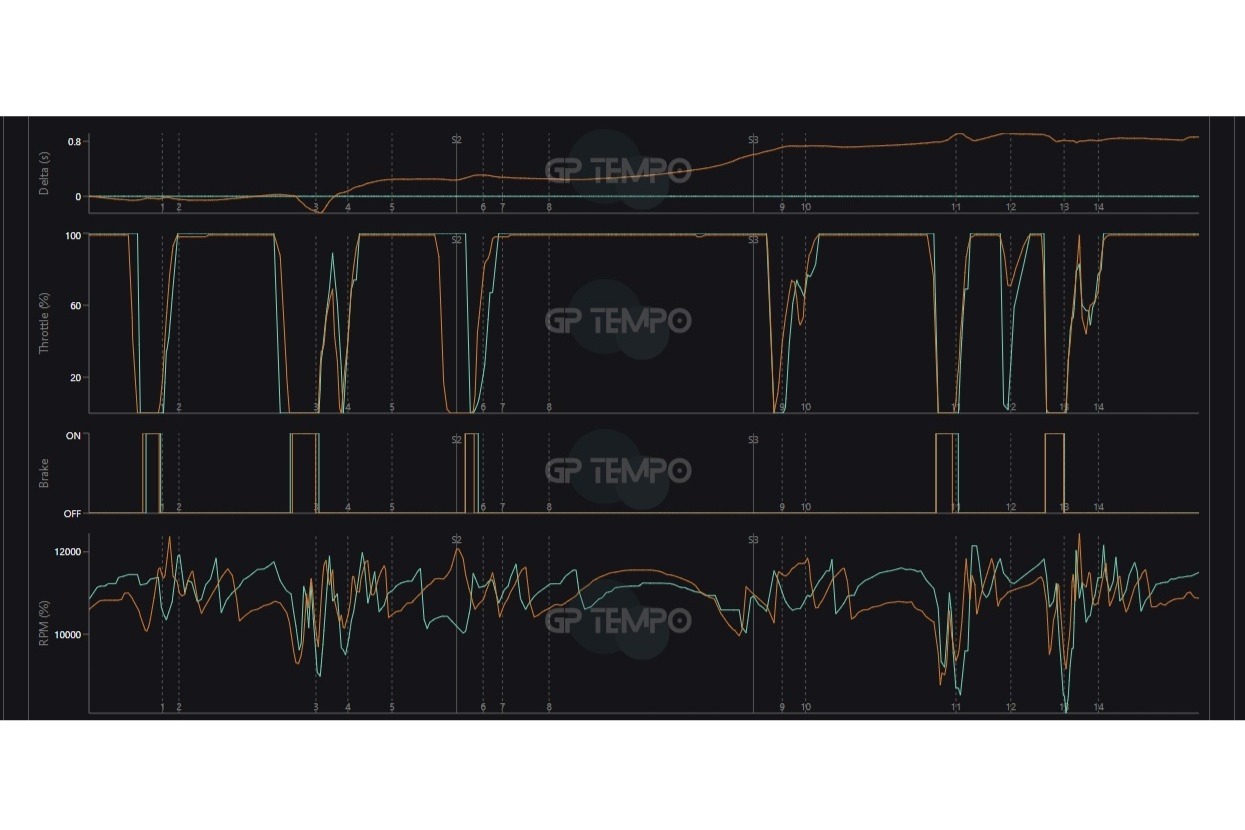
GPS data comparison between Russell and Piastri from Australian GP qualifying
Photo by: GP Tempo
More learning for customers after spec differences during testing
The question is how Mercedes can be so much more efficient than its customer teams with essentially the same power unit. Part of it may lie in the chassis and aerodynamic package, but that certainly does not tell the whole story. A more important point lies in how much more Mercedes can extract from the all-new power unit in terms of energy deployment.
“I can say that we spent a lot of time looking at several overlays, in particular Mercedes, but also to other competitors,” McLaren team principal Andrea Stella said after the race in Melbourne. “And definitely, the result of this analysis seemed to indicate that we have work to do as a team in collaboration with our HPP engineers. We have work to do to exploit the potential of the power unit, which, once I see the potential that HPP is extracting, looks like there’s more that is available.
“Now, it’s not obvious how you do that. For us, we are in a journey of knowledge. Probably, or maybe I should say certainly, a journey that is earlier than the works team. The works team and HPP will have worked together for a long time, so they will have collaborated, talked about how to use the power unit. That’s fair enough. But we’ll definitely intensify the collaboration with HPP because our understanding is that there is some low-hanging fruit that we should be able to cash in.”
Although that is to some extent the normal advantage of a works team, Stella believes there is more at play. The Mercedes customer teams ran with a different specification of the 2026 engine – more basic, also in terms of mappings – than the works team in Bahrain testing. Although that fully fell within the boundaries of the contractual obligations, it did mean that the works team could learn more about the actual package, while that did not apply to the customer teams.
“When it comes to ‘is this all that is available and are we underexploiting?’, I am not sure. I think we will need some more analysis to understand whether this is only about parameters that we can control or driver’s input that we can control, or that there are some other factors, more systemic, that not necessarily a customer team can control,” Stella added.
That last part is crucial, as Stella indicates that McLaren has not had everything in its own hands – simply based on what was available – and that the team now faces a steep learning curve. Acting based on what was available is twofold: the specific preparation in terms of energy deployment for the Albert Park circuit and also the overall car development.
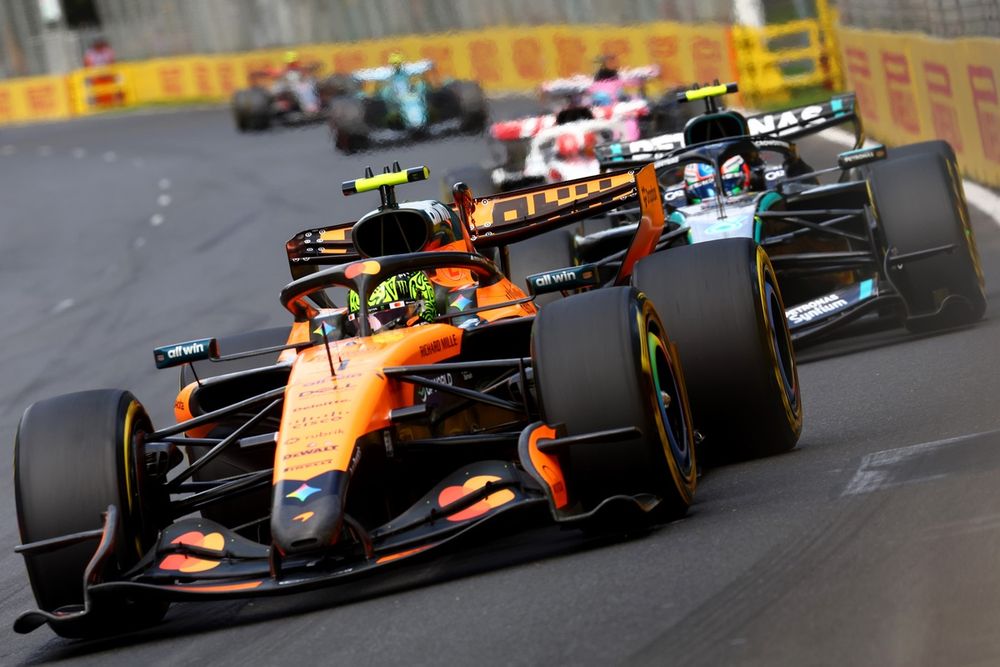
Lando Norris, McLaren, Andrea Kimi Antonelli, Mercedes
Photo by: Joe Portlock / Getty Images
Toto Wolff, however, made clear after the race that Mercedes has fulfilled all obligations and that it tries to serve its customers as well as it can, but that the beginning of a new era is simply complex.
“I think it’s clear when you roll out new regulations, there’s so much to learn,” Wolff said. “Whether you have a customer that’s on your gearbox or suspension, and in the same way on the power units, the development slope is very steep and you can never deploy things to make everybody happy. But I think most important is we’re trying to provide a good service, and that’s always the way.”
Williams “a little bit shocked”: Mercedes has been smarter
James Vowles knows both sides of the coin like no other, from his time at the works Mercedes team to his partnership with the manufacturer as a customer team at Williams. Just like McLaren, he also said in Melbourne that he was surprised by the large difference between the factory team and its customer squads.
He said: “What Mercedes are doing on the power unit is something that caught us off guard. It took a qualifying for us to really see just how off the pace we are in that regard. That’s probably three tenths, something in that ballpark.”
However, he dismisses the suggestion that Mercedes would deliberately hold things back from its customers: “And I still maintain this, Mercedes are incredibly fair to customer teams. I stated this already: we have everything that they have access to. They have just been cleverer than we have, and it’s our job to get on top of it. I’m just a little bit shocked by how much more clever.”
Where Vowles talks about access, that does not apply to information on how to extract the maximum from the power unit, but according to the Williams team boss that is perfectly logical.
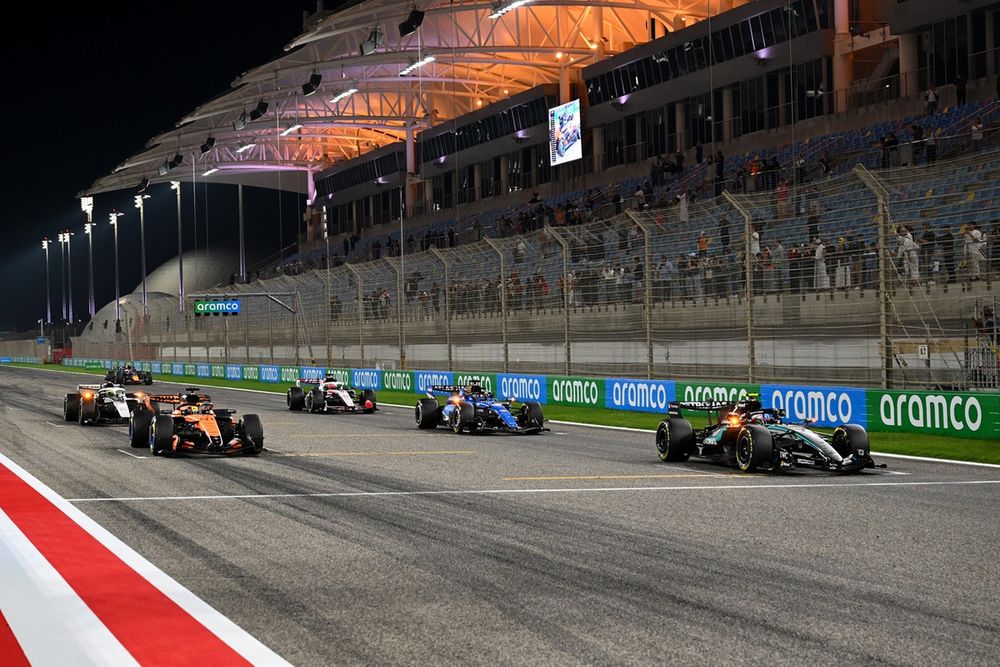
Oscar Piastri, McLaren, Andrea Kimi Antonelli, Mercedes, Esteban Ocon, Haas F1 Team, Alexander Albon, Williams, Sergio Perez, Cadillac Racing
Photo by: Mark Sutton / Formula 1 via Getty Images
“It is not an open door, as you would imagine, because that’s where the performance is found,” he said. “So it is down to us to try and work around it. But I would say we have to acknowledge we, as Williams, do not have the sophistication that they have in the level of technologies. And definitely that’s on us, that’s not on them.”
McLaren has no desire to follow the Red Bull route
In essence, it is – besides the packaging – another important disadvantage that customer teams have compared to a works team, especially with big rule changes. At the beginning of a new era this comes to the surface more than usual, although it does not immediately mean that McLaren is pursuing something different long-term – for example a structure such as Red Bull has created with its own engine project.
“We’re very happy with HPP. We won a couple championships while everyone was saying it was impossible to do it, so I think we proved that wrong,” Zak Brown said when asked whether McLaren might eventually be open to follow Red Bull’s path. “I’m very impressed with what Red Bull has done, but that’s not an inexpensive adventure they’ve gone on, but hats off to them.
“But I’m very happy where we are and focused on the moment. If an opportunity arose, we would look at it but you can also see the downside of not getting it right.”
With Mercedes, the customer teams know they will get a competitive power unit – something that has been confirmed in Melbourne. At the same time, the race weekend Down Under has also shown some disadvantages of that dependency. The roles in the competitive order have now been reversed compared to recent years, something Wolff – after several years of being beaten by a customer team – will certainly not mind.
We want to hear from you!
Let us know what you would like to see from us in the future.
– The Autosport.com Team