
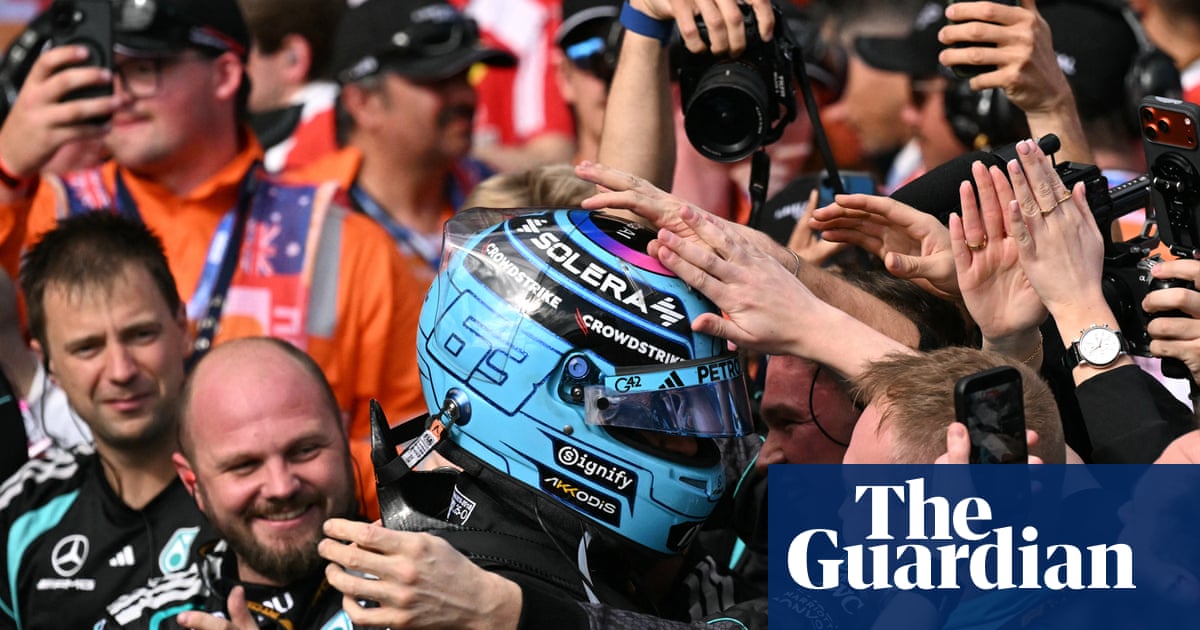
Formula One’s brave new world opened in Melbourne with at least something of a bang, doubtless to the relief of many who had considered its bold new era was destined for a whimper.
Yet the verdict from Albert Park was that the sport has work to do if it is to head off the distinctly troublesome spectacle of some of F1’s leading protagonists proclaiming they are rather unhappy with its new direction.
The ultimate result, a controlled and assured win for George Russell in the Mercedes which confirmed his car is the class of the field, was largely expected. Ferrari brought a feisty scrap to the fray, though, which suggests there is drama yet to come this season – allied to the inevitable questions over the Scuderia’s decision-making.
Equally there was a sense that the new rules, for all the derision heaped upon them over the weekend, may yet incline to a flair for the dramatic, even amid a mixed bag of responses – the whimper of discontent – from drivers.
The Ferrari team principal, Fred Vasseur, declared the opening 12 laps offered more fun than he had seen in F1 for a decade. His leading man, Charles Leclerc, went wheel‑to‑wheel with Russell, the pair doing a roaring trade for the lead as they deployed the new overtake mode. Russell highlighted what he considered a tactical fight in how the pair were able to come back at one another. He would say that, of course. The driver in the championship‑leading car will hold closely the rulebook his team have mastered.
Yet several drivers, including the defending world champion, Lando Norris, who finished fifth, complained the system was artificial as positions were exchanged repeatedly according to how they deployed their energy, and he damningly warned that the new formula meant a serious accident was waiting to happen.
“Depending on what drivers do, you can have closing speeds of 30-50kph, and when someone hits another driver at that speed, you are going to fly and go over the fence and do a lot of damage to yourself,” Norris said after the race. Norris’s teammate at McLaren, Oscar Piastri, endured an even more torrid day: the local favourite crashed out on the formation lap to the dismay of the crowd.
Perhaps it was inevitable that opinions would differ wildly and, to be fair, casting judgment one race into the new season would be premature.
Melbourne is an outlier of a circuit in energy management terms – a phrase that for all its clumsy, unappealing connotations towards flat-out racing is one to which we must become accustomed this season. The next round in Shanghai will present an altogether different proposition, as indeed will most of these opening weeks. Certainly there is a debate to be had but on this evidence it is too early for definitively formed conclusions.
At least now the process has begun. The buildup to the new season, with the biggest regulations change in the sport’s history covering both chassis and engine, and mandating an almost 50‑50 split in power from the internal combustion engine and electrical energy, had lasted a seemingly interminable age. To finally have the 22 cars on track to settle it came with something of a collective exhalation across the paddock. Finally the business end of F1, actually going racing, was here.
One thing at least was confirmed: Mercedes are the class of the field. Russell won with a commanding drive from the front of the grid and, with his teammate Kimi Antonelli in second, secured a strong one‑two for the team. This followed the form guide but while Mercedes did have a fair advantage, it was not quite as overwhelming as many predicted. After making blistering starts, Leclerc and Lewis Hamilton went wheel‑to‑wheel with them to thrilling effect before finishing third and fourth for the Scuderia.
George Russell (centre) battles with the Ferraris of Charles Leclerc and Lewis Hamilton in a dramatic early tussle. Photograph: Asanka Brendon Ratnayake/AP
Coming on the back of a dominant performance in qualifying, in which Russell was the best part of a second in front of Mercedes’ rivals, it demonstrates their car looks to be the complete package. It is well balanced, stable and has Russell purring, while the Mercedes engine is clearly delivering no shortage of horses. Crucially, within the strictures of said energy management that now plays such a central role, it is also proving the most efficient at the harvesting and deployment of the electrical element.
Indeed, much as Ferrari vied in the early stages, Leclerc and Vasseur accepted they could still not match Mercedes for overall race pace. Yet Russell was made to fight for it after Leclerc made a blistering start from fourth to claim the lead through the first corner. Ferrari’s form off the grid, demonstrated in pre-season testing, was put to extraordinary use when it mattered.
The pair then went toe‑to‑toe, changing places a gripping six times in nine laps as this new dark art of how and when to deploy limited electrical power played its part. The decisive moment came when Isack Hadjar had to retire on lap 12 and a virtual safety car was called. Both Mercedes cars pitted a lap later, looking for clear air while Ferrari stayed out, despite Hamilton’s protestations that one of them should have taken a stop.
It was key and when Hamilton and Leclerc did stop, Russell and Antonelli had a lead from which they could not be caught. Perhaps ultimately it was moot but if Ferrari are in the fray at the front – and their lightning starts suggests they will be there in the opening phase of many races – then not fumbling on the pit wall will be vital.
Russell, though, has opened his account with exactly the statement of intent he required,laying down a marker to match his status as favourite for the title. On this form and showing the calm assurance he has always promised, the Briton will be hard to beat, especially if Mercedes maintain this level of advantage.
“I am feeling incredible,” Russell said after his win. “It was a hell of a fight at the beginning. I had some really tight battles with Charles, so I was glad to cross the finish line. It’s been a long time coming to have this car beneath us.”
He may like to enjoy a somewhat less frenetic opening to forthcoming races but F1 must hope the arcane focus on the somewhat stultifying concept of just how and when the battery lets the loud pedal roar, at least keeps some wheel-banging in the equation, as it did in Melbourne.
Max Verstappen delivered a typically determined comeback drive to claim sixth place from 20th on the grid for Red Bull and there was a striking debut for the British rookie Arvid Lindblad who was eighth for Racing Bulls, to take points on his F1 debut.
For Aston Martin, what has been a disastrous opening to the season could not end soon enough. Fernando Alonso failed to reach the flag while Lance Stroll did finish the race, but was 15 laps back and not classified. There is no quick fix expected and the team are likely to struggle for some time with an engine that has a fundamental vibration issue and is also underpowered and unreliable.
Quick GuideAustralian GP: race resultShow
1 George Russell (GB) Mercedes
2 Andrea Kimi Antonelli (It) Mercedes
3 Charles Leclerc (Mon) Ferrari
4 Lewis Hamilton (GB) Ferrari
5 Lando Norris (GB) McLaren
6 Max Verstappen (Neth) Red Bull
7 Oliver Bearman (GB) Haas
8 Arvid Lindblad (GB) Racing Bulls
9 Gabriel Bortoleto (Bra) Audi
10 Pierre Gasly (Fr) Alpine
11 Esteban Ocon (Fr) Haas
12 Alexander Albon (Thai) Williams
13 Liam Lawson (NZ) RB
14 Franco Colapinto (Arg) Alpine
15 Carlos Sainz Jr (Sp) Williams
16 Sergio Pérez (Mex)
Not classified: Lance Stroll (Can) Aston Martin 43 laps; Fernando Alonso (Sp) Aston Martin 21 laps; Valtteri Bottas (Fin) Cadillac 15 laps; Isack Hadjar (Fr) Red Bull 10 laps.
DNS: Oscar Piastri (Aus) McLaren, Nico Hulkenberg (Ger) Audi.
Thank you for your feedback.
Cadillac marked their F1 debut by achieving their opening target, getting a car to the finish line with Sergio Pérez in 16th. Having built the team from scratch in little more than 12 months, it was an impressive achievement. Pérez was three laps off the lead at the close but have started with a solid foundation on which to build.
Audi also did well on their F1 debut, given they are manufacturing their own engines and having taken over the former Sauber team this year, with Gabriel Bortoleto taking points in ninth place.