
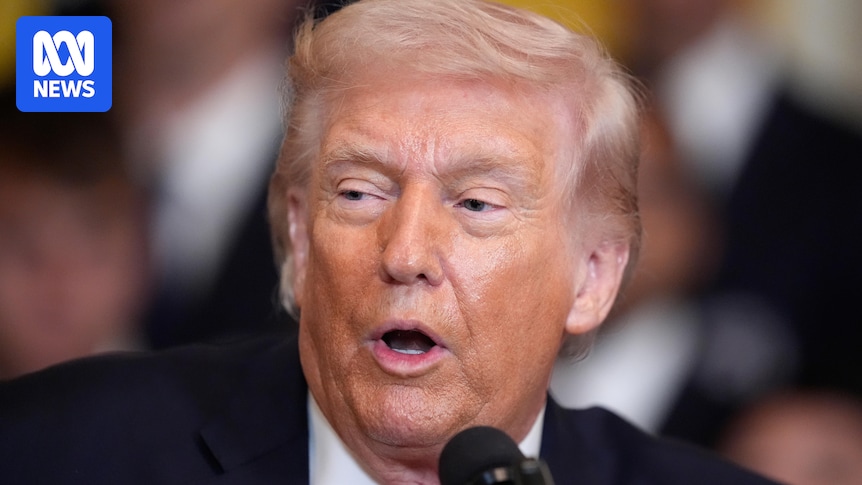
The oil price surged to $US91 a barrel over the weekend, after the energy minister of Qatar, Saad al-Kaabi, declared that Gulf countries would shut down all energy exports within days and predicted that oil would rise to $US150 a barrel.
Last week, Qatar declared force majeure (that is, a contract is voided by an extraordinary event) on its LNG exports, and al-Kaabi said all Gulf states would have to do the same very soon, adding that this would “bring down the economies of the world”.
Iran war live updates: For the latest news on the Middle East crisis read our blog.
But apart from a 40 per cent rise in the price of oil since February 28, global markets have been remarkably calm since the US and Israel attacked Iran, much calmer than after US President Trump announced tariffs last year or Russia invaded Ukraine in 2022.
Maybe that will change this week, but the insouciance seems to be based on the idea that Trump’s foreign policy is fundamentally transactional, so this war won’t last long because there will be a deal. There is always a deal.
It’s a hangover from last year’s so-called TACO trade (“Trump Always Chickens Out”), when tariffs were quickly negotiated away or unilaterally reversed.
This completely misses the point, or rather, a few points.
Loading…The problem of insurance
Even if the Gulf countries don’t all declare force majeure, the closure of the Straits of Hormuz is already a systemic risk to the global economy.
The problem is insurance, not Iranian mines. The cost of insurance for a ship travelling out of the Persian Gulf has become prohibitive or is simply unavailable.
The Trump administration has announced a $US20 billion reinsurance program through the US Development Finance Corporation to cover war-risk losses for vessels in the Persian Gulf, but JPMorgan estimates the total risk exposure for Gulf maritime trade at $US352 billion, an estimate the US Treasury secretary disputes.
The hidden forces driving Trump’s attack on Iran
A ship without insurance can’t satisfy the covenants in its finance agreements or the terms of its charter contract, no matter how many warships or minesweepers are protecting it.
So, the Gulf is likely to remain closed for as long as the conflict continues, and that doesn’t just prevent 20 per cent of the world’s oil from reaching markets, but also LNG, plastics and fertiliser, whose global supply chains are tight and brittle.
And this war could well be more like Iraq and Afghanistan than the recent, quick operation in Venezuela when the US military snatched President Nicolas Maduro.
LoadingA battle between ‘good and evil’
For a start, while the Trump administration says it wants the people of Iran to rise up and replace the Islamic government of Iran with a pro-Western democracy, indiscriminately bombing civilians doesn’t seem the ideal way to go about it.
And Iranian people probably haven’t forgotten that it was the CIA, with Britain’s MI6, that snuffed out their democracy in 1953 by organising a coup to replace the elected prime minister, Mohammed Mossadegh.
A report by the National Intelligence Council before the attacks on Iran assessed that even a large-scale military assault on the country would be unlikely to topple its theocratic government.
But more fundamentally, this conflict is being run to some extent by extreme adherents of three of the world’s great religions — Islam, Christianity and Judaism — who happen to be in charge of Iran, the US and Israel, and they see it as some kind of battle between good and evil.
Both Israeli PM Benjamin Netanyahu and Trump have repeatedly described the Iranian regime as “evil”, and Iran’s leaders have been labelling the US the “Great Satan” since 1979 and the Zionists as evil.
Trump posted on Truth Social on Friday: “There will be no deal with Iran except UNCONDITIONAL SURRENDER!”
Market reaction to that was: “Yeah, sure, of course there’ll be a deal — there always is with Trump.”
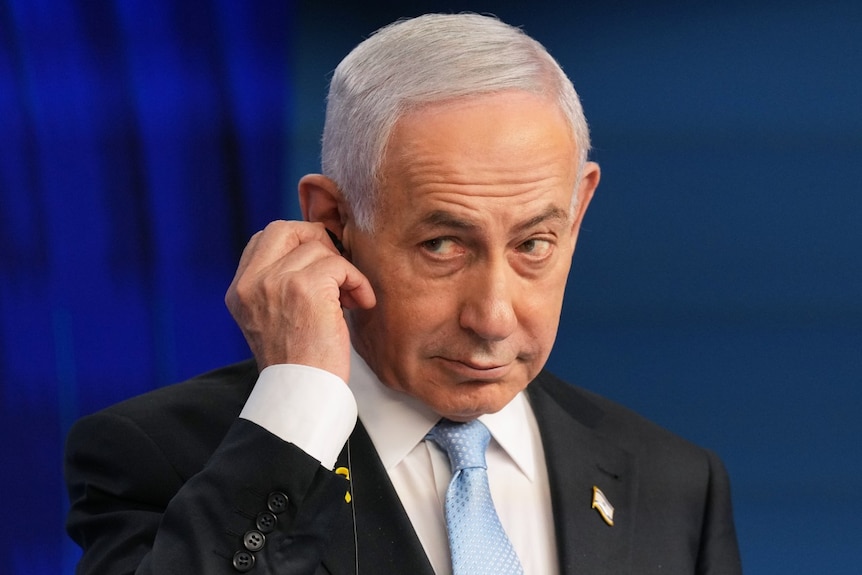
Benjamin Netanyahu says that Israel, alongside the US, will continue hitting Iran “with all our force”. (AP: Ariel Schalit)
When religion meets warfare
An about-face is always possible with Trump, of course, and he is the final decision-maker, but there is a lot more going on here than there was with the transactional trade-based geopolitics of tariffs.
Over the weekend, a video went viral of Trump sitting at his desk, apparently on Friday, head solemnly bowed, while a crowd of evangelical Christians stood around him, with their hands on him, praying for success in Iran.
Trump promised peace but launched nine foreign military actions
And a religious freedom complaint was lodged by some soldiers last week after US commanders allegedly told them that “President Trump has been anointed by Jesus to light the signal fire in Iran to cause Armageddon and mark his return to Earth.”
The encroachment of religion into politics and warfare in the US has been slow and deliberate, starting with the Supreme Court decision in Roe V Wade in 1973, legalising abortion.
That galvanised evangelical Christians into a long-term project to overturn it, which eventually came to fruition in June 2022 after Trump shifted the make-up of the Supreme Court in his first term.
The use of Trump to carry out the evangelical project in the US has a name: “vessel theology”, which allows evangelicals and Christian nationalists to support Trump despite allegations of his past sexual misconduct and adultery.
America’s first “born-again Christian” president was Jimmy Carter, who was in power when Iran became a theocratic Islamic Republic in 1979, leading to the second oil shock of the 70s and the hostage crisis of 444 days of captivity for 67 American embassy staff that destroyed his presidency and brought the Republicans’ Ronald Reagan to power.
Read more about the Iran war:
In Israel, the rise of extreme religious nationalism was also gradual, starting with the Six-Day War in 1967, which produced the Gush Emunim orthodox Jewish settler movement, and then the Labour Party’s loss at the 1977 election to Menachem Begin and the right-wing Likud party.
Since 2022, prime minister Netanyahu’s government has relied on a coalition of right-wing and ultra-Orthodox parties to maintain power.
LoadingThe 1979 Iranian Revolution
The revolution in Iran was motivated principally by economic and class grievances against the monarchy, as in the Russian and French revolutions, but, as in Russia, it resulted in long-term political control by the Shariah equivalent of Marxist-Leninists.
And ironically, the new constitution that the leader of that revolution, Ayatollah Khomeini, imposed on Iran in 1979 may have helped to motivate the preparation for Trump’s second presidency.
It was contained in a document called Project 2025, in which a key part was the idea of “Unitary Executive Theory”, which asserts that all power resides in the president.
Loading…
It is the basis of his refusal to seek congressional approval for either the tariffs or the attack on Iran.
Khomeini’s book, Islamic Government, compiled from a series of lectures he gave in exile in Iraq in 1970, set out what he called “Velayat-e Faqih” (Guardianship of the Jurist), which proposed that the Islamic religion should be central to politics, and that authority should be centralised in a single individual for efficiency and to prevent “interference” from other branches of government.
Khomeini’s ideas were codified into a new 1979 Iranian constitution, Article 57 of which explicitly subordinates the three branches of government — the legislature, the executive, and the judiciary — under the “Absolute Wilayat and Leadership of the Ummah (the Muslim community)” — that is, the dictatorship of the ayatollah.
Expert analysis on the Middle East:
What Americans are now learning is that although their constitution is secular, not religious like Iran’s, supposedly with “checks and balances”, it gives the president almost monarchical powers if he chooses to use them when there is also a supine Congress and Supreme Court.
Even if the US and Israel are able, with bombs from a distance, to destroy all vestiges of the Iranian government and the Revolutionary Guard, the leadership vacuum is more likely to result in chaos than any kind of smooth transition back to the kind of democracy that existed before the CIA coup in 1953 ushered in the tyranny of the Shah.
None of this feels quick.
Alan Kohler is a finance presenter and columnist on ABC News, and he also writes for Intelligent Investor.
Loading…