
A strip of cool water stretches west from South America along the equator, helping set the pace for some of the planet’s most important weather swings. That Pacific “cold tongue” helps steer the El Niño-Southern Oscillation, or ENSO, which can influence winter rain in California, drought in parts of Asia, and weather across much of North America.
Now, a model-based study suggests that one overlooked force helps drive that cold tongue’s yearly cycle: the changing distance between Earth and the sun.
That idea may sound odd at first, since the seasons are usually explained by Earth’s axial tilt, not by the slight oval shape of its orbit.
Yet the new work, published in Nature, argues that this distance effect is not a small side note in the eastern equatorial Pacific. Instead, it appears to create its own annual cycle, one that combines with the better-known tilt effect and changes the timing and strength of the cold tongue over very long stretches of time.
Schematic of the Earth’s orbital configuration. The Earth’s orbit around the Sun (marked S) is elliptical with the Sun at one focal point and with the closest approach at perihelion (at a distance rp) and furthest at aphelion (ra). (CREDIT: Nature) A second clock in the Pacific
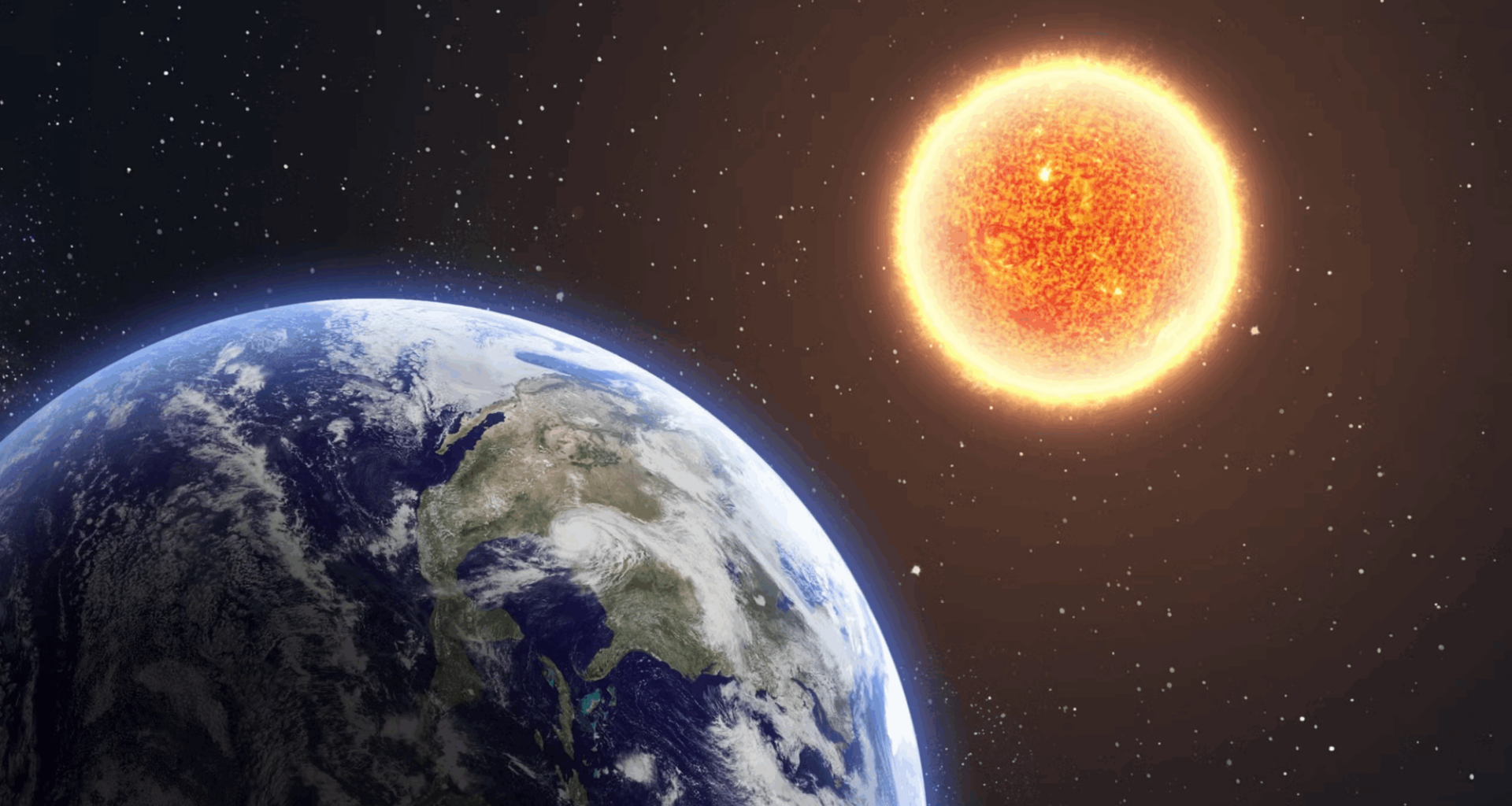
Currently, Earth is about 3 million miles closer to the sun at perihelion than at aphelion. That means sunlight is roughly 7% stronger at the closer point in the orbit. According to the study, that shift affects the cold tongue in a way climate scientists had not fully recognized.
“The curious thing is that the annual cycle from the distance effect is slightly longer than that for tilt, around 25 minutes, currently, so over a span of about 11,000 years, the two annual cycles go from being in phase to out of phase, and the net seasonality undergoes a remarkable change, as a result,” Chiang said.
That mismatch matters because the cold tongue is tied closely to ENSO. Alyssa Atwood, a former UC Berkeley postdoctoral fellow who is now an assistant professor at Florida State University, said the cold tongue’s seasonal cycle helps control how ENSO events grow and fade.
“Theory tells us that the seasonal cycle of the cold tongue plays a key role in the development and termination of ENSO events,” Atwood said. “Because of this, many of ENSO’s key characteristics are synced to the seasonal cycle.”
ENSO events usually peak during Northern Hemisphere winter and often fade by spring, a period scientists call the spring predictability barrier. If the cold tongue’s seasonal timing shifts, the study suggests, ENSO could shift with it.
As Earth gets closer to the sun in its elliptical orbit, the continent-dominated hemisphere (right) heats up more than the ocean-dominated or ‘marine’ hemisphere (left), generating trade winds that affect the Pacific cold tongue and likely the El Niño/La Niña cycle that determines whether California gets rain or drought. (CREDIT: UC Berkeley) What the models found
The team examined simulations from four climate models and found a consistent pattern. When orbital eccentricity was introduced, the cold tongue behaved as if it were responding to two annual cycles at once: one linked to Earth’s tilt and another linked to Earth-sun distance.
In their analysis, the distance effect was already substantial. At today’s eccentricity, its influence on the cold tongue was about one-third as strong as the tilt effect. Under more elliptical past orbits, the paper says, the distance effect could become as large as or larger than the tilt effect.
About 6,000 years ago, Chiang said, the two effects would have canceled one another enough to produce a muted annual cycle in the cold tongue. Today they reinforce each other.
The study also traced how this happens. Instead of warming the Northern and Southern hemispheres differently, as axial tilt does, changes in Earth-sun distance appear to produce an east-west contrast. The eastern “continental hemisphere,” dominated by the Americas, Africa and Eurasia, responds differently than the Pacific-dominated “marine hemisphere.”
That contrast shifts winds in the western equatorial Pacific. Those wind changes then travel east through thermocline changes, helping shape the cold tongue.
“The traditional way of thinking about monsoons is that the Northern Hemisphere warms up relative to the Southern Hemisphere, generating winds onto land that bring monsoon rains,” Chiang said. “But here, we’re actually talking about east-west, not north-south, temperature differences that cause the winds.”
Modern-day observed Pacific cold tongue annual cycle. SST averaged over 6°S–6°N, showing the cold tongue annual cycle with the cold peak in boreal fall and warm peak in boreal spring. (CREDIT: Nature) Why scientists are paying attention now
Anthony Broccoli of Rutgers University said the findings add nuance to a lesson most people learn early.
“We learn in science classes as early as grade school that the seasons are caused by the tilt of Earth’s axis,” Broccoli said. “This is certainly true and has been well understood for centuries. Although the effect of the Earth-sun distance has also been recognized, our study indicates that this ‘distance effect’ may be a more important effect on climate than had been recognized previously.”
Still, the authors are careful not to overstate the result. Chiang emphasized that the work is based entirely on climate model simulations, not direct observations.
“This study is purely model based. So, it is a prediction,” he said.
That is one major limitation. Another is that while the cold tongue response appeared robust across models, Atwood noted that ENSO changes themselves remain model-dependent. The team did not directly test what a full cancellation of the two cycles would do to global weather, and the authors said future work should examine how strongly the distance effect influences ENSO and whether other regions show similar behavior.
Even so, the findings open a new line of questioning for paleoclimate science. If Earth’s orbital precession changed the cold tongue’s seasonal rhythm over 22,000-year cycles, some past climate records may need a second look.
Research findings are available online in the journal Nature.
Related Stories