
We’ve painted ourselves into a corner on climate change — our planet is going to exceed 1.5 degrees Celsius of warming. And while greenhouse gas emissions aren’t rising as fast as they used to, we’re still emitting carbon dioxide at record-high levels, so further warming is inevitable.
Stopping Earth from heating up further demands effectively zeroing out everything we emit from burning fossil fuels. But at this rate, there’s no way around the fact that we have to go further: We must not just reduce carbon emissions, but pull carbon dioxide back out of the air. The latest comprehensive report from the United Nations’ body of climate scientists made it clear that every scenario that sees us escaping dangerous warming requires carbon capture.
It’s possible to wrench the thermostat back in the other direction and avoid the worst outcomes. It just requires the small matter of scaling up nascent technologies to a global scale and building an entirely new industry from scratch to pull upward of 9 billion metric tons of carbon dioxide from the air each year. No problem.
But there may be a solution to this that checks all the right boxes and very few of the bad ones: extracting carbon directly from the sea.
It gets around some of the squeamishness around geoengineering approaches like dimming the sky to cool the Earth since there’s nothing being added to the environment; just removing the waste that shouldn’t have been spewed so recklessly in the first place. In 2023, hundreds of scientists signed onto a letter calling for more research, development, and field-testing of ocean-based CO2 removal.

When carbon dioxide dissolves in the ocean, it can change the pH of the water to make it more acidic, harming marine life. Joel Reyero/picture alliance via Getty Images
It can also address another problem created by our gargantuan carbon emissions: ocean acidification. When carbon dioxide dissolves in water, it forms carbonic acid, which is slowly starting to shift the pH of the world’s oceans. That affects marine chemistry in ways we’re only beginning to understand, and can threaten sea life by dissolving the shells of tiny organisms that form the foundation of the ocean’s food pyramid. Pulling carbon out of the ocean can slow this down.
So two fish on one hook. Simple, right?
Of course not. “There are quite a lot of challenges, to be honest,” said Adam Yang, who studies ocean CO2 removal at Dalhousie University in Canada. “This whole field of marine carbon dioxide removal is quite new.”
Yet there are already companies working on the problem with new technologies who say there is a business here that is planet-saving and profitable. Later this year, one ocean CO2 capture company — Equatic — is planning to commission the largest marine CO2 removal plant in the world in Singapore. It will pull about 10 metric tons of carbon dioxide from the ocean every day. That’s a miniscule amount compared to the billions of tons of extraction needed, but it would provide a demonstration that the technology does indeed work.
The bigger question is whether this can turn into a viable business, especially in an era where international cooperation is breaking down and some of the largest greenhouse gas emitters are backing away from their climate change commitments. When it comes to carbon dioxide, can we finally create an industry out of withdrawing more than we deposit?
How ocean-based CO2 removal works
The notion of pulling carbon dioxide out of seawater makes a lot of sense if you look at the basic physics. Current carbon dioxide concentrations in the atmosphere are around 430 parts per million. Those are likely the highest levels humans have ever experienced.
Yet at the same time, 430 parts per million is only 0.04 percent of the atmosphere. Extracting one metric ton of carbon dioxide would require combing through 1.8 billion cubic meters of air. That’s the equivalent of 720 Olympic swimming pools. That requires a lot of scrubbers, a lot of energy, and thus a lot of money.
But because of how carbon dioxide reacts with water it’s about 150 times more concentrated in the sea than in the sky. About 30 percent of humanity’s carbon emissions are absorbed by the ocean. This gives us a huge leg up on collecting carbon compared to drawing it straight from the air.
“We’re focusing on direct removal because the capture step is the most expensive and most complicated part,” said Gaurav Sant, an engineering professor at UCLA and co-founder of Equatic, the company building the largest ocean CO2 removal system. (Sant also noted that what they’re doing is “removal,” not “capture,” because capture implies a step where you have to concentrate the CO2).
When you take carbon dioxide out of the water, Henry’s law means that removed carbon dioxide is replaced by more carbon dioxide from the air, said Steve Oldham, the CEO of Captura, another company developing a system to capture carbon dioxide from the ocean. So if you keep drawing CO2 out of the ocean, it will also draw down the greenhouse gas from the atmosphere.
Since the ocean covers two-thirds of the planet, there is massive surface area for this reaction to take place.
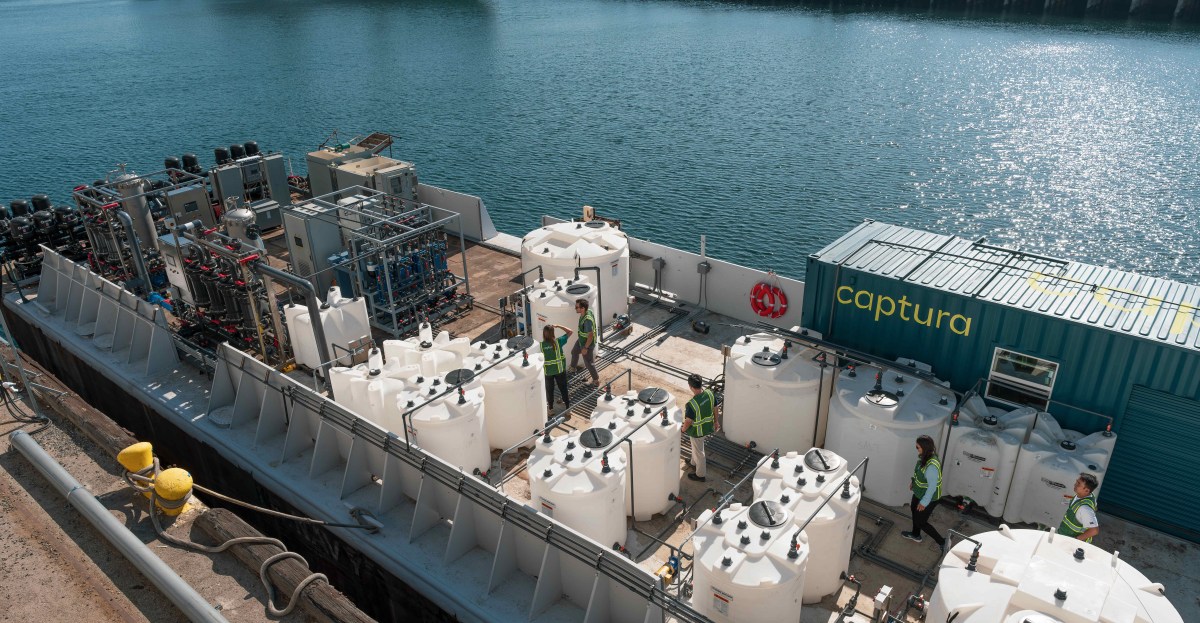
Their specific technologies are different, but both Captura and Equatic separate seawater into acids and bases to extract carbon dioxide and then recombine them to return neutral water back into the ocean. The water, now depleted of carbon and returned to the sea, can go on to soak up more CO2.
Oldham said that there are several key advantages to Captura’s system. One is that it generates its reaction chemicals from the ocean and returns them there; no extra chemicals are left in the water. The chemical process is in a closed loop.
Another benefit is that when their electrodialysis unit breaks down saltwater, it can store the elements for a while and run them back through the electrodialysis unit to generate electricity. Effectively, it’s a battery. That means the system can run on intermittent power, like from solar panels, and supplement its own electrons when necessary.
This is in contrast to other forms of marine carbon dioxide management techniques, like ocean alkalinity enhancement. This is where companies dump minerals into the ocean to make it more basic, raising its pH so it can absorb more carbon dioxide from the air. “If you have to add mountains of material into the ocean, it becomes hard to scale,” Oldham said. “We try to position ourselves differently.”
Captura currently has a pilot unit in Hawaii that they built in 70 days for less than $10 million. It extracts about 1,000 metric tons of carbon dioxide per year. Even if we could scale that up to a commercial level 500-kilotonne ocean-based CO2 capture plant, you’d need about 20,000 of those to remove 10 gigatonnes of global greenhouse gases.
On one hand, that doesn’t sound so far-fetched when you compare it to the scale of other industrial facilities. There are about 14,000 coal power plants and more than 100,000 wastewater treatment plants in the world. Mim Rahimi, an engineer at the University of Houston, noted that there’s already a lot of coastal infrastructure in many parts of the world to support shipping and oil and gas extraction. Ocean-based CO2 extraction can piggyback on the existing power grid, pipelines, and technical know-how in these areas, reducing some of the operating costs.
On the other hand, this is still a buildout of an entirely new sector based on a new technology at an extraordinary scale, and it needs to reach that in just a couple decades.
There are still some big technical and scientific obstacles too, starting with the sheer size of the ocean. It’s a big, complicated organism. Its composition shifts with the currents and the seasons, so extraction systems will have to adapt. Seawater is corrosive and full of living things that can readily foul machinery.
To ensure this is all carbon negative, the energy to power the system has to come from a source that itself doesn’t emit greenhouse gases. The captured carbon also has to be put to use or stored in a way that will prevent it from ever getting back into the atmosphere. And there’s so much about the ocean that we still don’t know. While electrochemical seawater carbon extraction is less invasive than some other marine carbon management ideas, we’ve never tried artificially removing carbon at scale and the full ripple effects are unclear.
Where does marine carbon removal fit into the climate toolkit?
While carbon-negative technologies will be essential for meeting our climate goals, we still have to do everything we can to curb greenhouse gases as much as possible first. This means decarbonizing power generation, driving, heating, and so on. But even then, there are still sectors of the economy with no easy route to zero greenhouse gases where it’s also difficult to capture them at the source, like air travel and shipping.
Captura’s Oldham said that leaves about 10 gigatonnes of emissions from these hard-to-abate sectors. It’s for these last remaining bits of emissions where carbon removal comes in.
But Equatic’s Sant said that if they get their costs down and performance up enough, CO2 removal could be an option for anyone looking to reduce their impact on the environment instead of just a last resort.
“If carbon management is cheap enough, indeed you go economywide,” Sant said. “You don’t create this tiered structure of saying we go after some things first and other things later.”
And marine CO2 removal will be one of many approaches we’ll need. Closing the gap on the remaining emissions will require a variety of systems like direct air capture, enhanced rock weathering, alkalinity enhancement, and so on. No one technology is going to have a monopoly, and given the scale of the problem, we need all the help we can get. But marine CO2 extraction does have a lot of advantages.
So how do you get someone to pay you to do this?
Carbon management is effectively a waste management problem, and we have business models for dealing with things like garbage and sewage. But history shows people only do this grudgingly, often long after a problem has become impossible to ignore. And right now, climate change is still pretty easy to ignore: carbon dioxide is an odorless, colorless gas that’s tricky to trace to its source whose effects are spread out across the planet.
“I think you could almost imagine if there was like a black cloud of carbon in front of your house, you would be like, ‘I need to get rid of this.’ And that just doesn’t happen,” said Jackson Somers, an economist studying the environment at the University of Connecticut. Absent regulations on carbon, if you want to get into the business of CO2 extraction, you need a customer who wants to compensate for their emissions, and right now, that’s a shallow pool.
The US, the world’s second-largest greenhouse gas emitter, is withdrawing from all things climate-related. There is still the 45Q tax credit that offers upward of $180 per metric ton of carbon dioxide captured from the air for facilities that begin construction before 2033. But marine CO2 removal is not eligible for this. Meanwhile, in the corporate world, the winds are blowing against environmental, social, and governance goals in the corporate world. “To be blunt, our timing is lousy,” said Captura’s Oldham.
Additionally, CO2 removal systems are decoupled from their sources — they’re not grabbing carbon where it is emitted, like with carbon capture and storage systems attached to power plants — so it requires a crediting mechanism to account for how much carbon is removed and where to send the bill. Carbon offsets, however, have earned some well-deserved skepticism after failing to deliver meaningful CO2 reductions.
So in order to function, marine carbon extraction companies will need iron-clad measurement, reporting, and verification of their CO2 removals, said Mai Bui, who studies carbon removal technologies at Supercritical, a firm that has developed a carbon removal market. While the market will set the price, the goalpost for CO2 removals is around $80 to $100 per metric ton.
There are some regulations that do encourage carbon removal at the moment. In several US states, the UK, and the European Union, there is a cap-and-trade policy system for limiting greenhouse gas emissions that would be able to use credits generated by extracting carbon from the ocean. Bui also noted that while political momentum around addressing climate change is weak, companies like airlines and shipping firms have to plan for decades ahead and are all too aware of how the political winds can change direction. They want to be ready for a world with more restrictions on carbon and are looking for any way they can to stay within their limits. In addition, Frontier, a consortium of companies including Google and JPMorgan Chase & Co, have pooled $1 billion to buy carbon removal credits to create a market signal for developers of removal technologies.
In the meantime, the CO2 extraction companies are also developing side hustles. Oldham said that Captura is licensing its electrodialysis system, which has a lot of other applications beyond CO2 capture, like desalination and lithium mining. Some companies might also pay to use the captured CO2 as a raw ingredient. Equatic’s Sant said the company is aiming to sell the hydrogen their system generates as an industrial chemical.
Despite the tough business and governmental environment, if marine CO2 extraction firms can survive the current moment and get their costs so low that investors want to get in on the ground floor before the pendulum swings back, then they could come out much stronger.
Whether this will work — as a technology at scale or as a viable business — is still unclear, and scientists are still learning what it would mean to reverse the damage to the climate since the dawn of the industrial revolution.
But we’re already in the middle of a giant uncontrolled planetary experiment on the effects of heat trapping gases. We must undertake a more thoughtful experiment on how we can avert the worst outcomes of a warming world. We know we will need something to withdraw CO2 from the biosphere, so we should probably get started.