
 Save
Save
You have reached your maximum number of saved items.
Remove items from your saved list to add more.
Save this article for later
Add articles to your saved list and come back to them anytime.
Got it
AAA
Whenever a new documentary surfaces about the Murdoch family, I always say a silent prayer: “Dear documentarians, please don’t resort to comparing the Murdoch family to the TV drama Succession, this lazy metaphor that has been flogged to within an inch of its life.” My prayers were answered as I settled in to watch Netflix’s new four-part factual series Dynasty: The Murdochs – but only for the first three minutes.
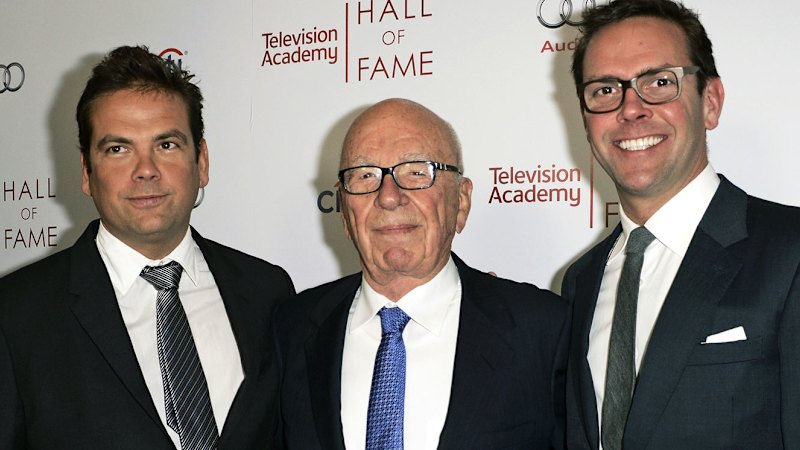
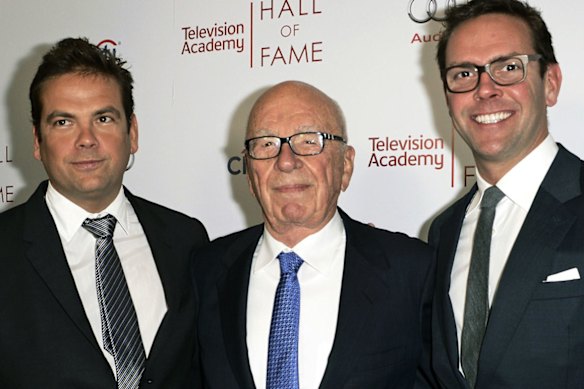 Happier times: Lachlan, Rupert and James Murdoch are central to this Netflix documentary.AP
Yep, you guessed it: “To explain the Murdochs, you have to understand the television show Succession on HBO,” said New York Times journalist Jim Rutenberg at 3.02 minutes in.
To be fair, Rutenberg apologised and explained how the Murdoch family all watched the drama about the fictional dysfunctional Roy family of media barons. A plotline in the series had prompted a worried memo that had set in train a chain of events culminating in the infamous Nevada courtroom showdown in December 2024 over the “irrevocable” family trust set up by nonagenarian Rupert Murdoch, whom Tina Brown once described as “the media world’s great white shark, with a slight trail of blood at the corner of his thin mouth”.
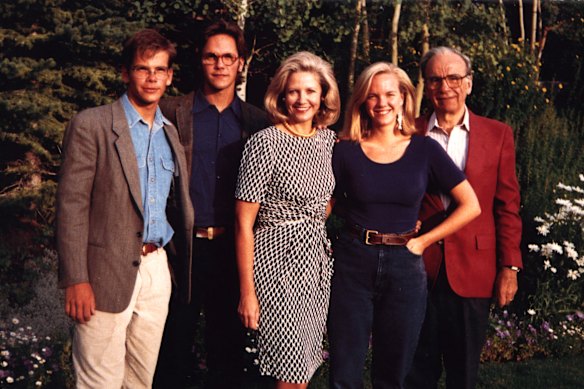 Rupert and Anna Murdoch with their children, (from left) Lachlan, James and Elisabeth, in 1992. OK, forget Succession, what’s it about?Related Article
This documentary by US filmmakers Liz Garbus and Sara Enright is all about that Murdoch family trust battle over Rupert’s successor, a battle prompted by the TV drama Succession, which itself was inspired by the decades-long jockeying for supremacy by Murdoch’s four eldest children Prudence, Elisabeth, Lachlan and James.
Just like the drama, this series is not the place for nuance. The Murdoch Dirty Digger Evil Empire worldview is given prominence and rarely challenged, with the program interviewing all the witnesses for the prosecution and barely any for the defence.
It follows on from reporting in The New York Times by Rutenberg and Jonathan Mahler, and The Atlantic magazine’s McKay Coppins, who wrote an astonishing authorised profile of James Murdoch that detailed the astonishing extent of family dysfunction over Rupert Murdoch’s plan to overturn the trust to favour Lachlan Murdoch’s accession.
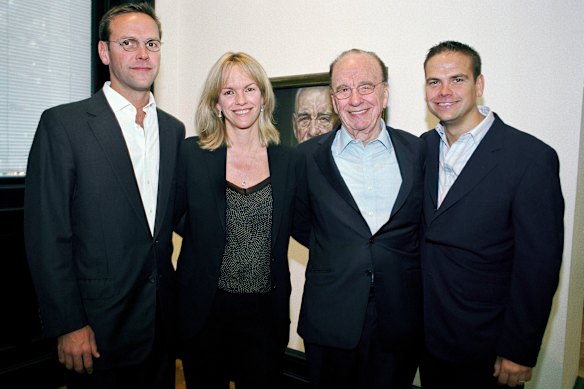 Rupert Murdoch is photographed with his children James, Elisabeth and Lachlan Murdoch at a private family gathering at London’s National Portrait Gallery in June 2007.GettyAre the Murdochs in it?
The Murdochs are rarely out of the news; Rupert Murdoch just celebrated his 95th birthday party in New York only hours ago. But interviews with the family are a rarity, which is a problem for modern documentary makers seeking to make a multipart series, such as the seven-part CNN effort The Murdoch’s Empire of Influence in 2022, the three-part 2020 BBC The Rise of the Murdoch Dynasty and the ABC’s three-part Australian Story series from 2024 Making Lachlan Murdoch.
Related Article
I am no Murdoch expert, but I realise I have obliquely encountered various Murdoch players in my working life. My first job out of university in the 1990s was as a copy boy delivering newspapers and magazines all around News Corp’s Sydney headquarters. Why Rupert Murdoch had to get sent copies of New Idea and Woman’s Day in New York, I have no idea. You could always tell when Murdoch snr was due in town for a visit – they put carpet in the lift from the carpark.
Lachlan Murdoch turned up to become publisher of The Australian and give a talk to the cadets, during which I asked him somewhat controversially what he actually did. Later, I worked for The Guardian in Britain, and observed in 2007 James Murdoch going spare in the bar after the Royal Television Society festival in Cambridge. He had asked for feedback, and one of my colleagues told him the view that Murdoch’s programming of the event had been “pedestrian”.
Years later, I was back at The Australian and bumped into Lachlan Murdoch, who was then running Channel Ten along with chief executive James Warburton, who exhibited a face like thunder when he spotted a couple of media reporters advancing. Murdoch merely looked up and smiled and asked if we wanted a coffee.
Another time, just after Christmas, I arrived in the office of The Australian to see an old guy at the sub-editors desk loudly making phone calls. It was Rupert, who decided to check during the holiday period which senior editors were on duty. They weren’t.
These types of genuine human interactions are entirely absent from this documentary. And that’s a problem. Because none of the family nor Murdoch executives want to talk – particularly not about the crime of phone-hacking (over which nine News UK journalists were convicted but chief executive Rebekah Brooks was found not guilty on all charges) – these documentaries tend to rely on contributions from secondary and third-party sources, commentators the audience has to take on trust.
 Members of the Murdoch clan at court (from left) Rupert Murdoch and his wife Elena Zhukova, Lachlan Murdoch, and Elisabeth Murdoch with husband Keith Tyson.AP/NTYIf there are no Murdochs, what is there?
Archival footage takes on key importance, and in this series, it is great. Australian viewers will note the voice of ABC News Breakfast host James Glenday taken from a news report. There is childhood footage of young Rupert and his parents, Sir Keith and Dame Elisabeth, while 1980s nostalgia fans will love a Midday with Ray Martin interview with Murdoch’s then wife Anna Murdoch (who passed away last month) about her novel Family Business – yet another example of surprisingly prescient fiction. But other devices to fill the gaps don’t work. The doco’s computer-generated board game featuring statues modelled on the Murdoch heirs which advance or fall back on a Monopoly-style board looks cheap.
Do we learn anything (apart from the fact the Murdochs still won’t talk)?
The final moments are poignant, reserved for a young James in a clip repeated from much earlier in the documentary, and his assessment that sometimes the media portray his dad as sinister, and he’s “really a nice person, a fun person”. A beaming Rupert playfully clocks his son on the jaw while offering a slight correction: “Sometimes, aye”.
If anything, this series is a portrait of a man who built up the world’s most incredible media empire but couldn’t manage his own children.
Dynasty: The Murdochs streams on Netflix from March 13.
Find out the next TV, streaming series and movies to add to your must-sees. Get The Watchlist delivered every Thursday.
Save
You have reached your maximum number of saved items.
Remove items from your saved list to add more.
 Stephen Brook is a special correspondent for The Age and CBD columnist for The Age and The Sydney Morning Herald. He was previously deputy editor of The Sunday Age. He is a former media editor of The Australian and spent six years in London working for The Guardian.Connect via X or email.From our partners