
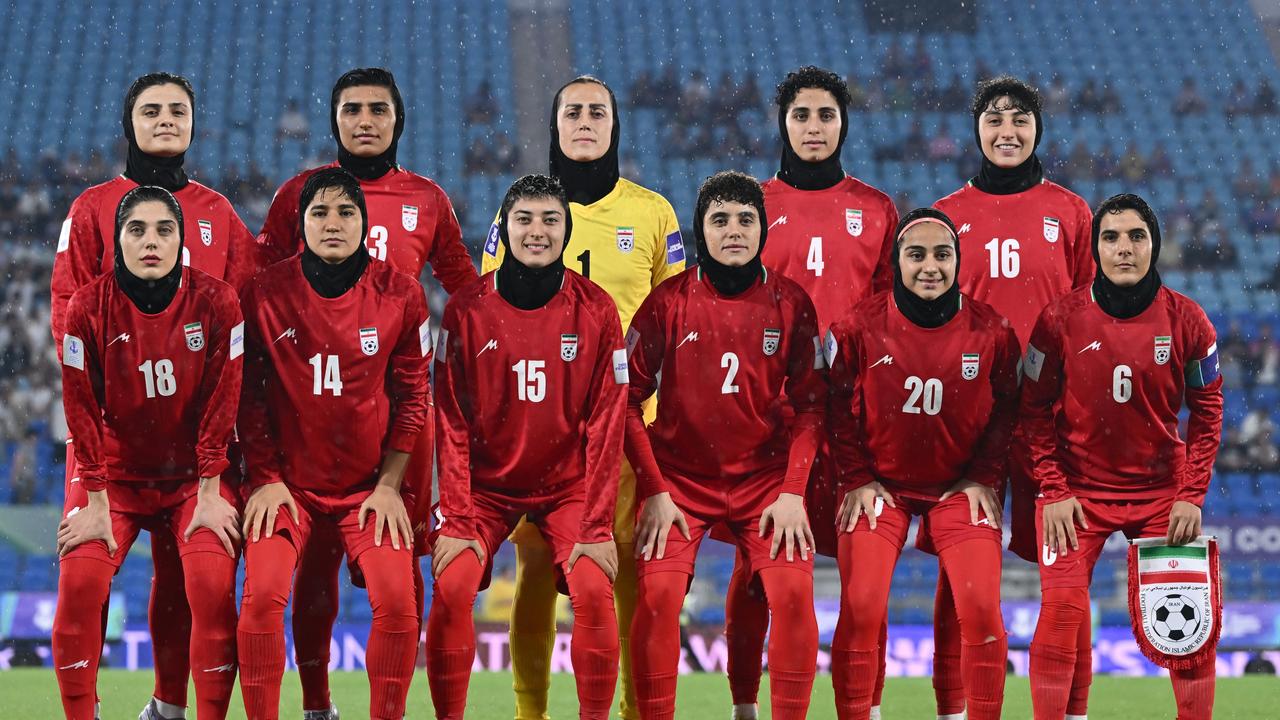
Multiple Iranian female soccer players have sought protection in Australia amid chaotic scenes on the Gold Coast that plunged the hotel where the team was staying into lockdown.
Five players are now under the protection of Australian Federal Police.
News.com.au understands that the Department of Home Affairs is now processing the claims after secret talks with the players after Sunday night’s game.
Chaotic scenes erupted in the lobby of the Gold Coast hotel around 6pm on Monday while talks were continuing, when minders linked to the Islamic Republic ran into the area looking for the women.
Supporters filming the incident claim that five female players had escaped the hotel and minders linked to the Islamic regime were looking for them.
What happens next?
Just four years ago Australia assisted the Afghan women’s national football team in escaping Afghanistan when the Taliban regained power in 2021.
Home Affairs Minister Tony Burke is expected to make a statement on Tuesday morning.
Mr Burke flew to Queensland on Monday night and is on the ground to speak to the women
Athletes who seek asylum in Australia during international sporting events generally do so by applying for protection under Australia’s refugee system.
Theoretically, they can lodge an application for a Protection Visa under the Migration Act 1958 if they fear returning to their home country.
To qualify, applicants must demonstrate a well-founded fear of persecution based on factors such as political opinion, race, religion, nationality or membership of a particular social group.
Some may also qualify for protection if they face a real risk of serious harm, including torture, the death penalty or other cruel treatment.
Once an application is lodged, the individual is usually granted a bridging visa, allowing them to remain in Australia while the Department of Home Affairs assesses their claim.
Australia has experienced several high-profile cases of athletes seeking asylum while attending international sporting events.
One of the earliest and most significant occurred during the 1956 Melbourne Olympic Games, held shortly after the Soviet Union crushed the Hungarian uprising.
In the aftermath, 61 Hungarian athletes, coaches and officials chose not to return home, making it one of the largest political defections in Olympic history and a powerful symbol of Cold War tensions.
Bus protest
Just 24 hours earlier, Australian protesters laid siege to a tour bus transporting Iranian female soccer players.

Around 50 protesters, some brandishing Iranian Lion flags, surrounded the bus as it left the stadium on the Gold Coast on Sunday night. shouting “save our girls.”
The Iranian Lion and Sun (Shir-o-Khorshid) flag was used before the 1979 Islamic Revolution and is used by protesters as a symbol of resistance against the current regime.
The women’s team is expected to fly out of the country within the next 24 hours after suffering a 2-0 defeat against the Philippines.
The defeat ends their Women’s Asian Cup campaign, which was marked by controversy after they refused to sing the Iranian national anthem on Monday.
‘Help’ sign from bus
Two female protesters filmed video overnight showing the moment one woman made a love heart symbol from the bus toward the protesters.
That is followed by a woman on the bus appearing to make the international sign of “help” from the window.
“The help sign is, I think, the most concerning,’’ Ara Rasuli, 25, said.
Another protestor, Aram, 19, said she had visited the police station on Sunday night demanding the AFP step in to speak to the players.
“There is a clear video of one of them doing the help sign. People’s life are in danger,’’ she told news.com.au.
She said her mother had spoken to two of the players in a lift at the hotel and that they were under surveillance.
“My mum was in an elevator with two of the players. They told her they cannot talk,’’ she said.
“There were threats to their family in Iran. They are super scared.
“Some of them were crying on the bus as we were chasing the bus and trying to stop it and don’t let them go.”
‘War traitors’ threat
The Lionesses are understood to have been told the plan is to fly them to Turkey before sending them back into Iran on buses, as bombs rain down on Tehran.
But the immediate threat is not just the war, but also to their families left behind.
Concerns for the young women escalated after state-controlled Islamic Republic of Iran Broadcasting broadcast a clip of presenter Mohammad Reza Shahbazi calling out the players in response to their silence during the anthem on Monday.
“In times of war, traitors must be dealt with more harshly. Anyone who takes even a single step against the country during wartime must face stronger consequences,” he said.
Foreign Minister Penny Wong declared on Sunday that Australia “stands in solidarity” with the Iranian women’s soccer team amid fears the women could be jailed or killed if they return to their country.
Thousands of Australians are urging the Albanese Government to act to protect the Lionesses players as they played their last game on the Gold Coast.
The women’s team saluted and mouthed the Iranian national anthem ahead of Sunday night’s match after an international furore over their failure to do so in an earlier match.
In a petition on Change.org, there are calls for urgent protection for the women who face an “impossible situation” – return to a war zone where they have been accused of being “traitors” or risk danger for their families at home if they stay.
“These concerns are immediate and serious. In their opening match, members of the team reportedly remained silent during the Iranian national anthem,’’ the petition states.
“Credible reporting has also raised concerns that regime-connected personnel are embedded with the delegation, that players are not allowed to move freely, and that their communications are restricted.”
The petition asks Australia to ensure that any player wishing to seek protection can do so safely, privately, and without interference from regime-associated officials or handlers.
“Australia is hosting this tournament. That carries not only logistical responsibilities, but moral ones,’’ the signatories warn.
“This is a moment for principled leadership. These players should not be let to go back into danger because they displayed conscience, dignity, or fear in public view.”
Solidarity call
Foreign Minister Penny Wong told the ABC’s Insiders she “stood in solidarity” with the men and women of Iran.
“It has been really moving for Australians to see them in Australia and the Matildas swapping jerseys with them was, I think, a very evocative moment. It spoke to solidarity and the way in which sport can bring us together,” she said.
“We know this regime has brutally murdered many of its own people. We know this regime has brutally oppressed many Iranian women and we stand in solidarity with the men and women of Iran, particularly Iranian women and girls.
“I don’t want to get into commentary about the Iranian women’s team.”
‘Don’t discuss’: Tight-lipped on Iran team approach
Speaking on Sky News, Assistant Foreign Affairs spokesman Matt Thistlewaite refused to say if Australia had already been approached by any female players for help.
“It’s been great to see the Iranian women’s team participating in the Asian Cup,’’ he said.
“We don’t go into individual circumstances for privacy reasons.
Asked, “Are you concerned they might be in trouble if they go home?” Mr Thistlewaite offered a cautious response.
“We don’t want to make any comments that might prejudice any decisions later on, so we don’t discuss,’’ he said.
Players killed by regime
The team has already lost one national player, Zahra Azadpour, 27, who was gunned down by Islamic Republic forces in January while protesting in Karaj, in north central Iran.
Another, a 23-year-old female football referee Sabha Rashtian, was shot dead while protesting in Isfahan.
Iran International TV sports journalist Raha Pourbakhsh said the women were under duress from the regime while travelling in Australia.
“They have threatened them with their careers being ended and also jail time,” Pourbakhsh told The Sports Ambassador podcast.
“Their phones have been tapped, they forced the players into signing hefty bail agreements assuring the authorities they would not become refugees in Australia, they will not apply for asylum.
“They have also been told that they must sing along to the national anthem and also to show joy and happiness if they score a goal to show that everything is normal.”
Sources close to the team have told international media outlets that seeking asylum in Australia is not an option for most players, with because their families are under threat in Iran.
Clear mandate to act
Iranian-Australian human rights activist Tina Kordostrami told news.com.au that FIFA, the sport’s governing body, had a clear mandate to act.
“The players have visas until the end of March. They don’t have to leave Sunday,’’ she said.
“The regime is clearly controlling these girls. FIFA has a responsibility here. That’s within their own protocols.
“The Australian government needs to find some sort of safe space so they can talk to people. Their phones are tapped.”
Calls to offer women asylum
In August 2021, former Socceroos captain and human rights advocate Craig Foster played a key role in evacuating over 75 Afghan women soccer players, athletes, and their families from Kabul following the Taliban takeover.
In that instance, Australia organised visas and safe passage for the team.
“Everyone is aware of the situation,” Mr Foster told news.com.au.
“The safety of every team member and their families is the most important thing. So everyone understands the sensitivity.”
Why they didn’t sing national anthem
The Iranian women’s national football team, nicknamed the Lionesses, sparked international headlines when they did not sing the national anthem ahead of their match against South Korea on the Gold Coast on Monday.
The incident was interpreted as a silent protest against the Islamic Republic regime amid reports the women’s phones are tapped and their families under threat if they claim asylum in Australia.
But by Thursday night, they sang and saluted under orders from the regime at their second group stage match against hosts the Matildas.
Ms Kordostrami said that a threat made on state-controlled TV in their homeland was alarming and frightening for the young women.
“Technically, the AFP is able to stop someone forcefully being removed from Australia. If the girls say they don’t want to leave the government can step in,’’ she said.
“FIFA has to intervene right now. We need to break through to them.”
Originally published as Iranian soccer players seek assistance in Australia