
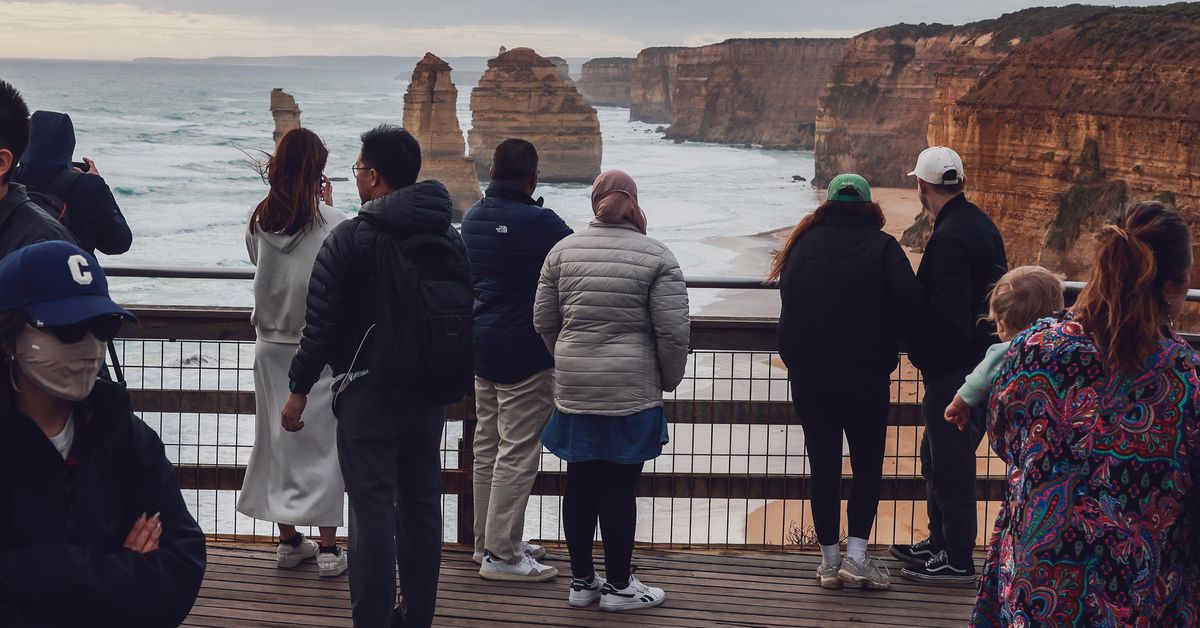
The Victorian government is about to impose a “tourist tax” on the iconic landmark, which attracts about two million visitors a year, in a bid to preserve it.
Just seven of the 12 original limestone landmarks remain standing.
 Tourists will soon have to pay a fee to visit the iconic Twelve Apostles on Victoria’s Great Ocean Road. (Nicole Cleary)
Australian and international visitors will be charged to enter the new $126 million Twelve Apostles Visitor Experience Centre, which is due to open by the end of the year.
“It’s only fair that visitors to the region pay a small fee to visit this world-class destination so that we can maintain it for future generations,” Environment Minister Steve Dimopoulos said.
“We’re investing in the future of the Great Ocean Road region and making sure every single cent spent in the region stays there.”
There will also be a new visitor booking system to manage numbers and parking during peak periods.
The price of entry hasn’t been confirmed yet, and will be decided in consultation with local councils, businesses, and traditional owners.

But Great Ocean Road Regional Tourism chairman Andrew Jeffers acknowledged “no one likes being charged for something that was free in the past”.
“This is a fee for the visitor centre that’s being proposed,” he said.
“It doesn’t limit their access to other parts of the Great Ocean Road. There’s no fee being proposed for that.”
Revenue will be collected by the Great Ocean Road Parks and Coastal Authority.
It will fund beach access and visitor facility upgrades in the area, as well as the maintenance of historic landmarks.
Jeffers said some of the money will also go towards upkeep on the recently constructed visitor centre.
 The popular tourist spot is slowly eroding and only seven of the original 12 stacks remain. (Nicole Cleary)
A select number of Australians will be exempt from the fee.
Local residents and members of the Eastern Maar community, who are the traditional owners in south-western Victoria, will not be charged.
This isn’t the first natural landmark in Australia to impose a “tourist tax”.
Entry fees also apply at major tourist locations like Kosciuszko National Park in NSW and Uluru-Kata Tjuta National Park in the Northern Territory.
Park fees at Kosciuszko National Park start from $29 per vehicle per day in the winter peak, and $17 per vehicle per day during the rest of the year.
A three-day park pass for Uluru-Kata Tjuta National Park is $38.
NEVER MISS A STORY: Get your breaking news and exclusive stories first by following us across all platforms.