
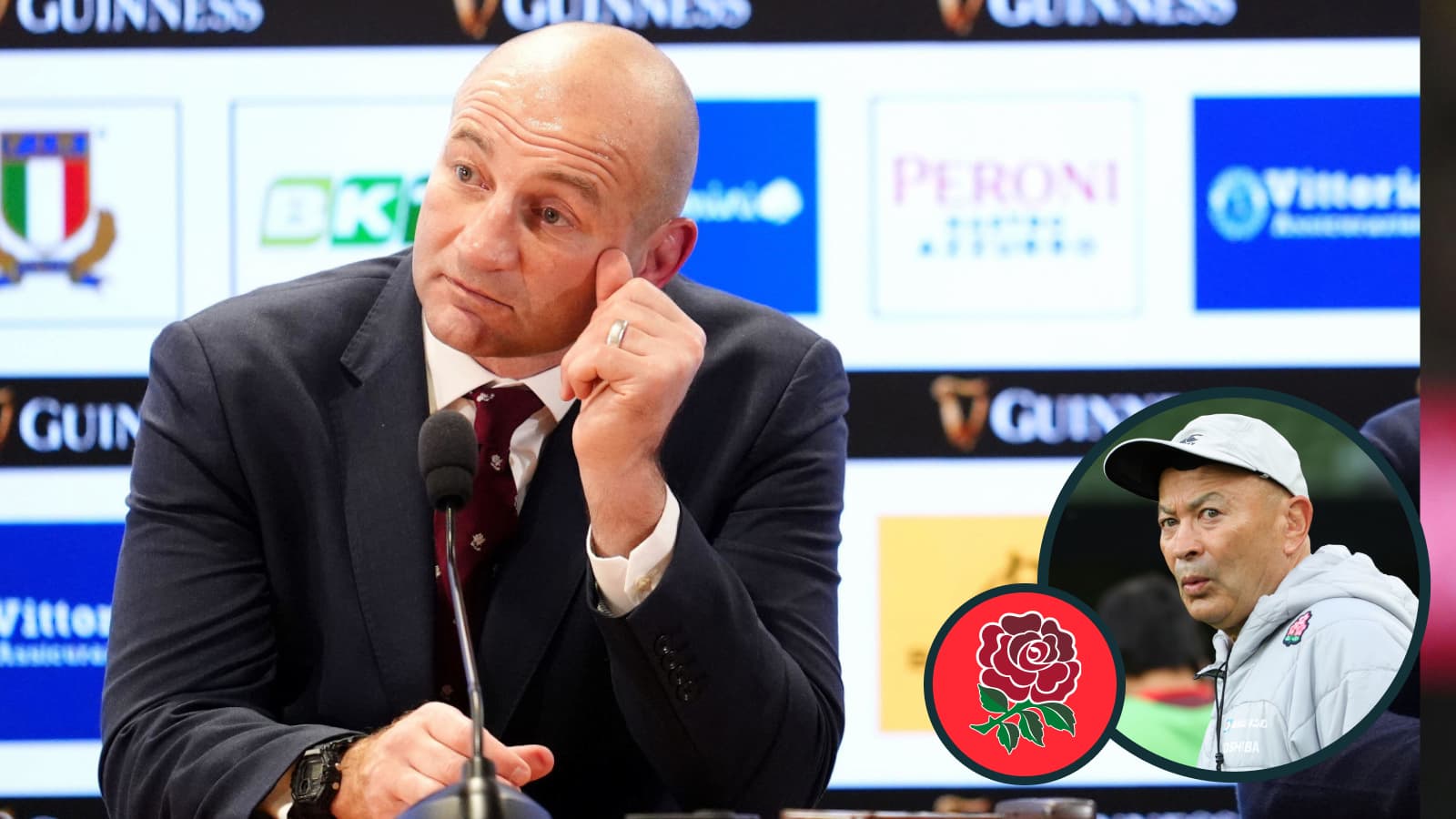
“I have had this rule for 30 years and it has never let me down. You are never quite as bad as the media and the fans are telling you. And you are never, ever, as good as the media and the fans are telling you.”
Eddie Jones said it the way he says everything; direct, unblinking, without decoration and without apology.
England need to hear it. But so, if Jones is being completely honest, does Steve Borthwick.
What England have endured since Murrayfield has been the full weight of a sporting nation’s disappointment compressing into something uglier than criticism. A 31-20 loss to Scotland, a 42-21 dismantling by Ireland, and then Rome; a first-ever defeat by Italy, blowing an 18-10 lead, two yellow cards for Sam Underhill and Maro Itoje, a late Leonardo Marin try, and a tunnel walk that felt like the end of something. The hysteria has been loud. Some of it has been justified. Jones is not here to pretend otherwise.
Emotion killers
“The thing that finishes teams before they’ve started isn’t bad tactics. It’s emotion killers. Things they didn’t plan for that break their momentum before they’ve had a chance to build it. France went to Murrayfield with everything prepared. Then the sun came over the stand and straight into their eyes and they turned the ball over three times before their emotional engine had even fired. Scotland are a canny side and they use every advantage to their benefit, especially Finn Russell who understands the geometry of that stadium better than anyone. The sun did his work for him. From those turnovers Scotland got field position, they got momentum, they scored twice. France’s emotional plan was dead before it existed.”
He sees the same dynamic in cricket. “New Zealand arrived in Ahmedabad with their emotional identity; we chase, we back ourselves, we’ve done it all tournament. Then they saw that pitch and they had a decision to make that their whole tournament hadn’t prepared them for; a clear bat first and use scoreboard pressure. They made the wrong one; their emotion killer was the toss. The game was over before it started.”
Brian Moore: The England issues that are ‘getting monotonous’ and would ‘vex an under-14s team’
Early decisions but huge impacts. The first 15 minutes carry a weight the rest of the match rarely recovers from. Before the systems engage, before the emotional architecture either side has built has time to assert itself; that is where championships are shaped. Jones has spent 30 years watching teams lose matches they should have won because something walked in that nobody had planned for, and the momentum never came back.
“Mike Tyson said everyone has a plan until they get punched in the mouth. England have been punched in the mouth three times in three weeks. Scotland hit them at Murrayfield and the discipline fractured. Ireland hit them in Dublin and the pattern repeated. Italy hit them in Rome and Underhill and Itoje were walking to the bin having thrown away an 18-10 lead against a side they had never lost to. That is not bad luck. That is a profile. And a profile is a much harder thing to fix than a result.”
The difference with England is that their emotion killer did not arrive uninvited. It was built into the foundations before a ball was kicked. When Borthwick spoke before the Six Nations of a potential title decider against France, he handed his players an expectation they had not yet earned the right to carry. The narrative was set; England were contenders and Murrayfield was an obstacle, rather than a destination. And when Scotland exposed that narrative in the first 20 minutes, physically, emotionally, with the crowd and the occasion and eighty thousand reasons to believe, England had no answer because the belief they had been given was borrowed rather than built. That is the sharpest version of Jones’s emotion killer thesis. Sometimes the killer is the sun. Sometimes it is the words in the week before the match.
This is also the frame through which Jones has been watching Fin Smith, and his patience with the criticism is limited. Smith’s crossfield kick for Tom Roebuck’s try before half-time in Rome was a piece of skill execution that demanded composure, vision and timing in equal measure. It happened in a Test match under pressure. It was brilliant.
“Nobody’s talking about it,” Jones said. “Yet it was a brilliant piece of skill.”
Stuart Barnes: Either Maro Itoje is an idiot or England are over-coached… I know which I believe
He went further. Smith and his centre partnership have been asked to solve an Italian midfield that has played 30, 40, Tests and a load of club games together, Tommaso Menoncello, Nacho Brex and Paolo Garbisi knowing each other’s game at club level inside out, the chemistry between them built over years rather than weeks.
“Whichever way you cut it, they are outstanding players,” Jones said. “England’s combination is learning on the job against one of the most established midfields in the Six Nations. Sure, they had a bit of history at Worcester, but nothing compared to the Azzurri boys.”
Which brings him to Borthwick. Jones does not flinch.
“Is there a better coach available than Steve Borthwick? No, there isn’t. Steve is a quite brilliant tactical coach. He is learning the emotional strategy of Test coaching on the job. And that is a really big task.”
The specific window, other than those coach killing early errors, Jones is watching is the 50 to 70-minute mark. “That is where Test matches are won and lost. Not at the end, when everyone can see what’s happening and the crowd is telling you. In that 20-minute period in the middle when the game is still in the balance and you have to feel what it needs before it shows you. That is the hardest thing in Test coaching to learn. You cannot teach it in a classroom. You can only learn it by getting it wrong in front of 80,000 people and understanding why.”
Opinion: The issues blighting England and the one statement that says everything
Borthwick is in that classroom now. The pre-tournament title talk was part of the lesson. The two yellow cards in Rome were part of the lesson. The tuition fees are steep and the margin for further experiment is narrowing. Jones knows this too.
Jones is not arguing that selection has been beyond reproach or that the collapse in Rome was merely unlucky. The yellow cards were not emotion killers. They were errors of discipline that a senior Test side cannot afford and cannot explain away. What Jones is arguing, and it is a narrower argument than his critics are allowing him, is that the diagnosis being screamed from the rooftops bears little resemblance to the actual patient. That is a different thing from absolution.
Jones refuses to mistake the volume for the diagnosis.
“Trust me, they are nowhere near as bad as people are making out. Equally, they were nowhere near as good as people were making out when they were on their run.”
Call for calm
He has one ask, not of the players and not of the coaches, but of everyone else.
“Patience, belief. Let these players fail on the job, because only when they fail on the job can they learn what it takes to succeed.”
Want more from Planet Rugby? Add us as a preferred source on Google to your favourites list for world-class coverage you can trust.
The sun was in France’s eyes at Murrayfield. New Zealand lost a World Cup final because they could not read what the pitch was telling them at the toss. England walked into their own tournament carrying an expectation their coach had built for them before the first whistle blew. Emotion killers come in all shapes. The hardest ones to see are the ones you construct yourself.
Jones, who has made every version of that mistake across four nations and 30 years, is not panicking. Whether England have the time left for patience to become a virtue rather than an excuse is a question only the next two weekends can answer.