
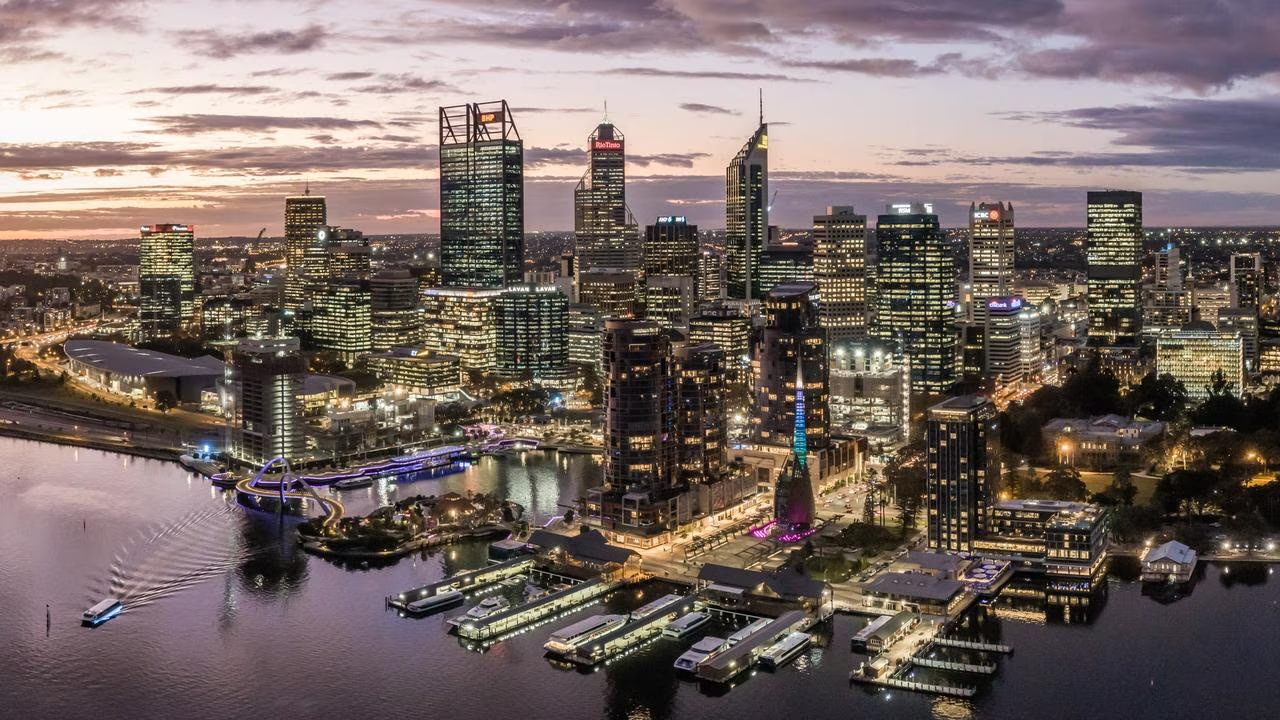
Imagine living in a country with no income tax, ocean sunsets over white sandy beaches — and enough natural resources to fuel half the world’s industry.
Nearly 100 years after Sandgropers voted to free themselves from the yoke of the Commonwealth and go it alone, WAxit talk is back on the menu with a fresh push by west to sever the umbilical cord with the “bloated” Canberra bureaucracy.
A new book launching this week, Secession by Western Australia, is billed as a 400-page, 15-chapter manifesto laying out a detailed case for the resource-rich region to walk out of its “abusive marriage” to the eastern states and become a sovereign nation.
Julian Gillespie, a former barrister who led challenges against Covid policies, is the principal author, joined by Professor Gigi Foster, an economist at the University of NSW, University of WA economist Michael Baker, and medical expert Professor Ian Brighthope.
“The principle of self-determination is reflected in the legal case Julian lays out,” Prof Foster told news.com.au.
“It’s only the people of WA [who can make that decision]. The abusive husband doesn’t have to say, ‘I agree that you should go away.’ We do expect we’ll be challenged by Canberra.”
Mr Gillespie said Western Australia had “always suffered” and it was “clear WA has not received a good deal ever since federation” in 1901.
“WA only gets back 75 cents on the dollar in GST,” he said.
“A lot of Australians aren’t aware that WA political leaders at the time were essentially strongarmed [into joining the Commonwealth]. They weren’t listened to, promises weren’t kept, they expressed that publicly. In the early 1930s there was a very clear majority by the WA population seeking secession, but the legal terrain wasn’t clear.”
The results of that vote were taken to UK Parliament seeking assistance to bring secession to fruition.
“The House of Lords stepped back and said, ‘We can’t get involved anymore, you have your own Constitution, you have to deal with it internally,’” Mr Gillespie said.
“It was thought at the time [secession] needed a national referendum.”
He argues, however, that Western Australia’s constitution allows for unilateral withdrawal from the Commonwealth through a state referendum and legislation.
The book, which has been in the works since August, then lays out a “blueprint” for the newly independent Western Australia.
“[We] unearthed all the evidence to show this is possible, legally, fiscally and monetarily,” he said.
“This is a very disciplined piece, it’s to an academic standard but it’s accessible by Joe Punter. They are the people that have to make the decision based on the evidence we put forward. It’s 15 chapters covering defence, health, a new monetary system, a new currency, what happens to the miners, the North-West Shelf, the new corruption system, policing system. We’ve turned over every stone. The final chapter is a full-blown draft new constitution which embodies all the prior 14 chapters.”
The “meat and potatoes” of the book lays out a vision for a new self-sufficient nation with virtually no taxes besides a “streamlined GST” and land rates — all funded by a blanket 20 per cent royalty on the state’s natural resources.
“When we cut out the no longer necessary commonwealth government layer, apply a 20 per cent universal royalty tax on the onshore and offshore miners, and reduce the size of government here, you end up with a neutral to surplus [position],” he said.
“Big miners not paying income tax, payroll tax, tax compliance [costs] reduce greater than 95 per cent, they end up revenue positive. RIO, BGP, Fortescue and Hancock, they’ll be $1 billion better off every year. They’re still in a very good position.”
Mr Gillespie said an independent Western Australia would find itself in a similar position to Qatar, which has a population of around two million.
“No one pays taxes, it’s got one of the great sovereign wealth funds globally,” he said. “It’s also reflective of what’s occurred in Norway and other nations which have downsized their bureaucracy like Hong Kong, Singapore, Estonia.”
While Western Australians like to grumble about secession — with separatist sentiment strengthened by “hard border” closures during Covid — that feeling has failed to translate to votes.
The WAxit Party, a merger of the Small Business Party and the WA Republic Party, received just 0.34 per cent of the vote at the 2021 state election.
“WAxit has all the right ideas but not the execution,” Mr Gillespie said.
“They didn’t get enough intellectual muscle behind the shared ideas we have with them. Without all that fine detail to show this is possible … there wasn’t enough to attract the broad range of minds you needed to build momentum.”
Mr Gillespie said the proponents of the 1933 referendum provided a “similar level of detail”. “They all rose and voted in favour by a majority,” he said.
The effect on the remaining states of Western Australia seceding and taking its billions upon billions of mining revenue away would be dire, to put it mildly.
“The federal government would have to make up excuses to try to justify its continued existence, and impose further taxes,” Mr Gillespie said.
Prof Foster added it was “basically inspiration for the eastern states”.
“Most populations in the west feel they are serfs in a neo-feudal situation and don’t know how to get out,” she said.
If history is any guide, though, chances for a WAxit revival are likely slim.
In the modern era, the handful of successful secession movements, from Bangladesh and Eritrea to East Timor and South Sudan, have only come about through bloody, sometimes decades-long conflict.
Still, WAxit is not alone in the west.
In Canada, the similarly resource-rich province of Alberta is on track for a potential independence referendum as soon as this year.
In the United States — where the question was asked and answered 160 years ago — movements like Texit, Calexit and even Alask-exit are growing in popularity, although largely symbolic.
Prof Foster said there had been growing disillusionment with existing governments across much of the developed world since the Covid era.
“If you love the west, love freedom, love human thriving, it’s all of the good things that come for people when their societies are set up to reflect their wishes,” she said.
“We’ve seen the erosion of that reality in our societies, it’s very troubling.”
Speaking to The Australian on Monday, Patrick Gorman, the Assistant Minister to the Prime Minister, rubbished talk of secession for WA.
“This is the cheapest version of false hope,” he said.
“People have been selling this dodgy product for 125 years. It is idiotic to see current global fractures, trade wars and conflict and think that secession is the answer for Western Australia. Australia should not waste our energy negotiating with ourselves. Our public services, our national defence and our economy are all stronger under our federation.”
A book launch event will take place on Friday night at the Adam Armstrong Pavillion in Dalkeith.