
The 2026 Formula 1 season got underway with the Australian Grand Prix in Melbourne, where the sport’s all-new rules were put through their paces for the first time.
Fox Sports, available on Kayo Sports, is the only place to watch every practice, qualifying session and race in the 2026 FIA Formula One World Championship™ LIVE in 4K. New to Kayo? Join now and get your first month for just $1.
After months of rumour, speculation and innuendo, we finally got a glimpse of the true state of the sport — the good and the bad.

Albert Park was always going to be a fascinating weekend regardless of on-track events given the sheet quantity of unknowns.
In the aftermath of the race, Pit Talk podcast hosts Michael Lamonato and Matt Clayton sat down to reflect on some of the biggest lessons of the weekend.
LESSON 1: THE NEW RULES AREN’T (ALL) BAD
The 2026 regulations drew extremely mixed criticism from the drivers, though there appeared to be a correlation between level of unhappiness and level of competitiveness. For example, winner George Russell seemed fine with the rules, whereas defending champion Lando Norris, who finished a minute off the pace and nowhere near the podium, is very much against them.
PIT TALK PODCAST: The 2026 Formula 1 season is underway, with George Russell leading a Mercedes one-two to victory in Melbourne. But not every driver was thrilled with their first experience of the new rules.
Lamonato said it was too early to be definitive about the regulations given the teams rated the Albert Park layout as among the four most difficult circuits for the power unit, but he didn’t agree with Norris’s description of the racing being ‘artificial’.
“I’m not convinced what we’re seeing is any worse than a driver getting DRS, pressing the button, breezing past before the braking zone and just overtaking,” he said.
“You have to use something to make your overtake. You’ve got that battery charge. You’ve got to get the overtake done. If you don’t, then you’re vulnerable to the guy behind.
“The other driver can also fight back, which I like, whereas with DRS, if you’re leading by a second and you’re at the wrong track where the DRS is too effective, you have no hope.
“I’m willing to give the benefit of the doubt and say it could in an overall sense, when we get to the end of the season, could be a positive difference on Sundays.”
Clayton was pessimistic about the regulations after qualifying, when the need to manage electrical power meant drivers were far from the limit of grip that usually dictates the single-lap spectacle.
“The actual spectacle of qualifying was so unedifying,” he said. “The signature turn there, and it has been for years, is the turn 9-10 chicane. It’s one of the highlights of that circuit.
“That sequence of corners was always an absolute highlight on the calendar every time Formula 1 came to Australia, and the cars just looked, frankly, a bit pathetic through there. They were so much slower than they had been previously. You knew the drivers weren’t pushing. The challenge wasn’t there.
“My pessimism about things wasn’t helped by Saturday.”
‘That guy f****** sucks!’ | 00:26
LESSON 2: WORKS TEAMS ARE IN CONTROL
The Mercedes and Ferrari works teams were in a class of their own on Sunday, and the only third party to their battle was Red Bull Racing, which this season is also a works constructor.
McLaren, meanwhile, has been left to wonder how much it’s missing out on for having to buy its motor from Mercedes and develop an understanding of it on the fly.
“The value of being a full works team is higher than perhaps I would have thought,” Clayton said. “I think these engines are just so different and so new that if you are a works team, you are starting so much more on the front foot than a customer team.
“If you do a bit of a deep dive into where the deficit was between George Russell and pole and where the McLarens were in fifth and sixth with Piastri and Norris, it was mostly about how Mercedes deployed what it had and perhaps McLaren searching a little bit to try and find the ideal way to do that.
“I wouldn’t go as far as saying that McLaren’s got a turkey of a chassis and they’re going to be no good. I don’t think that’s going to be the case.
“But wasn’t it interesting that the customer teams felt like they were on their back foot and had more to learn simply because they just don’t have the laps and the hours and the miles in these machines that the works teams do.”
Lamonato noted that Mercedes’s customer teams all felt on the back foot at the first round of the season.
“Both James Vowles and Andreas Stella, the Williams and McLaren bosses respectively, both suggested in different ways that they’re not getting as much information as they would have liked from Mercedes,” he said.
“There’s so much in the software or the inputs in the software about understanding how the engine works that does make a difference, and so the works team is suddenly not going to give you all of that.
“It’s almost like a muscle that’s never had to be flexed, because the engine is now a different kind of performance part because it’s just so all-encompassing.
“If you have a little bit more combustion power, it means you can roll off a little bit earlier into the corners, which means you charge your battery a bit more, which means you’ve got a bit more electrical power at the start of the straight, which means your car is faster by the time you get to the corner, which means you can roll off even more. It’s a virtual cycle.
“Then if you have efficient aerodynamics — which Mercedes clearly also has; there is a car effect here, not just an engine effect — it all just compounds and suddenly you look pretty dominant.”
Scary near miss at the back of the grid! | 00:42
LESSON 3: FERRARI IS ON THE RIGHT TRACK
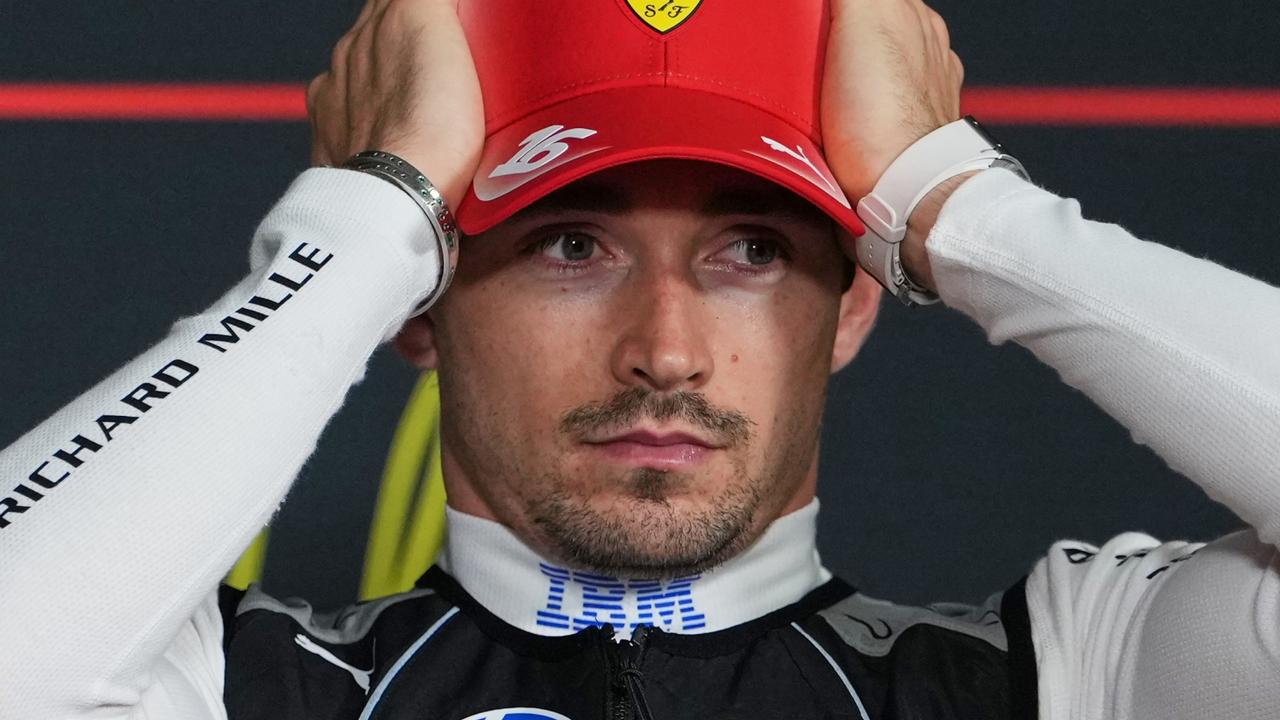
Leclerc’s blistering race start got him into the lead at the first turn, from where he held off the faster Mercedes of George Russell until a strategy error cost the Ferrari star a shot at victory.
It was nonetheless a hopeful performance, with the scarlet cars never far adrift of the silver ones — enough that Lamonato thought the team could be optimistic it’s on the right track.
“In race conditions it’s clear that Mercedes was the quicker car, but not by that much,” he said. “I actually think Ferrari is in the ballpark.
“As we go to some different tracks, characteristics are going to play to different cars.
“Particularly when we go to more street-style tracks or tracks just with more corners, that Ferrari engine is so good out of the corners thanks to that small turbo.
“I think Ferrari — with a little bit of a development push as well because so much of this season is going to be about development — can say that they’re in the mix.”
Clayton joked that the car has become so low for Ferrari, though he too saw reason for optimism for F1’s oldest team.
“This is where we’ve got to with Ferrari — we go, ‘It’s not as bad as we thought!’ as opposed to just giving them actual praise,” he said. “Less bad, so that’s all good.
“I think the fact that Ferrari made [Mercedes] work for and perhaps exceeded our expectations is a good sign for what’s to come.
“I think it’s really good for the narrative of the season, because we know there’s no issue there in terms of the driver quality.”
Piastri explains where it all went wrong | 01:28
LESSON 4: ARVID LINDBLAD HAS MADE A GOOD FIRST IMPRESSION
The 2026 season features only one rookie driver: Arvid Lindblad at Racing Bulls, where he partners Liam Lawson for the Red Bull development team.
Lindblad was much hyped by Red Bull last year but had a muted Formula 2 campaign comprising a single feature race victory and sixth in the standings. He was elevated unilaterally by former Red Bull adviser Helmut Marko before the Austrian left the brand.
“I wasn’t 100 per cent convinced about Arvid Lindblad, I’ve got to be honest,” Clayton said. “It wasn’t necessarily because I thought he wasn’t worthy of being in Formula 1, but sometimes you see these guys in F2 and there’s something there, but it’s not super consistent.
“But he was incredibly impressive with what he did on track. He was also incredibly impressive with just how he handled the entire thing.
“I thought Lindblad was incredibly impressive given the complexity of driving these cars. Yes, a track that he’d been on in F2 before, but still, it’s a completely different challenge. I wasn’t expecting him to be terrible by any means, but he was really, really quite impressive given the stakes, his age and his experience — and that car looked halfway decent.”
Lindblad qualified ninth and finished eighth to score points on debut, leaving Lamonato similarly converted by the British rookie’s composure.
“I was a little bit sceptical, and I thought actually that meant there was a bit of pressure on him to prove his elevation, but on the evidence of the first weekend, he’s doing very well,” he said. “We are missing that comparison with Lawson a little bit this weekend — he was outqualified by Lawson, but not by much.
“Lawson will be a good bar — he’s a tough racer and he’s pretty quick as well.”
Mercedes Top 2 – Russell wins AUS GP | 00:51
LESSON 5: RED BULL RACING FINALLY HAS A FULLY FORMED DRIVER LINE-UP
Isack Hadjar stepped into Formula 1’s ejector seat as Max Verstappen’s teammate this season after his three predecessors flopped in the role.
In just his second season in Formula 1, he readiness to step into the Red Bull Racing meat grinder was a major talking point ahead of the season.
But the Frenchman led the way in Melbourne, qualifying on the second row after Verstappen crashed out of Q1, and he would likely have finished fifth had his engine not expired early in the race.
“Isack Hadjar from the beginning over the weekend looked like he had a good handle on the car,” said Lamonato.
“This is important to say not just in the context of the previous three teammates in the last 25 weekends that Max Verstappen had — three previous occupants of that car struggling.
“We shouldn’t forget what Red Bull Racing is doing there, which is supporting Max Verstappen at all cost, and the reason they have a second driver — yes, they are obliged to under the rules — is they just want someone there to pick up the pieces that Max might very occasionally drop.
“This weekend he dropped a lot of pieces. He crashed, and Isack Hadjar did what probably the maximum by qualifying that car in the second row.”
Clayton said it was clear Hadjar had the right temperament to make the move a success.
“I can’t say I’m super surprised with him, because something I really enjoy about him is that he is his own harshest critic. He holds himself incredibly accountable.
“I’ve felt that for the previous occupants of that seat it seemed to be something or somebody else’s fault most of the time.
“I think that Isack will probably beat himself up a fair bit when things are his fault and probably also when they’re not.
“Really good sign for him, and Red Bull might have two competent drivers in its car.”
‘That will hurt him for a while’ | 01:03
LESSON 6: OSCAR PIASTRI HAS TO DO IT THE HARD WAY AGAIN
Lamonato and Clayton couldn’t stay away from Oscar Piastri’s disastrous reconnaissance lap crash that put him out of the race before he’d even made it to the grid.
It’s the second season in a row Piastri has walked away from his home race having been heavily outscored by the championship leaders — last year he trailed Norris by 23 points after Melbourne; this year he’s 25 points adrift of title leader Russell.
“It’s remarkable, isn’t it?” Lamonato said. “Much like last year, he’s going to start round 2 with practically no points. Last year it was two points. This year it’s zero points.
“The lesson may be that he’s got to dig deep again.
“Last year he took the lead after the fifth round in Saudi Arabia, so it took him four weekends to overhaul that 23-point deficit. It’s obviously a very different context this year, but funny that he should be engaging in the exact same sort of comeback two years in a row.”
Clayton cautioned that it wasn’t yet clear whether McLaren would have the pace in the opening months of the season to reel in that sort of deficit.
“The difference for me this time is that last year McLaren were in a comfortable one-two and were clearly the class of the field … it was pretty clear they had a significant advantage,” he said.
“We can’t say that about McLaren right now.
“He was the better of the two McLaren drivers the entire weekend until we got to race day. He was faster in every single practice session and all the elements are qualifying, and he qualified higher on the grid.
“It’s not all doom and gloom, but of all the races to that in, given the expectation and the build-up…”
You can subscribe to Pit Talk wherever you get your podcasts.