
Stan Choe
Updated March 10, 2026 — 7:56am,first published 5:20am
Save
You have reached your maximum number of saved items.
Remove items from your saved list to add more.
Save this article for later
Add articles to your saved list and come back to them anytime.
Got it
AAA
The US stock market careened through a manic Monday, going from a steep early loss to a solid gain as worries turned into hope that the war with Iran may not last that long. Oil prices whipped from nearly $US120 per barrel, their highest since 2022, back toward $US90.
The S&P 500 dropped as much as 1.5 per cent in the morning before flipping to a gain of 0.8 per cent. The Dow Jones Industrial Average clawed back a plunge of nearly 900 points to rise 239 points, or 0.5 per cent, while the Nasdaq composite climbed 1.4 per cent.
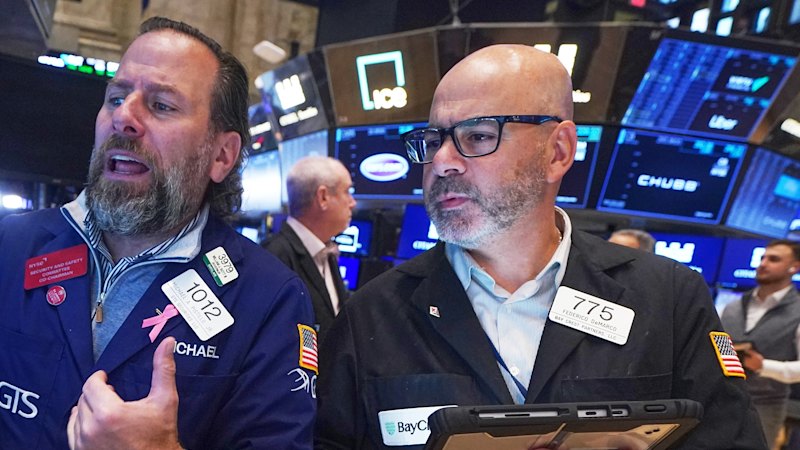
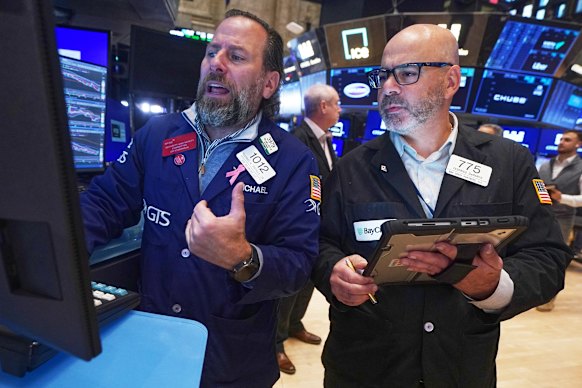 Wall Street slumped early in the session before recovering.AP
They’re the latest hour-to-hour swings to pummel financial markets because of the uncertainty about just how high oil prices will go and how long they will stay there because of disruptions to the energy industry in the Middle East. Markets made their remarkable reversals during the last hour of Wall Street’s trading after President Donald Trump told CBS News that he thinks “the war is very complete, pretty much.”
The Australian sharemarket is set to claw back most of the previous session’s heavy losses, with futures pointing to a rise of 184 points, or 2.2 per cent at the open. The ASX lost 2.9 per cent on Monday as panic spread through global markets. The Australian dollar jumped as the US dollar weakened. The Aussie was trading at US70.77¢ at 8.43am AEDT.
Related Article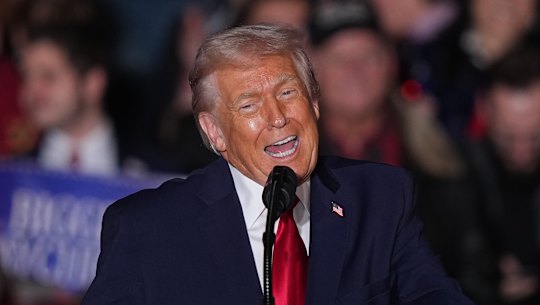
Trump’s comments calmed worries that had built earlier in the morning, when the price for a barrel of Brent crude, the international standard, briefly touched $US119.50. It hadn’t been that expensive since the summer of 2022 after Russia invaded Ukraine.
If oil prices stay very high for very long, households’ budgets already stretched by high inflation could break under the pressure. Companies, meanwhile, would see their own bills jump for fuel and to stock items on their store shelves or in their data warehouses. It all raises the possibility of a worst-case scenario for the global economy, “stagflation,” where growth stagnates and inflation remains high.
Concerns have focused in particular on the Strait of Hormuz, a narrow waterway off Iran’s coast that a fifth of the world’s oil sails through on a typical day. Iran had earlier threatened to set fire to ships sailing the strait.
If the strait remains closed for only a few weeks, the price of oil could push to $US150 per barrel of higher, according to oil and gas strategists at Macquarie Research.
But oil prices pared their gains through the day, initially on talk that seven of the world’s largest economies could coordinate moves to push back on the spikes. They then slid sharply after CBS News said Trump said of Iran that “if you look, they have nothing left. There’s nothing left in a military sense.”
Trump also added that when it comes to the Strait of Hormuz, he’s “thinking about taking it over,” according to CBS.
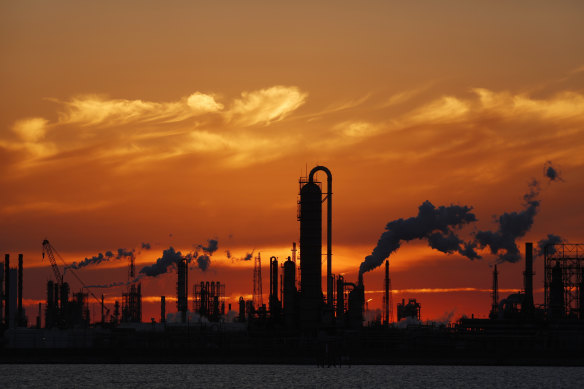 If oil prices stay very high for very long, households’ budgets already stretched by high inflation could break under the pressure.Bloomberg
A barrel of Brent crude pulled back to settle at $US98.96 in the afternoon and then kept falling afterward below $US90. A barrel of benchmark US crude touched $US119.48 during the morning, then pulled back to settle at $US94.77 and then sank toward $US85.
The US stock market has a history of bouncing back relatively quickly from past military conflicts, as long as oil prices don’t stay too high for too long. Some professional investors continue to suggest that drops in prices for stocks could ultimately offer opportunities to buy them at cheaper levels before they rise again.
“We continue to believe that the current acute shortage of oil will be reversed in the coming months as new supply comes online and oil should drop significantly,” according to Sameer Samana, head of global equities and real assets at Wells Fargo Investment Institute.
Even with all the recent swings in the market, the S&P 500 index that sits at the heart of many 401(k) accounts is still within 3 per cent of its record set in January.
All told, the S&P 500 rose 55.97 points to 6,795.99. The Dow Jones Industrial Average added 239.25 to 47,740.80, and the Nasdaq composite gained 308.27 to 22,695.95.
To be sure, prices could reverse again in the coming days given all the uncertainties about the war. That’s what happened through the huge swings that rocked Wall Street last week.
In stock markets abroad, where economies are more dependent on the import of oil and natural gas, stocks fell sharply before Trump’s comments were published. South Korea’s Kospi sank 6 per cent, Japan’s Nikkei 225 tumbled 5.2 per cent and France’s CAC 40 dropped 1 per cent.
Related Article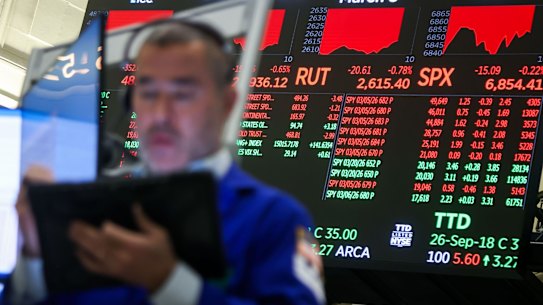
Trump’s comments came after he said late on Sunday that high oil prices at the moment were worth the cost.
“Short term oil prices, which will drop rapidly when the destruction of the Iran nuclear threat is over, is a very small price to pay for USA., and World, Safety and Peace,” he said in a posting on his social media network.
In the bond market, the yield on the 10-year Treasury fell to 4.10 per cent from 4.15 per cent late Friday.
Worries about high inflation and oil prices are pushing upward on Treasury yields, and the 10-year yield briefly rose above 4.20 per cent early Monday.
But worries about a potentially slowing economy are pulling downward at the same time. On Friday, a discouragingly weak report on the US job market showed that employers cut more jobs last month than they added.
Yields then slid late in the day when oil prices eased.
AP
The Market Recap newsletter is a wrap of the day’s trading. Get it each weekday afternoon.
Save
You have reached your maximum number of saved items.
Remove items from your saved list to add more.
From our partners