
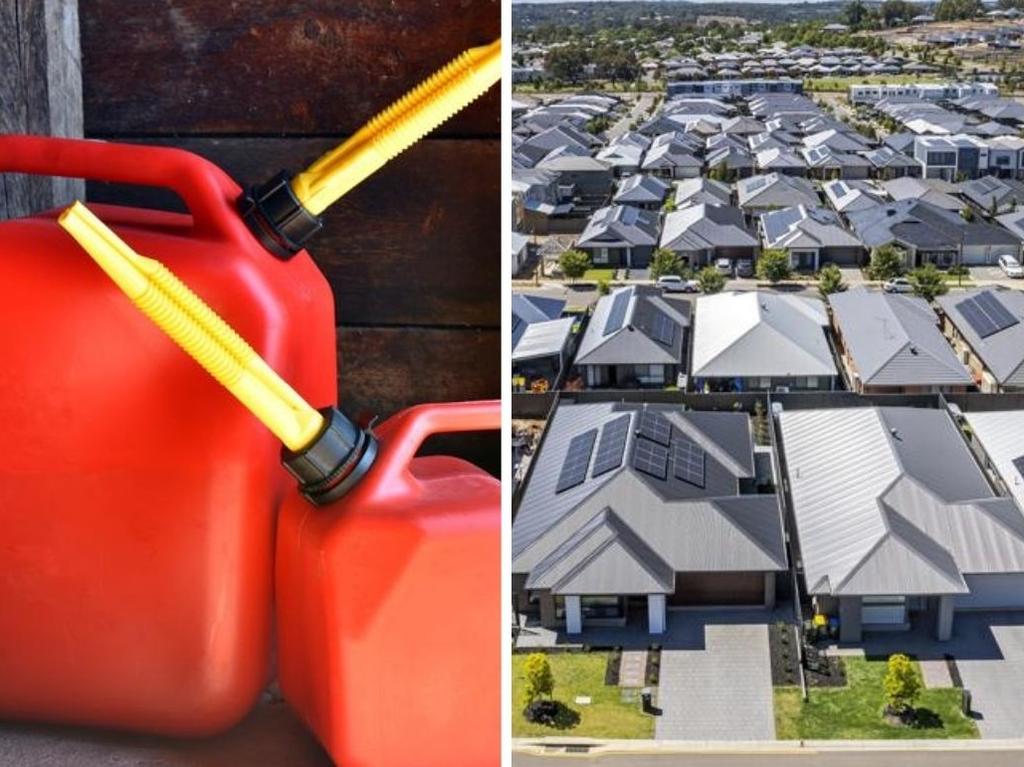

Aussies panicking over the cost of fuel began stockpiling petrol and diesel last week.
Panicked Aussies stockpiling fuel at home face a major blow that would hit them with a crippling bill, with the Insurance Council of Australia warning policies could be voided.
Homeowners rushing to store extra petrol and diesel after a surge in fuel prices amid Middle East tensions risk finding themselves without insurance coverage if things go wrong, with standard policies specifically excluding damage from hazardous materials.
Insurers and states have strict rules over the circumstances around storage of hazardous chemicals and fuels – with the family garage not considered the right fit for bulk storage.
A spokesperson for the Insurance Council of Australia warned “policyholders have a duty to disclose anything that materially changes the risk profile of their property and significant fuel storage may constitute such a change”.
“Home insurance policies have exclusions for loss or damage arising from failure to comply with laws,” the spokesperson said.
“Those considering storing large quantities of fuel on premises must comply with applicable standards for storage of dangerous goods.”
“The Insurance Council encourages anyone with questions about their coverage to review their Product Disclosure Statements and to contact their insurer directly.”
Homeowners are being urged to revisit the terms of their insurance policies, with most standard policies having specific exclusions for damage or liability from hazardous materials like stored fuel, pollution or contamination from chemical spills, materials not stored according to legal requirements and any bulk fuel storage above basic domestic purposes.
Any accidents could leave homeowners footing the entire bill for clean-up costs, property damage and even liability to neighbours in such circumstances.
Energy minister Chris Bowen has urged Aussies not to panic over fuel supply. Picture: Hilary Wardhaugh/Getty Images
Brisbane City Council reports name hazardous chemicals as those defned in the Work Health
and Safety Regulation 2011 and include those “harmful to people and the environment, such as fuel oil, motor oil, lubricating oil and waste oil, radiator coolant, solvents, degreasers and thinners, paints, lacquers and varnishes, acids and alkalis, pesticides and herbicides” – all of which have special storage safety rules around them in homes and businesses.
According to Suncorp Insurance, its home insurance policy does not cover “loss, damage or legal liability for or caused by, connected with, or arising from any hazardous materials if not stored or used in accordance with the relevant law, controls, and manufacturer’s instructions”.
Queensland already has an existing case where a homeowner lost an insurance claim for a leaking underground petroleum tank because it was not considered a fixture of the home and the policy excluded damage from pollutants.
The warning comes as Energy Minister Chris Bowen urged Australians not to stockpile fuel, saying there was “no need for panic buying” despite kilometre-long queues at service stations around the country.
“There is no need to rush to the service station and fill up,” Mr Bowen said in a press conference in the days after the bombardment of Iran by the US and Israel began. “There is no need for panic buying. That will just make the situation worse.”
He said last week that Australia had “in excess of the minimum stock obligations – 36 days’ worth of petrol, 34 days’ worth of diesel, and 32 days’ worth of jet fuel on hand as we speak”.
“That’s in addition to the petrol and diesel that’s in service stations sitting in tanks around the country as we speak and, of course, the petrol that’s already in cars.”
He said refining companies had informed him they “have confidence in the oil supplies through to May” and had contracts in place “which they fully expect to be honoured and delivered”.
“There is no immediate threat to petrol suppliers in Australia” adding that the Treasurer had written to the Australian Competition and Consumer Commission chair to monitor for price gouging.
RACQ has referred fuel retailers to the ACCC over price gouging claims.
Queensland’s peak motoring body RACQ has since referred major fuel retailers to the ACCC for investigation after prices surged within hours of the Middle East war breaking out.
RACQ’s Principal Economic and Affordability Specialist, Dr Ian Jeffreys, said “we’ve seen an increase in the global oil price, but that usually takes around two weeks to flow through to bowsers here in Australia, not two days”.
“This behaviour from fuel retailers is extremely disappointing at a time when Queenslanders are worrying about already high cost-of-living pressures.”
Dr Jeffreys advised consumers to focus on finding the cheapest fuel rather than hoarding it.
“Now, more than ever, it’s important to fight back as a consumer by using price monitoring services to find the cheapest fuel near you and reward those stations with your business.”
RACQ’s Annual Fuel Price Report found Brisbane motorists paid more for unleaded last year than drivers in any other Australian capital, with its average for regular unleaded at 185.2 cents per litre, nearly 11 cents more than Perth’s average of 174.3 cents per litre.
Mr Bowen said “I do understand people’s concerns, but it’s important that people know we do have a good stock of petrol in reserve in Australia”.
RACQ safety warning: Why fuel storage is so dangerous:
– Only carry or store fuel in approved metal or plastic fuel containers meeting AS 2906-2001 standards – plastic oil containers and drink bottles pose significant fire risks from static build-up
– Don’t carry fuel inside a car or caravan
– Don’t store fuel for long periods – most fuels only have a shelf life of about three months under ideal conditions
– Don’t carry or store more fuel than essential for immediate needs
– Always store fuel in a cool place away from potential ignition sources
– Never fill a container that’s in a car, ute tray or trailer – always place on the ground first
(Source: RACQ)