
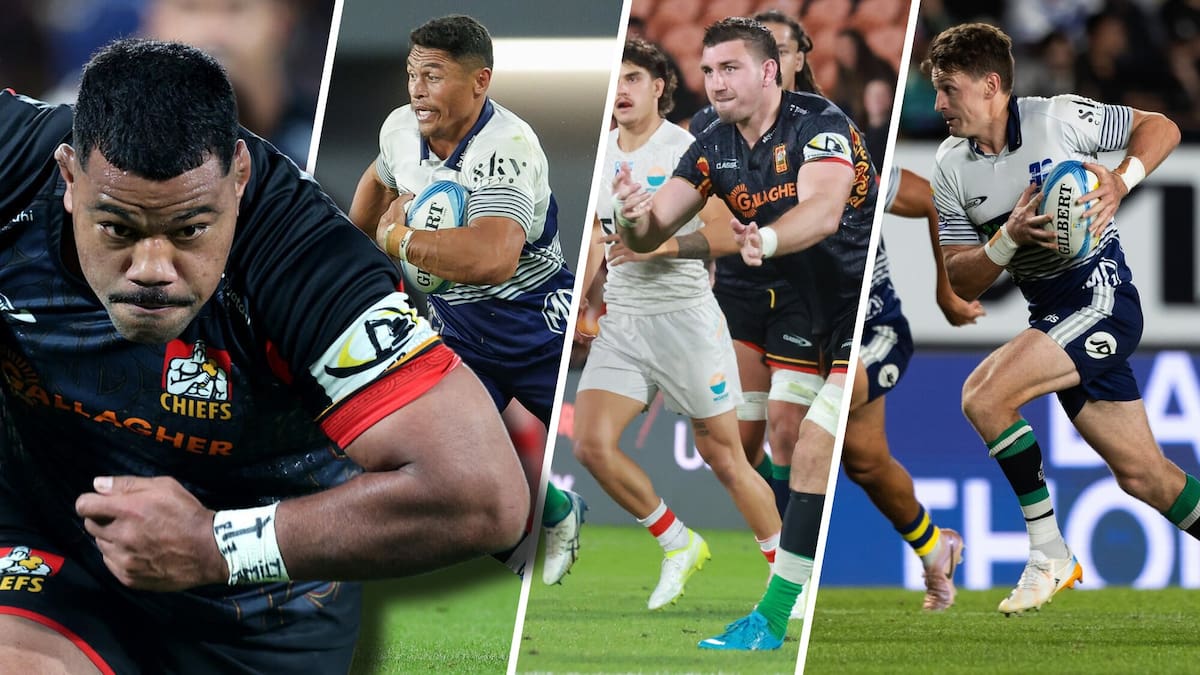
The other games were try-scoring feasts, headed by the Chiefs and Moana Pasifika (13 tries and 81 points in the match), the Hurricanes and the Waratahs (12 tries, 78 points), Highlanders-Force (10 tries, 70 points) and Reds-Brumbies (9 tries, 65 points). That’s 44 tries in four games and just below 300 points in 320 minutes of rugby.
Blues captain Dalton Papali’i tracks the ball during the Super Rugby victory over the Crusaders at Eden Park. Photo / Photosport
Super fun if you like tries being scored (and who doesn’t?) but some defences were far too easily opened. While we are still in the early-days, frothy part of Super Rugby (the intensity will increase later), it is nonetheless limited value as test-match prep.
However, we can exempt the first half when the Blues attacked the breakdown (skipper Dalton Papali’i said later they’d approached the match with ”dog”), sabotaged the Crusaders’ lineout (good work, Sam Darry, Josh Beehre and later Anton Segner), their scrum was solid, they drove well in the narrow channels before going wide, and their defence was committed. The second half got messy, but the first was likely not a million miles from how Rennie may want his team to play. Though the Crusaders had an off day and sorely missed Will Jordan, the Blues’ style reduced errors and promoted them in the opposition.
Clarke and Carter
If the All Blacks were selected right now, Caleb Clarke and Leroy Carter would be the starting wings. Clarke’s three tries, pace and strength led the way and Carter’s own three-try performance was copybook in terms of pace, finishing and adding value in general play, rather than lodging out on the wing.
Blues winger Caleb Clarke scores against the Crusaders at Eden Park. Photo / Photosport
Midfield riches
However, who’d be chosen at second five-eighths? In my view, Jordie Barrett still leads the way after another creative performance at the heart of the Hurricanes’ scoring. He had a leading hand in three tries in the second half, sewing up the match, and was instrumental in the Canes’ repeated penetration of the Waratahs defence for the 59-19 win.
But how do you omit Quinn Tupaea and/or Timoci Tavatavanawai? Both again had leading roles in victories – and both are of the blood-and-thunder, I’m-going-straight-ahead type of player Rennie is said to like and who also excel in offloads and turnovers.
Not yet a test 13
Centre is likely to be causing some concern. Billy Proctor is running like a scalded cat in the comparative roominess of Super Rugby. His three tries against the Waratahs were well taken though he gave away one to Max Jorgensen with a poor bridge pass.
Crusaders utility Leicester Fainga’anuku may be better suited to the intensity of test rugby – but does not yet look like an All Blacks centre. His distribution is fine, but he too often heads for contact and, against the Blues, lost the ball too much.
Barrett wins return of the 10s
In their first matches of 2026, Beauden Barrett and Damian McKenzie made contrasting studies. McKenzie was mostly happy to feed his outsides while making a couple of nice dabs – while Barrett played a more complete game, steering the Blues purposefully, his running and passing impactful. McKenzie will have relished the 57-24 win over Moana Pasifika and is nicely primed for the Chiefs’ next match, away to the Brumbies on March 20.
Blues playmaker Beauden Barrett makes a run against the Crusaders. Photo / Photosport
Gardiner continues to bloom
Blindside flanker is more complicated. Incumbent Simon Parker probably has a narrow lead right now with the Crusaders’ Dom Gardiner close behind. Gardiner blotted his copybook with a yellow card for head contact but showed energy and speed saving a potential try after the Blues’ Cody Vai kicked ahead to regather. His deft pass was also essential in Rivez Reihana’s try which brought the Crusaders back to 19-13 down against the Blues. The leading candidates are probably: Parker 1, Gardiner 2, Devon Flanders (Hurricanes) 3, Ethan Blackadder 4, Samipeni Finau 5 (though he has barely had game time yet).
Hooker pressure cooker
Samisoni Taukei’aho maintained his challenge to be starting All Blacks’ hooker with a solid match for the Chiefs while Codie Taylor also hewed away well, scoring a driving maul try. Asafo Aumua is also in the race, with a good try and several powerful carries against the Waratahs. Throwing remains his weak spot, however, with four wayward efforts (though one was expertly poached by the Waratahs’ Miles Amatosero), one of which indirectly led to a Waratahs try.
Change the knock-down law
One of rugby’s most irritating rules is the deliberate knock-down law that saw Caleb Clarke sin-binned against the Crusaders. The video shows Clarke did not try to knock the ball down. He leapt, using two hands to catch it, just failing to secure the intercept of Noah Hotham’s loop pass over Clarke’s head to a lone Crusader.
Ten minutes later, Crusaders skipper David Havili knocked a Blues pass down with one hand. No yellow card, not even a penalty – and the Blues had a three-man overlap. Consistency? Havili’s seemed more deliberate in terms of halting a viable attack and he had a guilty look on his face.
The game has enough yellow cards already and needs more allowance for fair attempts as opposed to putting everything in the “deliberate” basket.
The law says it is not an intentional knock-on “if there was reasonable expectation” the catcher could gain possession. Clarke had that.
Moreover, some responsibility must be sheeted home to the passer. If it is capable of being intercepted then, by definition, the pass is suspect – why reward that by reducing the opposition to 14?
Surely there’s more room for refs to differentiate between a knockdown preventing a potential try and a fair attempt to claim a vulnerable pass.
Paul Lewis writes about rugby, cricket, league, football, yachting, golf, the Olympics and Commonwealth Games.