
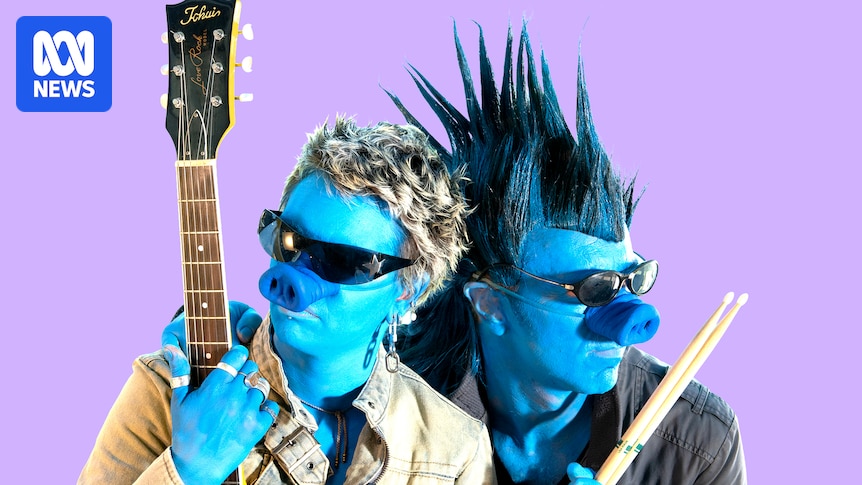
Passing the point of no return knowing full well you could be financially wrecked if you continue is both exhilarating and terrifying.
After all, there’s nothing quite like a high-stakes game creeping over your head with growing magnitude to help you feel alive.
Near-sleepless nights are common, but when you’re pulling together an all-original rock opera involving 21 eager, talented young South Australians — and doing so largely out of your own pocket — there’ll be little rest until you pass the finish line.
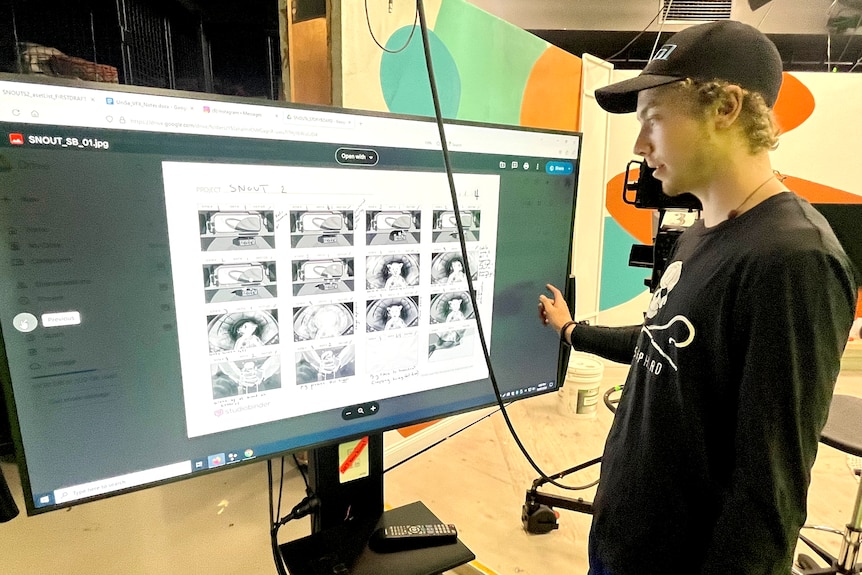
SNOUT’s visual effects artist/production manager Isaac H-Sutton looks over storyboards. (Supplied: Box City Theatre)
Welcome to the world of the Adelaide Fringe where, along with big-name comedy acts, a myriad of circus burlesque productions and food vendors, there are also hundreds of artists taking big risks to premiere original works.
As well as hoping they will break even on their investment — making an actual profit can be a stretch goal for some — they pray one of the many industry delegates in Adelaide for Mad March will take an interest in their show.
After all, the Fringe creates one of the most concentrated fields of festival directors, representatives and industry delegates in Australia, which is why artists like myself are putting everything on the line with shows like SNOUT: The Rock Opera.
We hope it will be a spectacular finale for the Fringe’s final week and grow legs for further development.
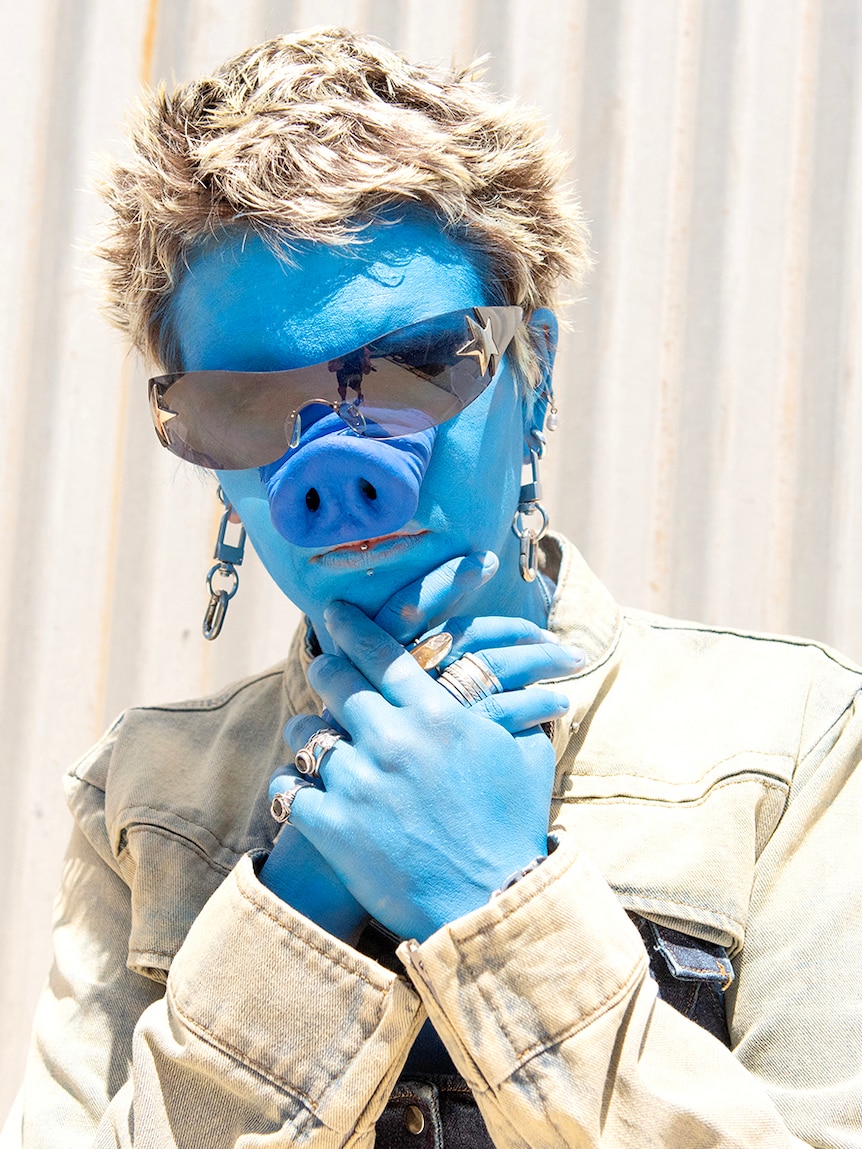
SNOUT: The Rock Opera’s lead singer Shyla Van Dok is an Adelaide-based performer. (Supplied: Box City Theatre)
But getting to that point is a drama in itself, one packed with grant applications (most of which failed), production preparations, wheeling and dealings with venue operators, insurance companies, backline providers, technicians, and endless emails that leave you hanging for responses.
It’s an organisational jigsaw and sometimes pieces are lost while you’re out herding cats.
And then there’s the creative side, which, for me, involved composing a one-hour score of progressive music for an 18-piece band, finding musicians with the ability and commitment to take it on, writing and directing the show, and overlooking the creation of visual effects.
If it wasn’t for the enthusiasm of those who stepped up to the plate — including a make-up graduate willing to paint our musicians blue and a group of visual effects students creating digital animation for SNOUT’s offbeat science-fiction story — very little would take off at all.
Loading…
But they are here because they believe in the project, and you, which means pulling out all the stops for several months stops to drive the thing home because, frankly, no-one else is going to do it.
A ‘daunting’ prospect
For Sydney’s Remy Rochester, who is bringing her contemporary dance and physical theatre duet, Please … Continue? to the Adelaide Fringe for the first time, the idea that everything is on your shoulders and yours alone has been a “steep learning curve”.
“Every other time we’ve performed this work, it’s been programmed into a festival so I’ve been able to focus on the work,” the choreographer and dancer said.
“But this time around, I’ve realised that unless I am the one doing it, nothing is going to happen.”
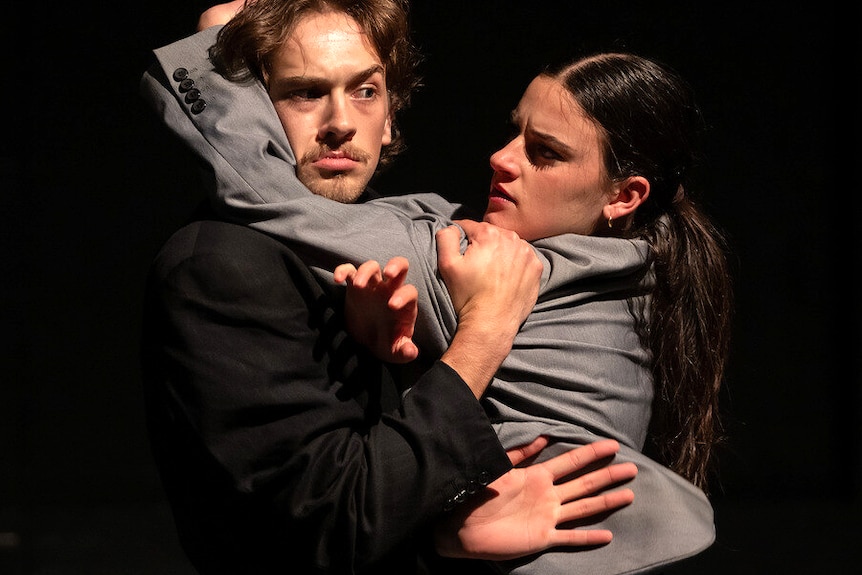
Angus Onley and Remy Rochester are dancing in Please … Continue? at the Adelaide Fringe this year. (Supplied: Remy Rochester)
That includes marketing and attracting audiences from among the “sea of shows” at the Adelaide Fringe.
“It’s a bit daunting, actually, coming from interstate where I have my community of family, friends and artists who I feel would ensure there’ll be familiar faces at every show,” Rochester said.
“I’m a dancer and choreographer. I don’t have a degree in marketing and producing, and doing that myself in Adelaide feels very much like shooting in the dark.
“I don’t know what’s effective in this scenario, so I’m bit apprehensive on that front.”
Enter the Adelaide Fringe organisation, which, after 66 years growing into the second largest fringe festival in the word, is a well-oiled machine packed with enthusiastic staff and volunteers eager to help.
They can’t help you produce your show, but they can help you find venues, find industry delegates and collaborators who may be interested in your work, introduce you to media — a useful moment when competing with hundreds of other artists — give you support and even feed you.
“I’ve always been able to call [the Adelaide Fringe office] and there will be someone to help, which I love,” Rochester said.
Fringe hubs such as Gluttony, too, which is hosting SNOUT, are also helpful and full of tips to help with marketing.
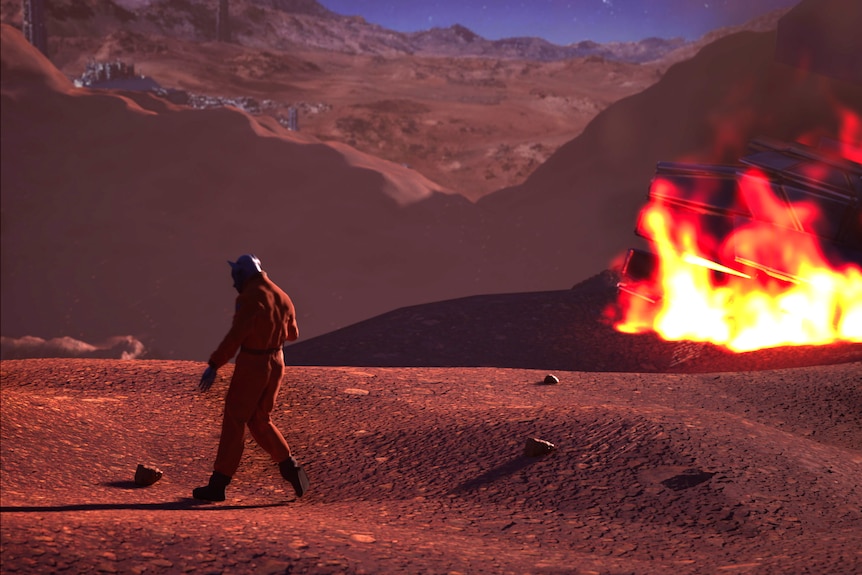
A screenshot of SNOUT: The Rock Opera’s visual effects in progress. (Supplied: Box City Theatre)
They have a stake in the game through a percentage of ticket sales (although a significant up-front hire fee must be paid as a deposit along with any additional backline expenses), so they have an interest in seeing you succeed.
Ms Rochester says it’s different to the Sydney Fringe Festival, however, where the stakes are even higher for organisers.
She said that after the registration fee is paid, the Sydney Fringe takes over the venue hire, technicians and marketing, all the dance acts are programmed into the same hub and, unlike in Adelaide, there is no up-front fee for venue hire, which is instead paid for through a profit split alone.
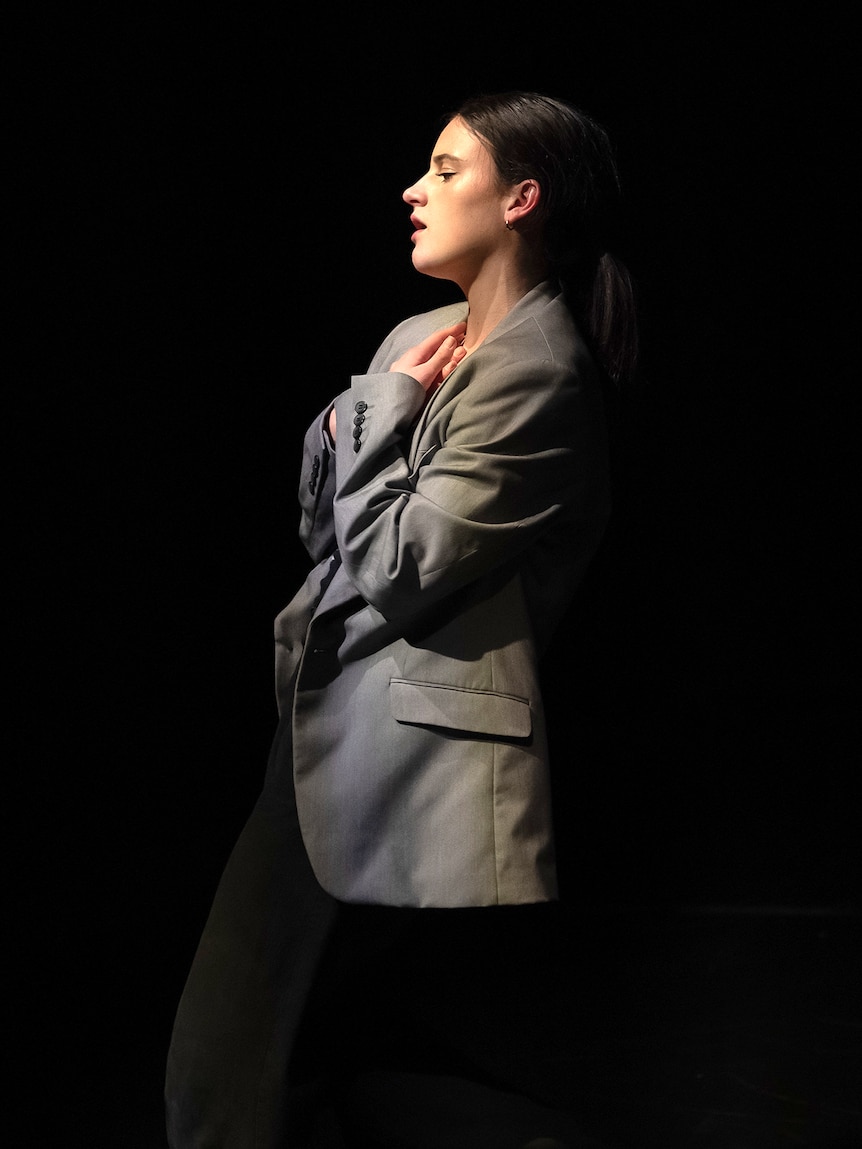
Remy Rochester is a dancer and choreographer from Sydney. (Supplied: Remy Rochester)
“I feel a lot more comfortable doing that as an artist, sharing the risk with Fringe, and therefore I know it has an incentive to get people to my shows because they literally have a vested interest in that,” Rochester said.
She described the feeling of having 100 per cent of the risk put onto the artist as being “a lot of weight on my shoulders”.
“But we appreciate this Fringe festival is massive and understand the team is doing the best they can with the huge number of artists and shows they’re coordinating,” Rochester said.
After all, the Adelaide Fringe has grown into Australia’s largest open access arts festival with more than 1,500 acts this year. The last Sydney Fringe, by comparison, had just over 460.
Backing yourself
Adelaide Fringe acting chief executive Tara Macleod said first time artists often took on every part of the process themselves, along with performing, and acknowledged it could be very daunting for them.
“You might be producing the show, doing the marketing, selling the tickets and handling the logistics, sometimes all at once. You are backing your own work and taking on that risk yourself, which is a significant leap, especially when you are bringing new ideas to the stage,” she said.
But Ms Macleod said the Fringe wasn’t just a platform; it also worked to ensure emerging artists were supported with funding, guidance and practical resources.
“The aim is to lower barriers where we can and give artists the best possible chance to find their audience and build a sustainable career,” she said.
This included awarding more than $1,000,000 in grants to help 247 artists, venues and producers in 2026.
Fringe ticket sales ‘drop off a cliff’ as rain forecast fizzes
SNOUT: The Rock Opera was one of them — although the larger personal investment remains scary.
That is why, despite all the support, when an unexpected setback throws you into disarray and that hard, unrelenting deadline inches closer regardless, the anxiety is real.
But it’s under the shade of that encroaching beast that, for me at least, the familiar world about you seems more serene, the mundane more sweet, the day-to-life you put on hold for a shot at something bigger seems like bliss.
That in itself may be the worth the price of admission — that and giving youth a chance to put their work on the world stage.
SNOUT: The Rock Opera plays at Gluttony’s Tandanya Theatre from March 17 to 22.
Please … Continue? shows at The Garage International at the Dom Polski Centre from March 12 to 14.