
Australia has responded to a call for help from the United Arab Emirates (UAE) as it faces bombardment from Iranian drones.
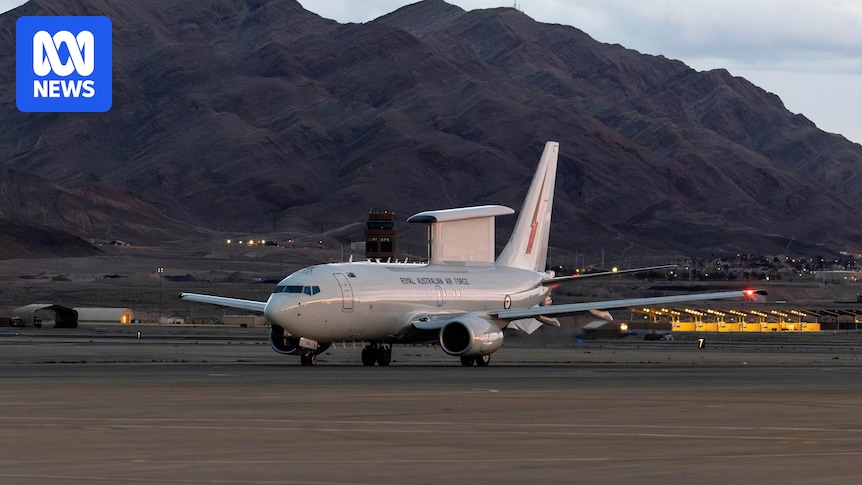
One of the country’s most sophisticated military surveillance planes will be deployed, along with a crew of about 85 defence personnel to operate it.
A supply of air-to-air missiles will also be sent to help shoot down the drones causing chaos across the region.
Surveillance is one of Australia’s strengths and has been put to use supporting Ukraine’s efforts in its war with Russia in the past.
But the request from Gulf countries also highlighted a gap in Australia’s capabilities the government has in recent years been rushing to fill — finding, targeting and shooting down cheap, mass-produced, long-range drones.
A big plane with a bigger radar
Some time today, an E-7A Wedgetail will depart its base at Williamtown, north of Newcastle, bound for the Persian Gulf.
Australia has a fleet of six Wedgetails, and they have recent experience in similar conditions to what they will find defending the UAE and other Gulf states.
In mid-2025, a Wedgetail was deployed along with 100 Australian Defence Force (ADF) personnel to Poland to help Ukraine counter drone and ballistic missile strikes coming from Russia.
Australia to provide military support to Gulf states
It ran more than 45 missions throughout its three-month deployment, including monitoring Russian jets violating Estonian airspace and providing intelligence as Ukraine was bombarded with drones and missiles during a heavy Russian attack last September.
The E-7A Wedgetail is in some ways a conventional aircraft with an exceptionally powerful radar capability.
Based on the Boeing 737-700, its radar is strong enough to cover 4 million square kilometres of terrain, according to Defence.
That is larger than Western Australia and the Northern Territory combined.
As with Ukraine, the deployment of the Wedgetail requires a fairly significant contingent of personnel to operate it.
Defence Minister Richard Marles today said “in the order of 85” ADF personnel will be deployed with the aircraft.
Read more about the Iran war:Air-to-air missiles on the way
While the deployment of the Wedgetail was seen by some defence analysts as a fairly obvious contribution Australia could make, the offer of missiles took some by surprise.
The request for military support came in writing from the UAE, and the prime minister appeared to indicate that missiles were a specific request.
“In response to a request, my government intends to provide advanced medium-range air-to-air missiles to the United Arab Emirates,” Anthony Albanese said.
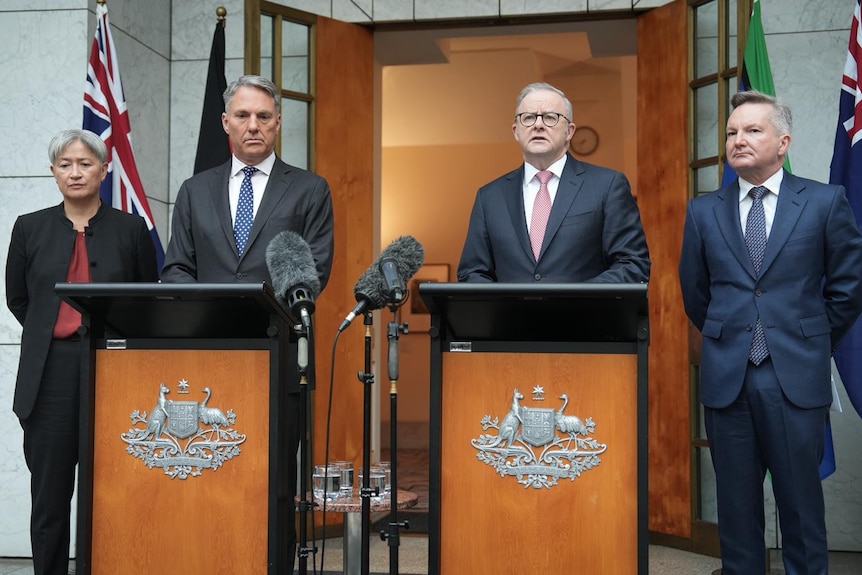
The government has announced it will provide military assistance to Gulf states. (ABC News: Matt Roberts)
The volume of attacks coming from Iran is testing the stockpiles of missiles held by Gulf states in particular, according to analysts, which is why they are looking for supplies elsewhere.
And while the “Shahed” drones used by Iran are relatively cheap and simple to produce, the guided missiles required to shoot them down are both very expensive and complicated to make.
Jennifer Parker from the University of Western Australia’s Defence and Security Institute said the weapons will be much needed.
“One of the most significant challenges for the Gulf states right now is not only the detection of these ballistic missiles and drones, but the ability to shoot them down,” she said.
“Some of these drone attacks are occurring in what you would consider saturation — large numbers of drone attacks, which is very intensive in terms of the use of interceptors or missiles.
“I think it would be a welcome contribution.”

About 85 ADF personnel will be deployed with the aircraft, Richard Marles says. (ABC News: Matt Roberts)
The ADF is not currently known for its counter-drone capabilities, but it is investing heavily in the weapons in a bid to bolster its own defences.
In mid-2025, the federal government announced it would spend more than $2 billion acquiring new missiles for both air-to-air and surface-to-air purposes.
Those are not the missiles being offered up. It is understood the missiles bound for the UAE will come from “existing stocks”.
What this war tells us about future wars
There are lessons Australia should take from this conflict to help better prepare for the next, according to Ms Parker, particularly when it comes to the threat of drone attack.
The scale of drone attacks coming from Iran has forced the US and other countries to turn to some unexpected places for guidance. For example, the US has called on war-torn Ukraine for help.
‘Unprepared’ to defend against Iranian drones, US calls on Ukraine for help
Ms Parker said one option Australia could consider was sending fighter aircraft to the region, both to help defend Gulf states and gain valuable experience in this kind of warfare.
“I do think that potentially, if this goes on further, Australia should look at what more we could provide in a defensive capacity,” she said.
“We do have a range of capacities, including our fighter aircraft.
“And this is sad to say, but [it would be] critical experience for our Australian Defence Force in a changing world.”
The federal government is planning to spend more than a billion dollars on bolstering anti-drone defences in the coming years, primarily through the $1.3 billion “Project Land 156” program.
Loading
That funding will be rolled out over the next 10 years on a range of different counter-drone defences.
Ms Parker said countering the type of long-range drones causing havoc in the Gulf at present needs to be a top priority for government funding going forward.
“There are a number of gaps in ADF capability, but investment in integrated air and missile defence, the ability to detect and shoot down these [drones], needs to be a priority for the May budget,” she said.
“Yes, we have capability, and we are providing some of that capability to the Middle East, but we have limited capability in a wide range of critical areas that we would need to protect in a conflict.”
Loading…