
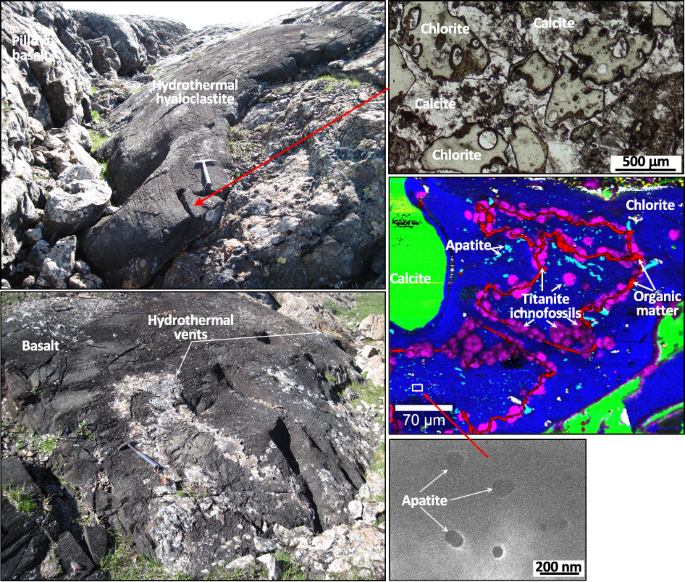
Djokic, T., Van Kranendonk, M. J., Campbell, K. A., Walter, M. R. & Ward, C. R. Earliest signs of life on land preserved in ca. 3.5 Ga hot spring deposits. Nat. Comm. 8, 15263 (2017).
Wacey, D. et al. Geochemistry and nano-structure of a putative ~3240 million-year-old black smoker biota, sulphur springs group, Western Australia. Precamb. Res. 249, 1–12 (2014).
Dodd, M. S. et al. Evidence for early life in Earth’s oldest hydrothermal vent precipitates. Nature 543, 60–64 (2017).
Papineau, D. et al. Metabolically diverse primordial microbial communities in Earth’s oldest seafloor-hydrothermal jasper. Sci. Adv. 8, eabm2296 (2022).
Baross, J. A. & Hoffman, S. E. Submarine hydrothermal vents and associated gradient environments as sites for the origin and evolution of life. Orig. Life 15, 327–345 (1985).
Russel, M. J. The importance of being alkaline. Science 302, 580–581 (2003).
Dick, G. J. The microbiomes of deep-sea hydrothermal vents: distributed globally, shaped locally. Nat. Rev. Microbiol. 17, 271–283 (2019).
Furnes, H., Banerjee, N. R., Muehlenbachs, K., Staudigel, H. & DeWit, M. Early life recorded in Archean pillow lavas. Science 304, 578–581 (2004).
Cavalazzi, B., Westall, F., Cady, S. L., Barbieri, R. & Foucher, F. Potential fossil endoliths in vesicular pillow basalt, coral patch seamount, Eastern North Atlantic Ocean. Astrobio 11, 619–631 (2011).
Staudigel, H., Furnes, H. & DeWit, M. Paleoarchean trace fossils in altered volcanic glass. Proc. Natl. Acad. Sci. USA 112, 6892–6897 (2015).
Banerjee, N. R., Furnes, H., Muehlenbachs, Staudigel, H. & DeWit, M. Preservation of ~3.4-3.5 Ga microbial biomarkers in pillow lavas and hyaloclastites from the Barberton Greenstone Belt, South. Earth Planet. Sci. Lett. 241, 707–722 (2006).
McLoughlin, N., Grosch, E. G., Kilburn, M. R. & Wacey, D. Sulfur isotope evidence for a Paleoarchean subseafloor biosphere, Barberton, South Africa. Geology 40, 1031–1034 (2012).
Lepot, K., Benzerara, K. & Phillippot, P. Biogenic versus metamorphic origins of diverse microtubes in 2.7 Gyr old volcanic ashes: multi-scale investigations. Earth Planet. Sci. Lett. 312, 37–47 (2011).
Bridge, N. J., Banerjee, N. R., Mueller, W., Muehlenbachs, K. & Chacko, T. A volcanic habitat for early life preserved in the Abitibi Greenstone Belt. Can. Precamb. Res. 179, 88–98 (2010).
Furnes, H. et al. Comparing petrographic signatures of bioalteration in recent to Mesoarchean pillow lavas: tracing subsurface life in oceanic igneous rocks. Precamb. Res. 158, 156–176 (2007).
Lepot, K., Philippot, P., Benzerara, K. & Wang, G.-Y. Garnet-filled trails associated with carbonaceous matter mimicking microbial filaments in Archean basalt. Geobiology 7, 393–402 (2009).
Fliegel, D. et al. Septate-tubular textures in 2.0-Ga pillow lavas from the Pechenga Greenstone Belt: a nano-spectroscopic approach to investigate their biogenicity. Geobiology 8, 372–390 (2010).
McLoughlin, N. et al. Assessing the biogenecity and syngenicity of candidate bioalteration texture in pillow lavas of the ~2.52 Ga Wutai greenstone terrane of China. Chin. Sci. Bul. 55, 188–199 (2010).
Grosch, E. G. & McLoughlin, N. Reassessing the biogenicity of Earth’s oldest trace fossil with implications for biosignatures in the search for early life. Proc. Natl. Acad. Sci. USA 111, 8380–8385 (2014).
Sapers, H. M., Osinski, G. R., Banerjee, N. R. & Preston, L. J. Enigmatic tubular features in impact glass. Geology 42, 471–474 (2014).
Fisk, M. & McLoughlin, N. Atlas of alteration textures in volcanic glass from the ocean basins. Geosphere 9, 317–341 (2013).
McLoughlin, N., Wacey, D., Phunguphungu, S., Saunders, M. & Grosch, E. G. Deconstructing Earth’s oldest ichnofossil record from the Pilbara Craton, West Australia: implications for seeking life in the Archean subseafloor. Geobiology 18, 525–543 (2020).
Podbielski, M. et al. Troubles with tubules: how do iron-mineral chemical gardens differ from iron-mineralised sheaths of iron oxidising bacteria?. Geobiology 23, e70021 (2025).
Thorseth, I. H., Furnes, H. & Heldal, M. The importance of microbiological activity in the alteration of natural basaltic glass. Geochim. Cosmochim. Acta 56, 845–850 (1992).
Torsvik, T., Furnes, H., Muehlenbachs, K., Thorseth, I. H. & Tumyr, O. Evidence for microbial activity at the glass-alteration interface in oceanic basalts. Earth Planet. Sci. Lett. 162, 165–176 (1998).
McLoughlin, N., Brasier, M. D., Wacey, D., Green, O. R. & Perry, R. S. On biogenicity criteria for endolithic microborings on early Earth and beyond. Astrobio 7, 10–26 (2007).
Barge, L. M. & Price, R. E. Diverse geochemical conditions for prebiotic chemistry in shallow-sea alkaline hydrothermal vents. Nat. Geosci. 41561, 022–01067-1 (2022).
Papineau, D. Chemically oscillating reactions as a new model for the formation of mineral patterns in agate geodes and concretions. Minerals 14, 203 (2024).
Papineau, D. et al. Widespread chemically oscillating reactions during oxidative organic diagenesis recorded during the Ediacaran. Chem. Geol. 683, 122753 (2025).
Fisk, M. R., Giovannoni, S. J. & Thorseth, I. H. Alteration of oceanic volcanic glass: textural evidence of microbial activity. Science 281, 978–980 (1998).
Papineau, D. et al. Nanoscale petrographic and geochemical insights on the origin of Paleoproterozoic stromatolitic phosphorites from Aravalli, India. Geobiology 14, 3–32 (2016).
Johannessen, K. C., McLoughlin, N., Vullum, P. E. & Thorseth, I. H. On the biogenicity of Fe-oxyhydroxide filaments in silicified low-temperature hydrothermal deposits: Implications for the identification of Fe-oxidizing bacteria in the rock record. Geobiology 18, 31–53 (2019).
Maslennikov, V. V., Ayupova, N. R., Herrington, R. J., Danyushevskiy & Large, R. R. Ferruginous and manganiferous haloes around massive sulphide deposits of the Urals. Ore Geol. Rev. 47, 5–41 (2012).
Sole, C. et al. Evidence for Hadean mafic intrusion in the Nuvvuagittuq Greenstone Belt, Canada. Science 388, 1431–1435 (2025).
Rydland-Pederson, L.-E., McLoughlin, N., Vullum, P. E. & Thorseth, I. H. Abiotic and candidate biotic micro-alteration textures in subseafloor basaltic glass: a high-resolution in-situ textural and geochemical investigation. Chem. Geol. 410, 124–137 (2015).
Kouketsu, Y. et al. A new approach to develop the Raman carbonaceous material geothermometer for low-grade metamorphism using peak width. Isl. Arc 23, 33–50 (2016).
Lafhid, A. et al. Evolution of the Raman spectrum of carbonaceous material in low-grade metasediments of the Glarus Alps (Switzerland). Terra Nova 22, 354–360 (2010).
Ivarsson, M., Broman, C., Gustafsson, H. & Holm, N. G. Biogenic Mn-oxides in subseafloor basalt. PLoS ONE 10, e0128863 (2015).
Papineau, D. et al. Abiotic chemically oscillating reactions on the seafloor produce patterns in deep-sea ferromanganese nodules. Geochem. Perspect. Lett. 35, 55–61 (2025).
Bach, W. & Edwards, K. J. Iron and sulfide oxidation within the basaltic ocean crust: implications for chemolithotrophic microbial biomass production. Geochim. Cosmochim. Acta 67, 3871–3887 (2003).
Furnes, H., Muehlenbachs, K., Torsvik, T., Thorseth, I. H. & Tumyr, O. Microbial fractionation of carbon isotopes in altered basaltic glass from the Atlantic Ocean, Lau Basin and Costa Rica Rift. Chem. Geol. 173, 31–330 (2001).
Cañadas, F., Papineau, D., Leng, M. J. & Li, C. Extensive primary productivity promoted the recovery of the Shuram excursion. Nat. Comm. 13, 148 (2022).
McCollom, T. M. & Seewald, J. S. Serpentinites, hydrogen, and life. Elements 9, 129–134 (2013).
Proskurowski, G. et al. Abiogenic hydrocarbon production at Lost City hydrothermal field. Science 319, 604–607 (2008).
McDermott, J. M., Seewald, J. S., German, C. R. & Sylva, S. P. Pathways for abiotic organic synthesis at submarine hydrothermal fields. Proc. Natl. Acad. Sci. USA 112, 7668–7672 (2015).
Galvez, M. et al. Graphite formation by carbonate reduction during subduction. Nat. Geosci. 6, 473-477 (2013).
Gabriel, N., Papineau, D., She, Z., Leider, A. & Fogel, M. L. Organic diagenesis in stromatolitic dolomite and chert from the late paleoproterozoic McLeary formation. Precamb. Res. 354, 106052 (2021).
Goodwin, A. & Papineau, D. Biosignatures associated with organic matter in late Paleoproterozoic stromatolitic dolomite and possible implications for Martian carbonates. Astrobio 22, 1–27 (2022).
Kump, L. R. et al. Isotopic evidence for massive oxidation of organic matter following the great oxidation event. Science 334, 1694–1696 (2011).
Ueda, A., Cameron, E. M. & Krouse, H. R. 34S-enriched sulphate in the Belcher Group, N.W.T., Canada: evidence for dissimilatory sulphate reduction in the early Proterozoic Ocean. Precamb. Res. 49, 229–233 (1990).
Habicht, K. S., Gade, M., Thamdrup, B., Berg, P. & Canfield, D. E. Calibration of sulfate levels in the Archean Ocean. Science 298, 2372–2374 (2002).
Habicht, K. S., Canfield, D. E. & Rethmeier, J. Sulfur isotope fractionation during bacterial reduction and disproportionation of thiosulfate and sulfite. Geochim. Cosmochim. Acta 62, 2585–2595 (1998).
Ricketts, B. D., Ware, M. J. & Donaldson, J. A. Volcaniclastic rocks and volcaniclastic facies in the middle precambrian (Aphebian) Belcher Group, Northwest Territories, Canada. Can. J. Earth Sci. 19, 1275–1294 (1981).