
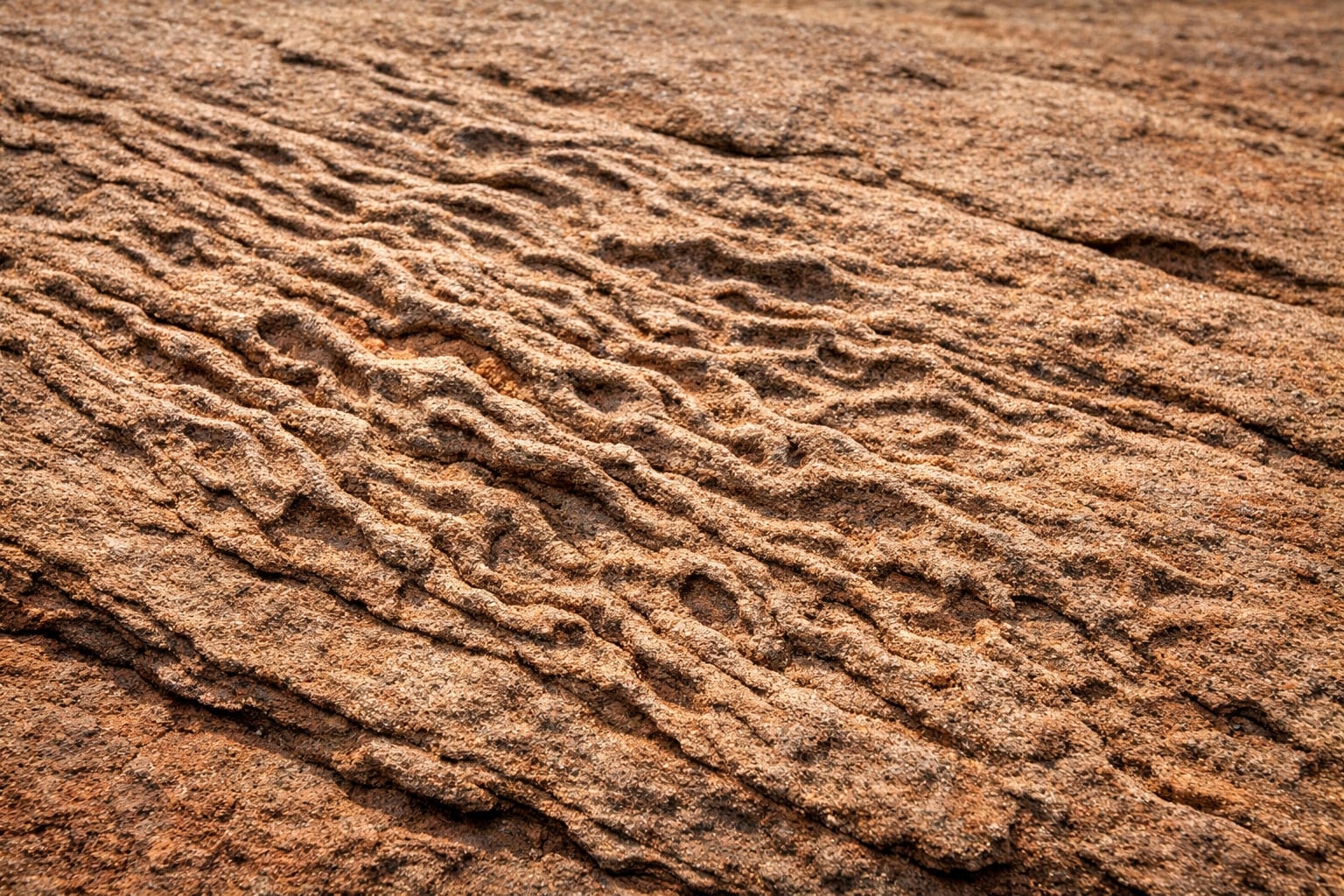
Wrinkle structures are small ridges and pits in rock, often made by microbial mats. They’re best known from Precambrian and Cambrian strata, where they serve as important evidence of early life, and can still be seen today in tidal zones. Normally, animals erase these delicate features before they’re preserved, which is why they’re rare in younger rocks.
They sometimes reappear after mass extinctions, when grazing animals vanish, allowing microbial mats to survive. Most wrinkles are found in shallow marine settings where sunlight supports photosynthesis and alternating sands and muds help preserve them. Reports of wrinkles in deeper water do exist, but they are usually attributed to sediment-flow effects rather than to true microbial textures.
In a recent study, scientists reported something unexpected: the first wrinkle structures from the Toarcian period preserved in deep‑water turbidites of Morocco’s Tagoudite Formation. These wrinkles resemble those found in shallower deposits, but at a depth of around 200 meters, they couldn’t have been formed by light‑dependent microbial mats.
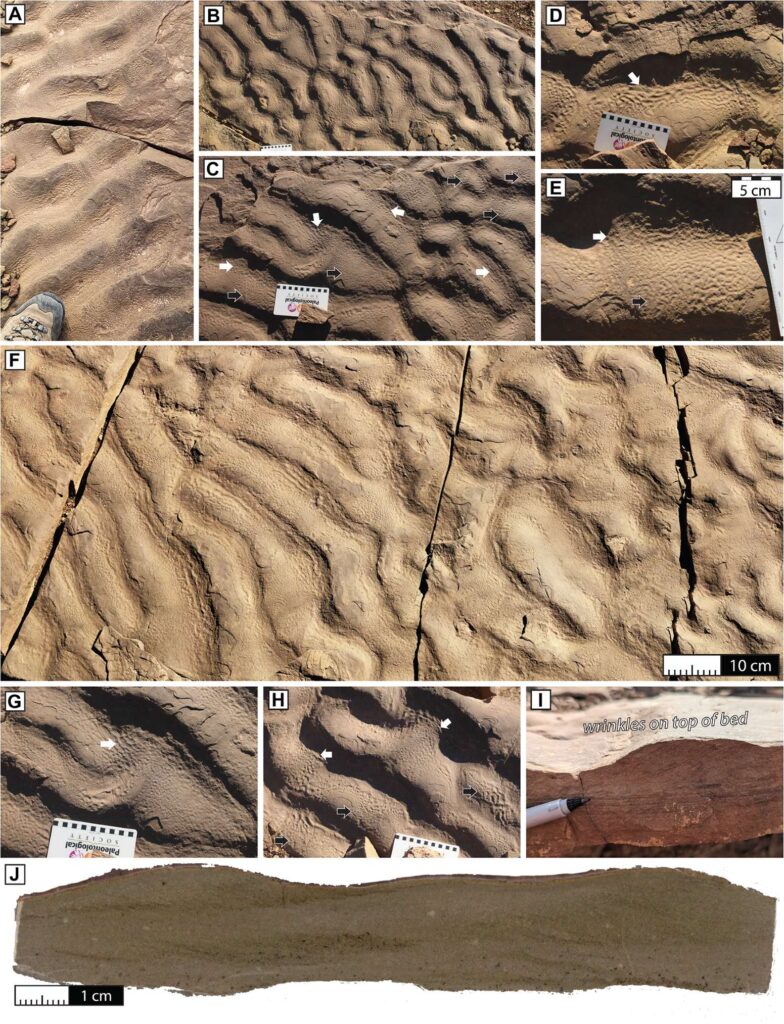 Photographs of wrinkle structures in the Tagoudite Formation of the Central High Atlas Mountains, Morocco. Black arrows point to wrinkles on ripple crests; white arrows point to wrinkles in ripple troughs. (A) Straight rippled bedding plane with wrinkles. (B) Complex ripples with wrinkles (scale bar squares are 5 × 5 mm). (C) Close-up of wrinkles in ripple troughs and crests from panel B. (D) Wrinkles in ripple troughs. Note the lack of wrinkles on the crest. (E) Well-developed wrinkles in the trough and crest of ripples. (F–H) Variations in size, shape, and texture of wrinkles as they interact with ripples on the bedding plane at ~74 m in the stratigraphic log. (I) Cross section of rippled unit (pen diameter is 9 mm at widest point). (J) Polished cross section through wrinkle structure sample (NPL00090497). Samples are reposited at the University of Texas at Austin (USA).
The team described the shapes and composition of their structures and proposed a new model showing how wrinkle structures could form in deep‑water settings through biotic processes.
Dr. Rowan Martindale, a paleoecologist and geobiologist at the University of Texas at Austin, was walking in the Dadès Valley in the Central High Atlas Mountains of Morocco when she spotted something that literally stopped her in her tracks.
She and Stéphane Bodin of Aarhus University were following the trail of turbidites, sediments left behind by submarine debris flows, on their way to study long‑buried reefs. Ripples are expected in turbidites. But what Martindale saw were not just ripples. They were delicate folds, crenulations etched across the surface.
The surprise was not just in their appearance but in their setting. These deposits had formed at least 180 meters below the surface, far too deep for sunlight to reach. Wrinkle structures, the kind Martindale thought she was seeing, are usually made by photosynthetic microbial mats in shallow water.
And the rocks themselves were only about 180 million years old, a time when animals were already disturbing the seafloor. By all conventional wisdom, such wrinkles shouldn’t have been there at all.
“As we’re walking up these turbidites, I’m looking around, and this beautifully rippled bedding plane caught my eye,” she says. “I said, ‘Stéphane, you need to get back here. These are wrinkle structures!
That contradiction set off a careful investigation.
“Let’s go through every single piece of evidence that we can find to be sure that these are wrinkle structures in turbidites,” Martindale insisted, because wrinkle structures, usually photosynthetic in origin, “shouldn’t be in this deep‑water setting.”
The team began piecing together clues. The team started connecting the dots. The team logged the rock layers and photographed the wrinkle structures at Boumrdoul (31.618472°N, 5.852694°W). After gathering representative samples, they sliced and polished them for a more detailed study.
They examined the samples using light microscopes and scanning electron microscopes (SEM) equipped with energy‑dispersive X‑ray spectroscopy (EDS), which identified the material’s elemental composition. All samples are now stored at the University of Texas at Austin.
Indeed, the sediments were turbidites, the team confirmed. Studying wrinkle texture revealed high carbon concentrations under wrinkles of biological origin. More recently, modern submersible video has recorded the growth of microbial mats in a dark underworld that isn’t nourished by sunlight and is instead supported by chemosynthetic bacteria.
Turbidites feed nutrients and organic matter into deep water. They also lower oxygen levels and create conditions that allow chemosynthetic mats to spread. In the quiet intervals between debris flows, bacteria wrinkle the sediment surface. Most of the time, the next flow wipes them away. But sometimes, the wrinkles endure.
Taken together, the evidence pointed to a clear conclusion: these were chemosynthetic wrinkle structures preserved in the rock record. For Martindale, that changes the picture. Wrinkle structures have long been linked only to photosynthetic mats. Still, this discovery shows they can also form in dark, deep‑water environments, meaning geologists may have overlooked entire settings where microbial life left its mark.
“Wrinkle structures are really important pieces of evidence in the early evolution of life,” she says. By ignoring their possible presence in turbidites, “we might be missing out on a key piece of history of microbial life.”
The next step involves recreating the process in the lab to test how wrinkles form under turbidite conditions. If successful, it could reshape how scientists interpret microbial traces in the rock record and where they choose to look for them.
Journal Reference:
Rowan C. Martindale; Sinjini Sinha; Travis N. Stone; Tanner Fonville; Stéphane Bodin; François-Nicolas Krencker; Peter Girguis; Crispin T.S. Little; Lahcen Kabiri. Chemosynthetic microbial communities formed wrinkle structures in ancient turbidites. Geology. DOI: 10.1130/G53617.1