
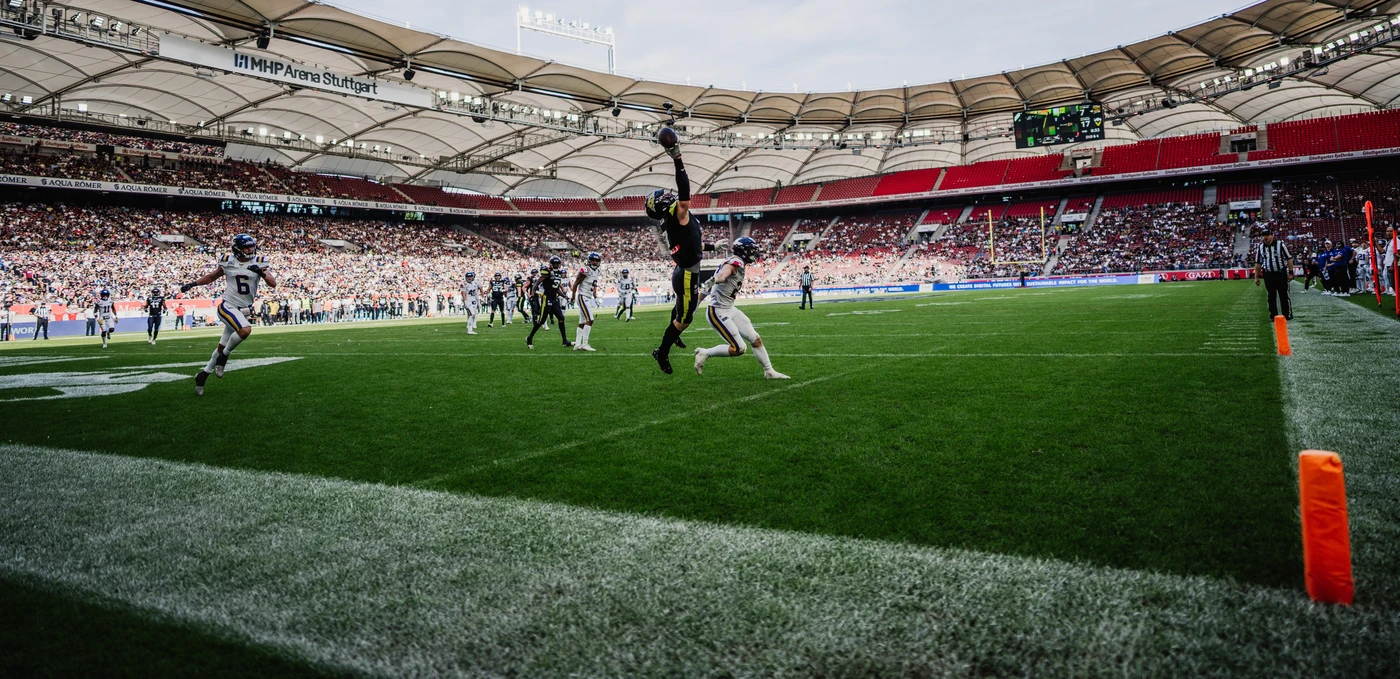
In an interview with American football magazine “Foot Bowl“, ELF CEO Zeljko Karajica talks about the current situation, discussions with partners and franchises, and once again emphasizes the necessity and urgency of finding a joint solution: “There’s no room for three leagues.” And: “The ELF is definitely still the perfect place to bring the teams together.”
You have announced that there will also be a league in 2026. How many teams are you planning for?
Zeljko Karajica: “We are talking about nine teams. Last week, we sent our schedule to the teams that we believe are eligible to play in the ELF. Or, to put it another way, these teams are not eligible to play in any other league. We are waiting for their response; the deadlines have been set.”
Can you tell us when the deadline is?
Karajica: “The deadlines expire this week. If we want to start at the end of May, we are now barely more than two months away from the kick-off of the first game. We have to get started now so that the planning can still work out seriously. Thankfully, we have all our partners on board, so we are in a position to implement all the games relatively at the push of a button and distribute them in the way we have been accustomed to in recent years.”
Many teams have publicly stated that they no longer want to be part of the ELF. Can you say specifically which teams are still in the ELF according to their contracts?
Karajica: “There are teams in the EFA such as Tirol, Paris, Nordic Storm, and Madrid that have ongoing contracts with us – as does Munich, which is also a shareholder in the ELF. On the other hand, in the AFLE, we have Berlin that still has a current franchise agreement. And the Wroclaw Panthers are still shareholder in the ELF. So there are some legal connections. These teams are bound by contract and cannot simply play somewhere else. We have tried to find a very reasonable solution together. However, we will now do everything we can to enforce this right. We have ongoing contracts, we will insist on that, and that will be the basis for our season and our league.”
You said that all partners are on board. Some service providers are complaining about unpaid bills. How do you explain the situation?
Karajica: “We would not be in self-administration if we had been able to pay everything on time. However, self-administration now allows us to plan ahead again and talk to our partners and creditors. The aim is to find a reasonable way to continue working together in the future. And the feedback from many, many partners is still very positive. Like us, many of them see this as a matter close to their hearts and are prepared to continue on this path with us in the future.”
There are reports that ProSiebenSAT.1 will no longer be broadcasting. Is that true?
Karajica: “Once again: our partners stand by us. We are engaged in an extremely constructive dialogue with our partners. We are waiting to be able to announce the schedule. Then the ELF will also be on ProSieben this year. And also on DAZN and all other partners we had and have in distribution. Last year, we broadcast linearly in 13 countries, plus DAZN worldwide in over 200 countries.”
Some franchises are complaining about unpaid bills, mainly relating to revenue share.
Karajica: “In this context, one must also ask whether all franchises have fulfilled their obligations to the league. We have always balanced the books. And I would argue that the balance we actually have now is more in favor of the ELF. In other words, the balance we are talking about here is not a criteria for the franchises’ compliance with the contract. Definitely not.”
What is the situation in terms of organization and personnel? How well is the ELF still positioned? There have been many departures…
Karajica: “Yes, there have been many departures. But I can reassure everyone: We still have everything we need to run the games. We have enough staff and service providers to actually get this up and running. You just have to trust us on that.”
You actually wanted to step down as CEO, as was publicly announced. Is that still the plan, or are you going to continue?
Karajica: “Yes, that was announced. The capital measure at the end of December was also linked to organizational and structural changes, and the relationship with the franchises would also have been reorganized. Another issue was my role as CEO. I would have stepped down. But the capital measure did not come to fruition. And so we now find ourselves in a special situation. Until it is clarified, I will continue and push ahead. But that doesn’t mean it should be a lifelong task.”
What improvements in terms of transparency and cooperation with the franchises are now planned? What has the ELF learned from the last few years?
Karajica: “One of the core issues that caught up with us was the pace at which we grew. This meant that information to the franchises sometimes fell by the wayside. We should perhaps have taken more time. We have to accept that criticism. The financial resources are of course also related to this. We grew quickly and produced a lot. Naturally, there were problems, both with the franchises and with the league. We need to work on these issues and seek dialogue.”
Teams such as Rhein Fire, Vienna Vikings, Stuttgart Surge, and Frankfurt Galaxy are no longer part of the league. Are you still in talks with each other?
Karajica: “Over the past five years, I have learned that unforeseen change is actually part of the standard repertoire. We set a benchmark with the final at MHP Arena, and everyone will have to measure up to that. I believe it makes sense for everyone involved to talk to each other. I would like everyone to put their egos aside so that we can talk to each other and take the next steps. The ELF is definitely still the perfect place to bring the teams together.”
One last question: Competition stimulates business. Do you think it’s possible to have two European leagues side by side – or maybe even three?

Karajica: “Absolutely not. There’s no room for three leagues. The reality is different: Last year, the ELF saw a decline in reach, for example on linear television in Germany. We were almost 10% below the previous year. We need to analyze this and ask ourselves: What can we do about it? I would argue that American football made in Europe is strong enough to be a good product. But three leagues, with this delicate plant we have here – parallel to each other, competing against each other – as much as I value competition, it don’t see a chance for that.”