
Back when Jack Nicklaus was in his heyday and Greg Norman was circling like a shark, there was a common cuss among professionals cursed by a Pete Dye designed golf course.
The remarkable architect, whose work comes into sharp focus during the Players Championship, particularly when players arrive at the 17th hole at TPC Sawgrass, was renowned for wanting to challenge the mastery of the world’s best golfers.
FOX SPORTS, available on Kayo Sports, is streaming The 2026 PGA Tour LIVE & Exclusive | New to Kayo? Join now and get your first month for just $1.

While TPC Sawgrass has been tempered ever so slightly, there are remnants from the course that in its infancy in the early 1980s drew exasperation, not greatness, from the best.
Sweetly struck irons would kick into the rough or down into a bunker. Precise drives in the air proved disastrous on landing as balls trickled into the water. And that was before competitors even got to a 17th considered one of golf’s great holes.
As Rees Jones, a famous designer from a family of course architects, told Golf Magazine after Dye’s death in 2020, the curse among professional golfers was common. This course is “dyeabolical”, they would complain.
If the wind is swirling on Sunday at the 17th tee, with the Players Championship on the line, expect that curse to come to the forefront if the world’s best fall foul on the infamous Par 3.
READ MORE
TEE TIMES: Blockbuster groups revealed as McIlroy text sparks concern
We’re back at the Island Green for this week’s Players Championship.Source: AP
SHAPING ‘UNPROMISING LAND’ INTO A LEGACY
The Players Championship is in part a celebration of the greatness of Dye, who inspired Nicklaus and Norman and many others in their own course designing careers.
In conjunction with his wife Alice, a former amateur of prowess who played a significant role in a course design business they started in the 1950s, Dye’s courses are a living legacy to his greatness.
Consider the following incredible courses designed by Dye, who was heavily influenced by an extended visit to Scotland in 1963, and count yourself lucky if you have had a chance to play a round.
There is the marvellous Whistling Straits in Wisconsin, the course Jason Day confirmed himself a major champion with a magnificent performance in the 2015 PGA Championship.
The epic “War by the Shore” Ryder Cup of 1991, clinched by the USA by one point, demonstrated the magnificence of the Kiawah Island Ocean Course in South Carolina.
The Harbour Town links on Hilton Head Island is an early design he shared with Nicklaus that, while short by modern standards, retains its teeth with its smaller greens and tight fairways.
The Dyes first course was opened in Heather Hills, Indianapolis, in 1961. Incredibly, in a feat of ingenuity, they also managed to build one at the famous Indianapolis Speedway.
Norman and he designed the Medalist Golf Club, among several Dye-influenced courses in Florida, which counts Tiger Woods and Rory McIlroy among its many elite members.
We could go on and on. Crooked Stick. The Teeth of the Dog in Casa de Campo. The Honors. Gulf Stream. Dye Preserve.
Or any of the bigger courses out west including La Quinta, not far from the Indian Wells Tennis Paradise which is hosting the world’s best tennis players this week. It is not surprising Carlos Alcaraz and Novak Djokovic jumped on a course this week.
Dye’s reputation was built on creating an imprint on land considered “unpromising”, which is a generous assessment of the territory of many of the courses he built including the acclaimed TPC Sawgrass in Florida.
It is now folklore that former PGA Commissioner Deane Beman, who wanted a championship that would be owned by the players of the Tour, sourced 415 acres of wooded wetlands and swamp near Ponte Verde Beach for the hefty price of $1.
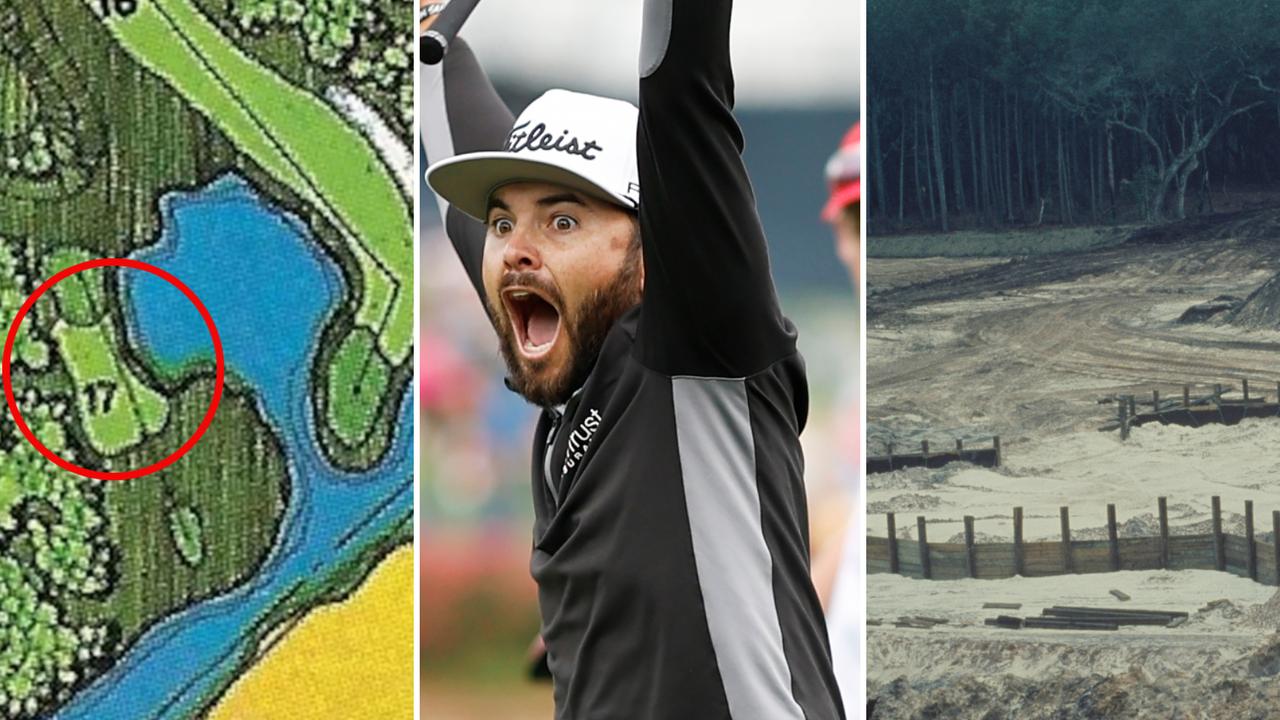
As it stands, the famous Island Hole was not part of the original design for TPC Sawgrass, with Dye instead plotting for a nifty Par 3 with a pond to the right of the green preceding the final hole.
The 17th was never meant to be an island green.Source: FOX SPORTS
But in a case that rings true to the saying that one never knows what they will find if they keep digging, Dye struck gold when excavating around the area where the 17th green sits.
Beman wanted TPC Sawgrass to be a true Stadium Course, a design where spectators could find vantage points from which to watch the greats in pursuit of glory on different holes.
When digging deep into the muck – again, the land was bought for only one buck – Dye and his team unearthed rich white sand underneath and struck a plan to switch the lie of the land around.
They excavated the sand layer, put the muck back in below it, and then poured the sand on top.
But according to Golf Digest, the cavity around the 17th green became deeper and deeper until it became clear to Dye’s wife Alice the green should become an island.
The green was initially canted towards the back, which would have been even more “dyeabolical”, before Dye’s wife wisely suggested a raised back to a green that is now famous given its role in shaping the champions at TPC Sawgrass.
Construction of the 17th hole, long before it was even an island.Source: Getty Images
LASTING A LIFETIME
The challenge for every designer is to build a course that lasts a lifetime, one that is impervious to the ravages of improvement in technology and athletic ability.
It is said that Dye lamented what “Long” John Daly did to Crooked Stick’s doglegs in the 1991 US PGA Championship.
Rees, in his chat with Golf Magazine in 2020 celebrating the legacy of the golf course designer, said Dye loved popular American golfer Fred Couples but hated how far he could hit the golf ball. Imagine his thoughts about Bryson DeChambeau.
Norman once told Dye he would rip apart TPC Sawgrass and did so with remarkable ease in 1994 when shooting rounds of 63-67-67-67 in a famous win in the Players’ Championship. It spelt potential doom for the course.
But time has shown that Dye had it right, as Nicklaus said was so often the case when paying tribute to his mate.
The Australian’s 24-under is an outlier by some margin. Only Scottie Scheffler, who shot 20-under to win by a shot two years ago, has managed to come close to that score.
Rory McIlroy shot 12-under last year to win a tense playoff against JJ Spaun. Cameron Smith recorded 13-under in his 2022 triumph while Jason Day shot 16-under back in 2016.
It is now 21 years since Adam Scott won the Players Championship and the Aussie veteran has arrived in Florida feeling confident, saying he was driving the ball longer than ever. But he said precision will be more important this week.
“It is helpful, when you think of some of the golf courses, (but) maybe not this one so much; it’s not such a bomber’s paradise,” he said.
“I love … coming back here. Obviously a very special place early in my career to have a big win like that. It is a lot of years ago and lots of things have changed here.
“But it’s fun to be part of that evolution and (I’m) hanging in there. Hopefully I’m going to give myself a chance at another run at the title this week.”
It is a decade since Day’s stunning success in the tournament, which came off the back of a record-equalling opening round of 63, and he said the key to winning was not the birdies he shot.
Hayden Buckley of the United States made an ace on 17 in 2023.Source: Getty Images
Rather it was negotiating holes 13 through 15 even par, with the erasure of mistakes rather than sublime shots the best way to produce a winning score at TPC Sawgrass.
“Fourteen-under is the average score that wins here, so you just have to get that, and if you can get past 14-under, you should have a high percentage chance of actually winning the tournament,” Day said leading into his triumph that year.
The course is about 300m longer than in 1982 but Scheffler said TPC Sawgrass retains something Dye would treasure, namely the respect of golfers. It demands consideration.
“I think when you look at this golf course, I think you see a variety of winners, and you also don’t see one style of player winning this tournament a bunch of times,” Scheffler said.
“When you look at the golf course, I think it is so unique in a sense of the way modern golf is trending. I think this (is a place) you kind of take some steps back, where the areas to hit into are small.”
Geoff Ogilvy, the champion Australian golfer who is now part of design firm Ogilvy, Cocking and Mead, told Australian Golf Digest this week TPC Sawgrass tests the senses and provides a psychological challenge for golfers.
This can be the angles from the tee. The holes that enable running shots. The doglegs that require shape. The pot bunkers. Or that water around the 17th green at Sawgrass.
“It’s amazing how often you seem to be hitting across the fairway rather than directly down the fairway at Sawgrass,” he said.
PONTE VEDRA BEACH, FL – MAY 09: A scenic view of the 17th hole.Source: AFP
“There are so many holes where you are fearful of driving through the dogleg. The same goes for a hole like the 13th at Augusta National. Making them turn the ball with their driver both ways is an important aspect to retain for any course designed to test the best.”
The only golfer to successfully defend the Players Championship, Scheffler discussed its virtues in Florida this week ahead of the tournament beginning on Thursday, with the course’s ability to force competitors to be creative among its many attributes.
“I grew up on a golf course where, when you hit it off line, it’s a parkland style golf course, so I wasn’t ever going to really lose many balls,” the No.1 said
“But when you hit it off line, you were in a lot of trees and you had to learn how to shape the ball low, high, around trees, controlling your distance, controlling your spin, running it.
“What I always loved about golf was always being able to try to do those different things. And this golf course, I think, kind of brings it out of us. It almost forces you into hitting different types of shots. I don’t know if my approach to the tournament has changed very much. But I think it suits my game because you have to play a variety of shots.
“I think that’s something that I’ve always enjoyed about the game of golf, is being able to try to curve the ball in different directions and hit different spins.”
Scheffler was in the infancy of his career when Dye died in 2020. Given his determination to build courses that tested the strengths of golfers, it is hard not to imagine he would have enjoyed the fact he is challenging the current champion.