
‘Could we all be aliens?’, one of the central questions of panspermia, just received some experimental support, thanks to a study that demonstrated the surprising resilience of tiny lifeforms. The recently published paper suggests that any microbes ejected in the debris of an asteroid compact could traverse space and crash-land on other planetary bodies — and survive.
“Life might actually survive being ejected from one planet and moving to another,” says the study’s senior author K.T. Ramesh, a professor of science and engineering at Johns Hopkins University. “This is a really big deal that changes the way you think about the question of how life begins and how life began on Earth.”
Exploring Extremophiles
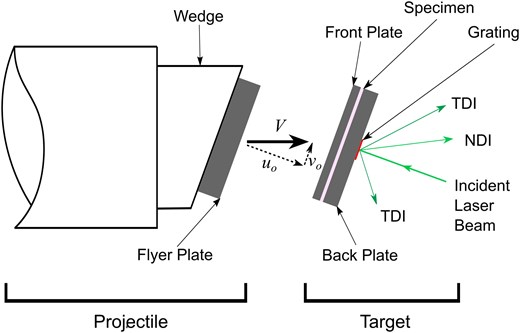
The researchers simulated an interplanetary impact by sandwiching a bacterium between two metal plates and then shooting it with an impactor propelled from a gas gun at speeds of up to almost 500 kilometers (300 miles) per hour.
 Credit: Zhao et al., PNAS Nexus, 2026.
The resultant collisions generated between 1 to 3 Gigapascals. That’s tens of times more pressure than a lifeform would experience 11 kilometers (7 miles) below the waves in the deepest part of the oceans, the Mariana Trench. These values also approach the force that may be experienced by an organism blasted from the surface of Mars.
For the star of the show, scientists chose the hardy bacterium Deinococcus radiodurans, which thrives in the harsh, high-altitude deserts of Chile. With its thick shell and a remarkable ability to repair itself, this extremophile is “notorious” for its ability to survive space-like conditions including extreme cold, dryness, and radiation. If life exists on Mars, “it’s likely to have similar abilities,” explains Ramesh.
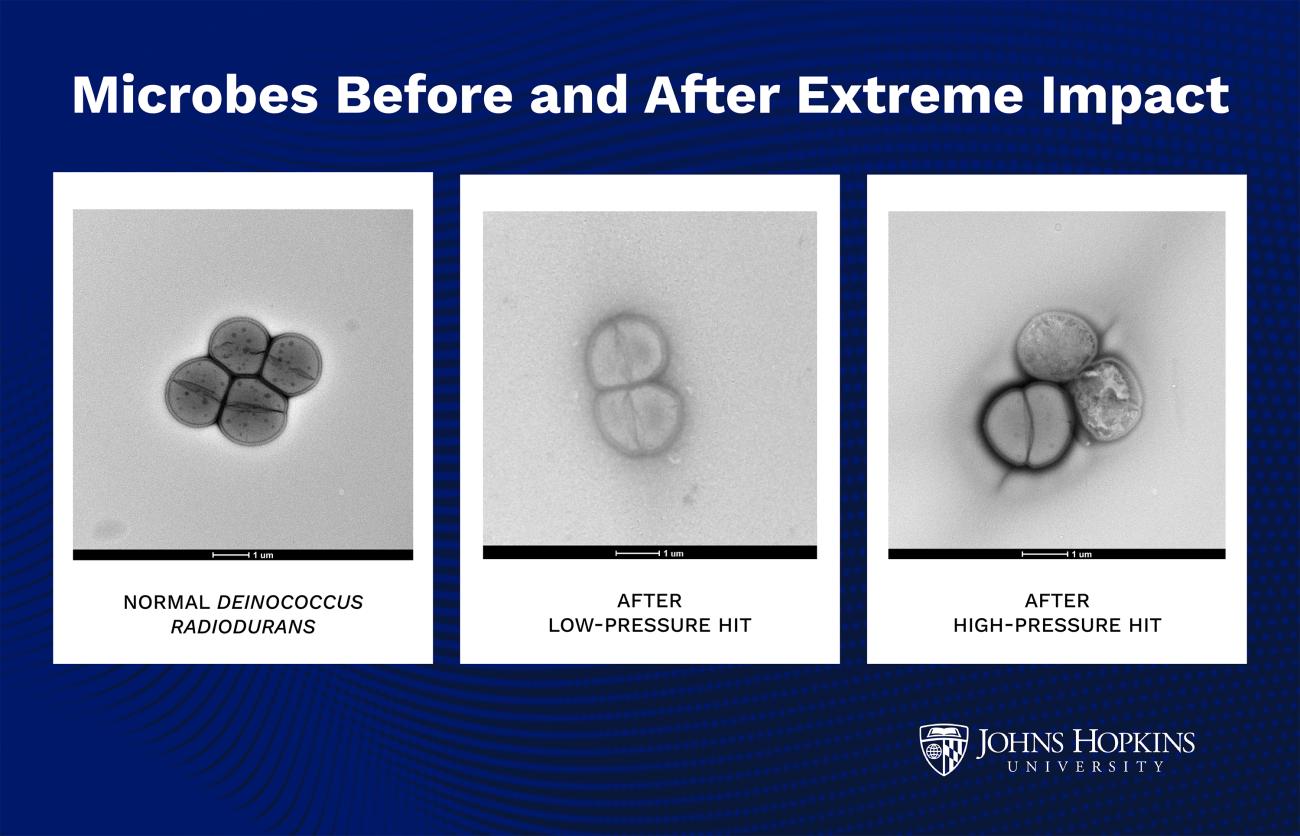
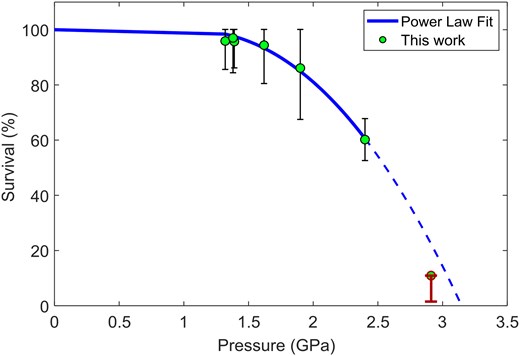
Surprisingly, the researchers found that around 95% of the bacteria survived impacts at 1.4 Gigapascals and displayed no signs of damage. Around 60% of the bacteria survived impacts at 2.4 Gigapascals of pressure, but suffered membrane and internal damage.
 Credit: Lisa Orye/Johns Hopkins University.
Finally, less than 10% survived when the researchers conducted a shot at 2.9 Gigapascals, proving that their power law prediction was robust:
 Credit: Zhao et al., PNAS Nexus, 2026.Support For Panspermia?
This research shows that the extremophile bacteria may have survival rates multiple orders of magnitude higher than previously tested microbes, like E. coli. In fact, the extremophiles out-survived the experiment, as the metal plate set-up broke into pieces during the higher-pressure impacts.
“We have shown that it is possible for life to survive large-scale impact and ejection,” says lead author Lily Zhao, a graduate student at Johns Hopkins University. “What that means is that life can potentially move between planets. Maybe we’re Martians!”
Plus, space impacts are one of the “dominant processes” in our solar system. Impacts create and destroy planets. They cause extinctions but can also benefit life by creating hydrothermal systems and supplying life-building molecules to pockmarked places like Mars and the solar system’s icy, ocean-filled moons.
Yet these findings aren’t just for filling in the neat-to-know-that-we-may-all-be-aliens drawer. They have essential implications for planetary protection policies, such as the possibility of contaminating Mars with life from Earth and, potentially, vice versa.