

Anonymous gamblers have made millions betting on the events of the Middle East war, prompting US politicians to call for a ban on such speculation.
Online bets correctly predicted the US and Israeli strikes on Iran, raising questions about whether the bets were based on insider information and what betting markets should be allowed.
Bets were placed on Polymarket, which describes itself as the world’s largest prediction market and allows users to “trade on the outcomes of real-world events”, using cryptocurrency.
Iran war live updates: For the latest news on the Middle East crisis read our blog.
Polymarket is classified as an interactive gambling service by the Australian Communications and Media Authority (ACMA) and is unlicensed in Australia and prohibited from operating here.
One newly created account on Polymarket made more than a quarter of a million US dollars betting on the strikes, the user’s profile on the website shows.
Other wagers included a bet Iran’s supreme leader, Ali Khamenei, would not be the leader of Iran by February 28, the date of the first US and Israeli strikes. The ayatollah was killed that day.
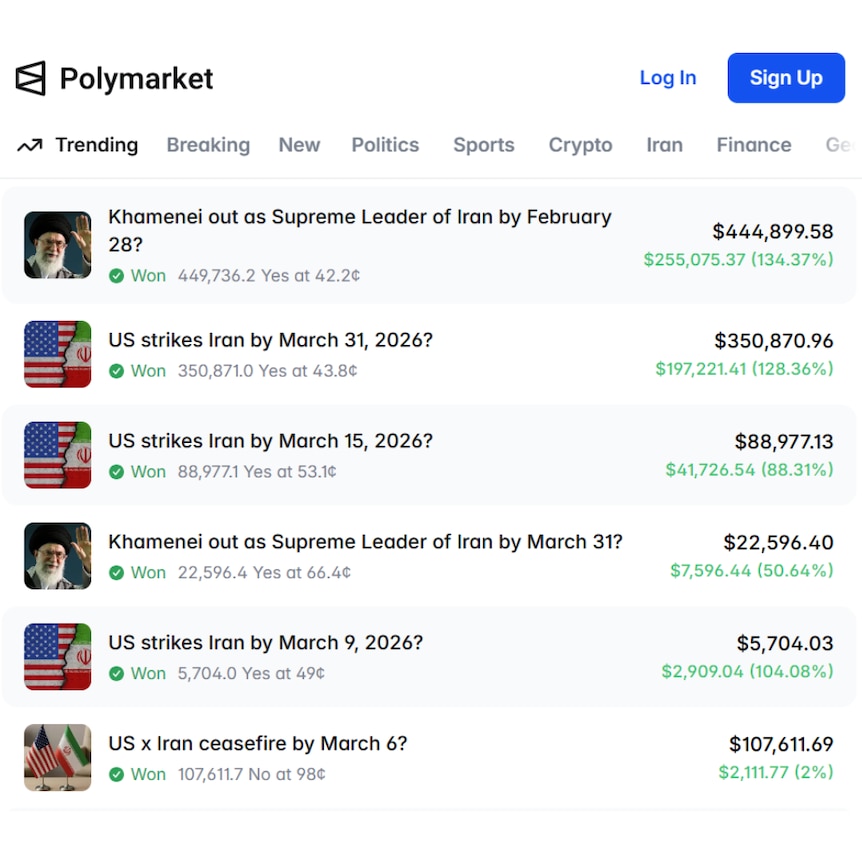
An account created less than a month before the strikes made over a quarter of a million US dollars on a single bet.
US lawmakers and gambling experts have questioned the ethics of profiting from a war that has killed more than 1,200 people to date, according to figures from Iran’s health ministry released yesterday.
Gambling ‘trivialising’ traumatic events
The bets were not by a lone wolf with money to burn and the instincts (or information) to make winning wagers.
More than 150 accounts correctly placed bets of more than $US1,000 ($1,416) on Polymarket in the days before the air strikes, according to the New York Times.
“When gambling operators turn war and human suffering into a betting market, it risks trivialising events that involve real loss of life, displacement and long-term trauma for affected communities”, Louise Francis, a public health and gambling expert at Curtin University, told ABC News.
“Unlike sporting events, wars are not voluntary or bounded contests. Treating them as betting markets risks desensitising the public to human suffering,” Dr Francis said.
Polymarket recently faced a backlash for letting users bet on a nuclear detonation this year, taking down that market last week — but betting on Iran is still available and extremely popular.
The ABC has contacted Polymarket for comment.
The bets are almost entirely on direct actions by the US Department of War, the type of information to which Pentagon insiders would be privy.
There are smaller betting markets available on the consequences of those actions, such as a spike in the price of oil after the strikes.
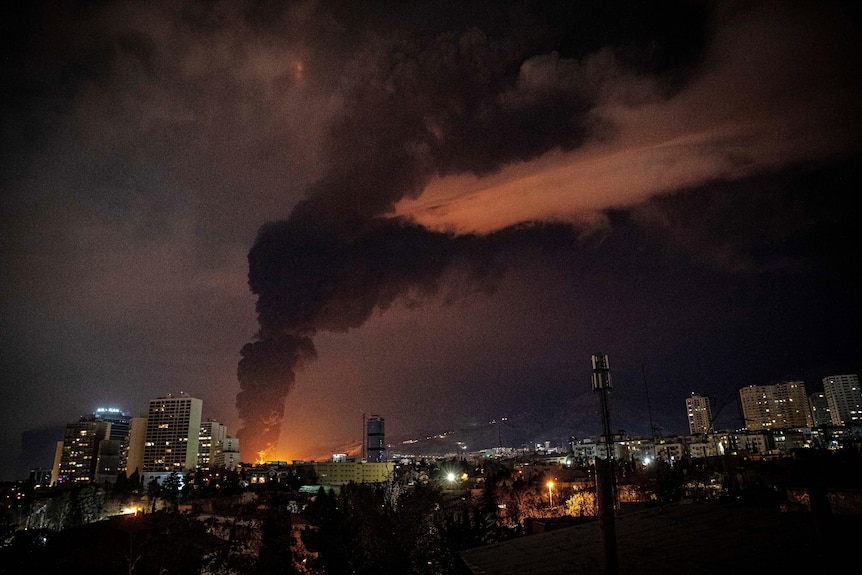
Predictions on US actions in Iran have been some of the platform’s most popular markets. (Alireza Sotakbar/ISNA via AP)
On Thursday, US Democratic Senator Chris Murphy accused the Trump administration of using classified information to bet on the war.
“The Iran War is fuelling a new kind of corruption: White House officials secretly profiting off war,” the senator posted on X.
“It’s disgusting. We need to ban it.”
Along with fellow Democrat, Congressman Mike Levin, Senator Murphy proposed a bill that would restrict betting on military actions, regime change or deaths, according to Reuters.
“We need answers, transparency and oversight,” Mr Levin wrote on X on Saturday.
Will Trump’s GENIUS bill pay off?
Information leaks have been a major issue for the Department of War, most notably when Secretary of War Pete Hegseth accidentally added a journalist to a Signal chat about planning for strikes on Houthi rebels in Yemen.
The Department of War did not respond to an ABC News request for comment on wagering on the Middle East war.
Polymarket mainly uses cryptocurrency, meaning bettors remain anonymous.
The Trump administration’s sweeping deregulation and dismantling of the department that oversees crypto fraud has removed what little oversight existed over crypto crime in the US.
Read more about the Iran war:
Mr Trump and his family have been vocal cheerleaders of cryptocurrencies, and he and the first lady have reportedly made hundreds of millions from their own cryptocurrencies.
Mr Trump’s son, Donald Trump Jr, has invested in Polymarket through his venture capital firm and is also an advisor on the board.
Betting is big business globally, with more than $US275 million ($389.2 million) currently bet on the platform’s geopolitics markets alone.
The amount of money involved means the odds are Polymarket will continue to attract users, but experts, including Dr Francis, have concerns about the ethics.
“It is basically reducing complex geopolitical crises to entertainment or speculation,” Dr Francis said.Loading…