


Major shifts to Earth’s climate usually unfold over thousands of years. Today, one can be seen in just a single lifetime.
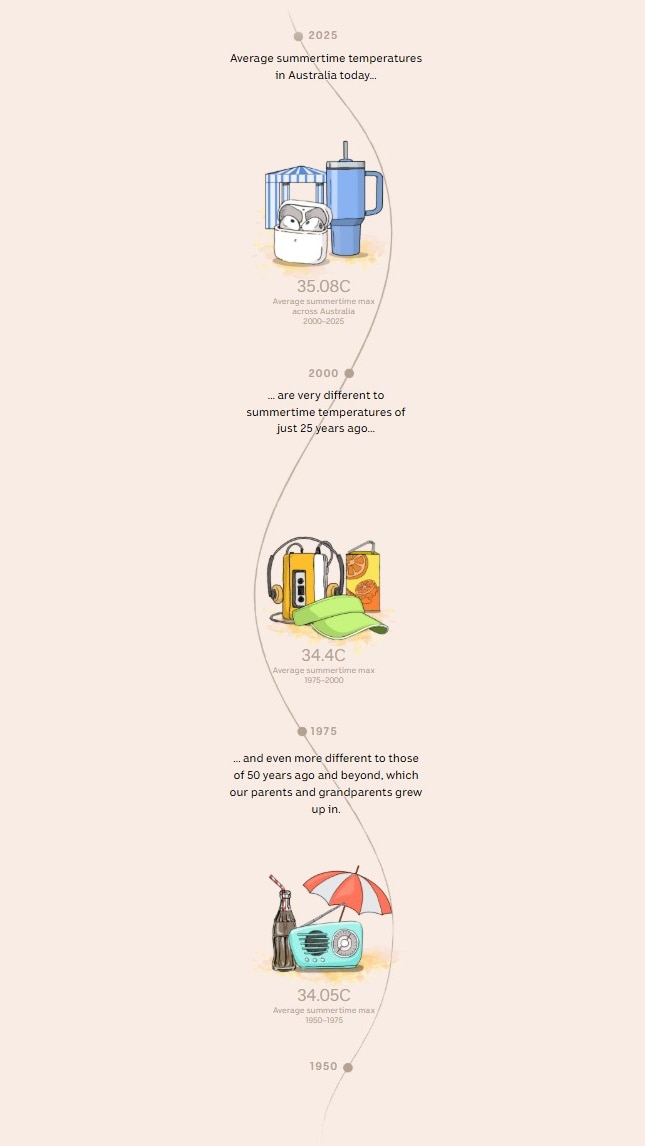 Average temperatures have risen by about one degree over the past 75 years.(ABC News: Sharon Gordon, Alex Lim)
A look at the overall Australian summers of the past shows daytime temperatures have risen by just over 1 degree Celsius since the 1950s.
But we don’t experience weather in averages.
It’s the day-to-day temperatures, in our home and on our holidays, that impact our lives.
So what does that look like on the ground for each of our capitals?
Data hides extreme heat
As we draw to the end of what has been a summer of extraordinary heat and rain for many, we’ve compared the summer temperatures of the current generation to the two before it.
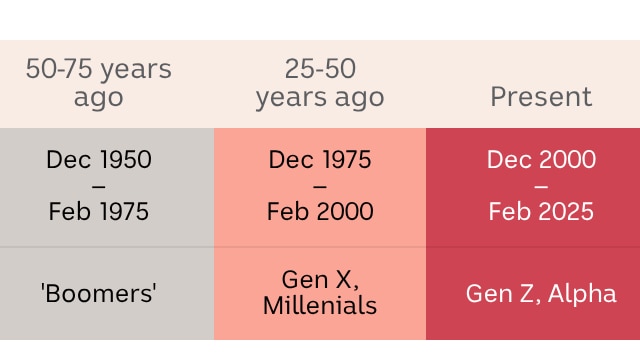 We;ve split the past 75 years into three eras.(ABC News)
While summers have become warmer on the whole, it’s the extremes which stand out the most.
In some instances, just 1-2C of warming across the season, has amounted to four times as many individual extreme heat days.
The increase in extreme heat days can be seen in most capital cities, with Adelaide and Canberra experiencing the most significant jumps.
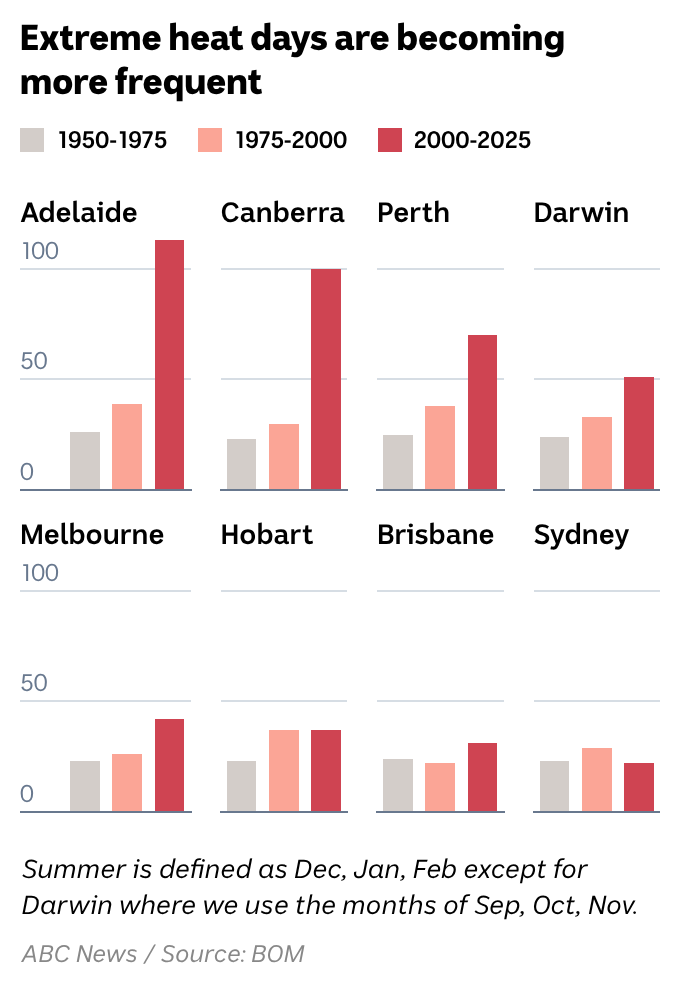 Adelaide’s extreme heat days have quadrupled.(ABC News)
Coastal Brisbane and Sydney don’t show the same strong increase due to their proximity to the ocean, but we’ll explain this further in a moment.
The reality of today’s summers
Let’s take a closer look at Perth, the capital which gets the hottest extreme temperatures during summer.
In the era prior to 1975, a day over 41.3C was considered extreme. This is not a random number. Only 1 per cent of summer days hit that temperature.
In the 25 summers from 1950-75, it occurred 25 times. So, once a summer on average.
Without any change to the climate, that frequency should stay about the same.
But that’s not the reality of what Perth has seen. Instead, it nearly triples.
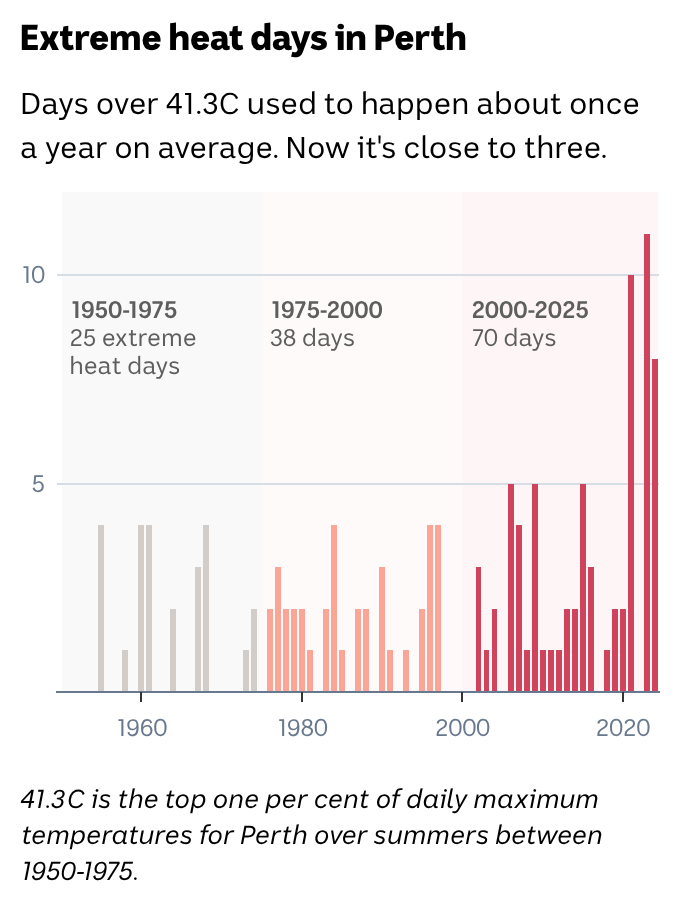 Extreme heat days have risen over the decades.(ABC News)
The rarer the extreme, the more obvious that increase is in the charts. For many, this is especially clear since the turn of the millennium.
In Melbourne, days over 42C have occurred as many times since the year 2000 as they did in the 90 years before that.
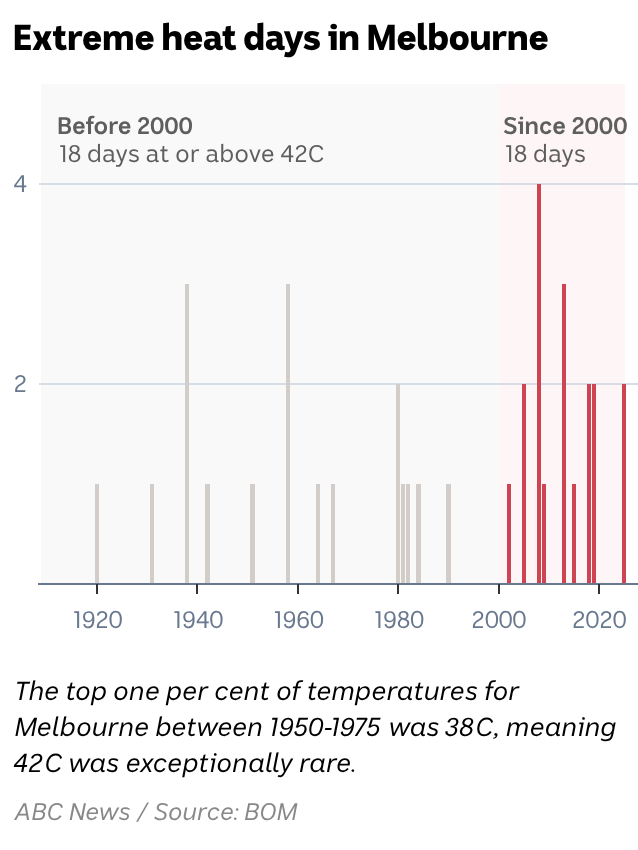 Melbourne’s extreme heat days are more frequent.(ABC News)
“You can see it in the numbers,” University of Melbourne climate scientist Linden Ashcroft said.
“These kinds of events are becoming more frequent and they’re often more intense when they do happen.
“Everything that we get is sort of defining our era as the era of a warmer planet, on top of Australia’s climate that’s already pretty extreme.”
Dr Ashcroft said these changes in the climate that have been seen can only be explained by the additional greenhouse gases in the atmosphere, caused by human activity like the burning of fossil fuels.
The season’s changing shape
Summer isn’t just getting hotter. For some, it’s also getting longer.
This is most noticeable in Canberra, but Adelaide and Perth also show a noticeable change.
To compare how summers have changed over time, we’ve taken the typical summertime temperatures of 1950-75 as a benchmark.
We then looked at when monthly average temperatures first reached that old ‘summer-like’ threshold, and when they fell back out of it.
Each of these columns shows the length of summer, according to that definition.
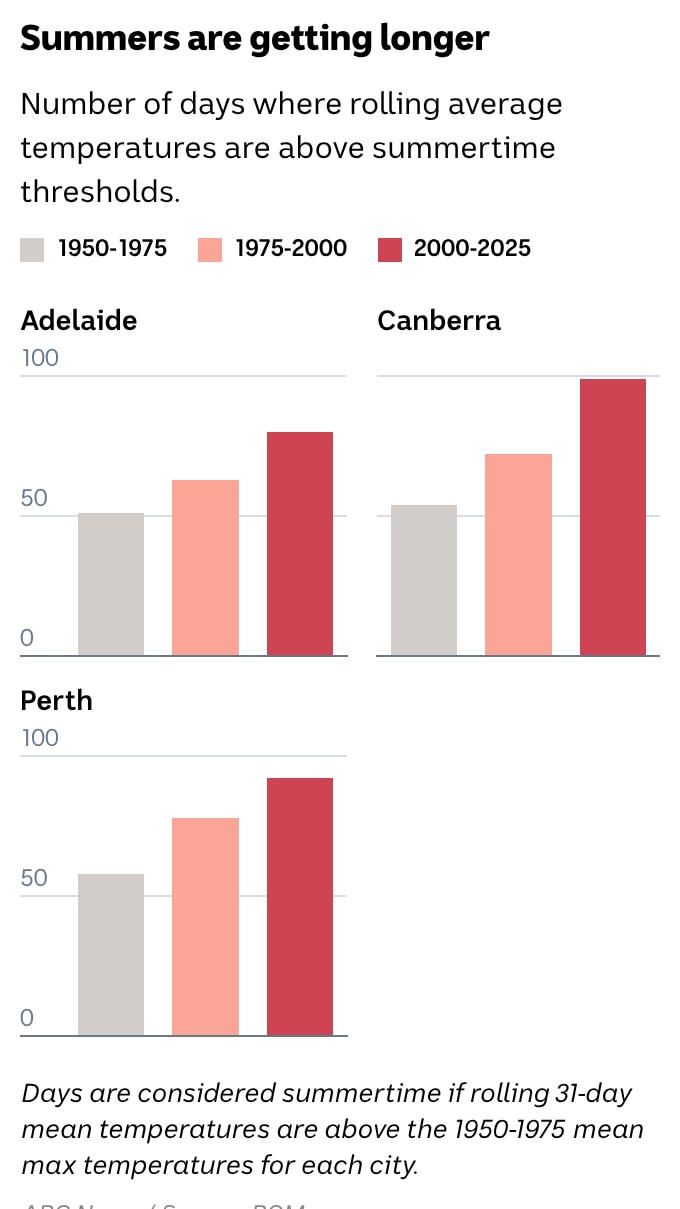 Season-length defined by temperature.(ABC News)
It’s clear, they’re much longer today.
Fifty years ago, Canberra’s summers only reached the typical summertime temperature threshold for 54 days. Today, it goes for 99 days
Let’s add a timeline in.
This way, you can see it’s mostly because summers are starting earlier.
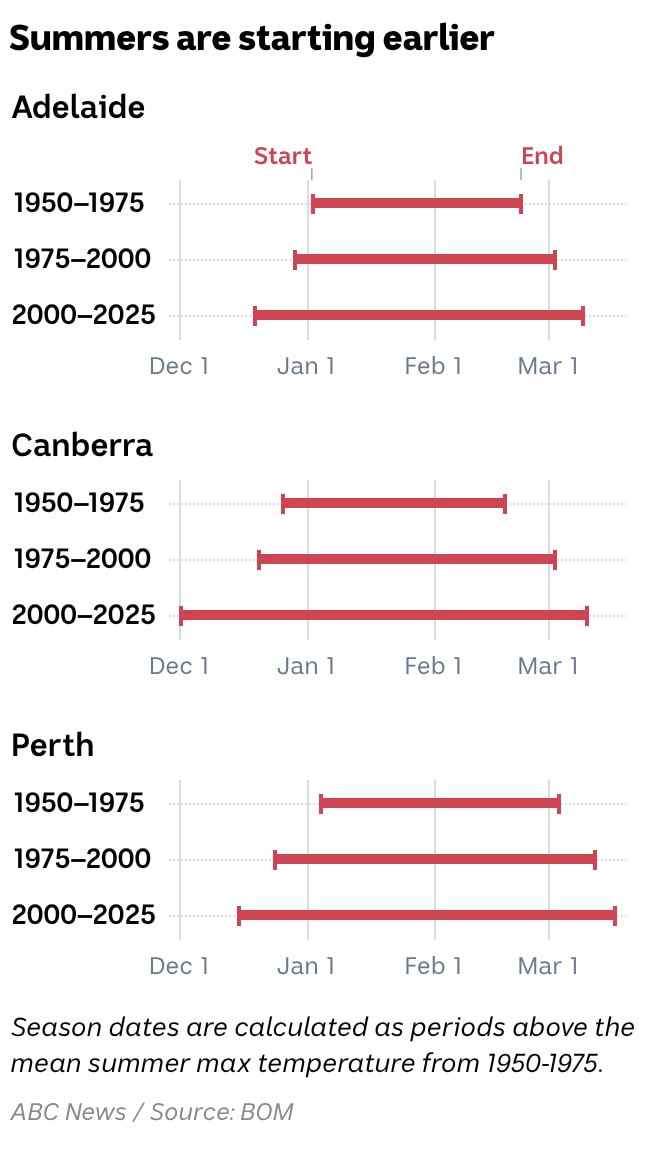 Canberra shows the most severe early onset of summer.(ABC News: Alex Lim)
In the 50s and 60s, the typical summer-like warmth seemed to kick in around Christmas time and end mid-February for Canberra.
Today, it’s starting almost a whole month earlier and finishing two weeks later.
The short memory of summer
So, if the trend is so clear, why does it feel like summers have always been this hot?
According to behavioural psychologists, it’s to do with the way our memories work.
University of New South Wales professor Ben Newell says our memories aren’t perfect records of data. Instead, they’re coloured by emotional experience.
“Our memories don’t have a photographic or a perfect [record] of all of the things that we’ve experienced,” he said.
“Specific salient events or emotionally vivid events … will come to mind readily and those will start to colour people’s overall perception of when it was hot.
“So you get this sort of biasing.”
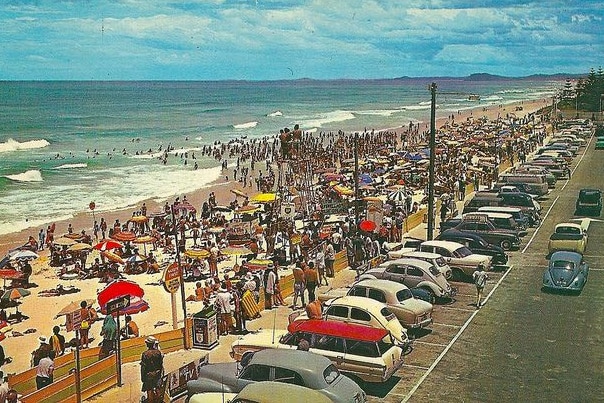 Heat has always been part of life in Australia; and the beach our escape. Pictured, Surfer’s Paradise in 1958.(Supplied: Brian Martin)
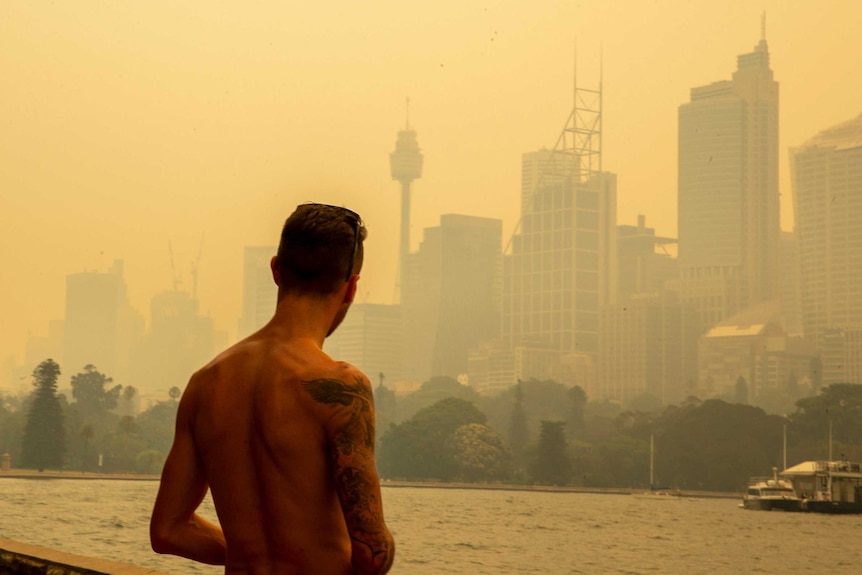 But if the world keeps warming at the current rate, there will be more and more extremely hot days. Pictured, the Sydney skyline during Black Summer.(Getty: Jenny Evans)
Professor Newell said we’re also quite good at recalibrating a new normal.
A research paper from 2019, which looked at what kinds of temperatures prompted people to tweet, found as people were repeatedly exposed to unusual temperatures, their baseline for what was tweet-worthy shifted with it.
“To give an example, 10 years ago, maybe you got four days over 40C in a row,” Professor Newell said.
“People would have gone ‘bloody hell, this is hot’ and they’d be tweeting about it.
“If that happened now, it’s like ‘oh, yeah, it’s always been like that’. So there’s this sort of psychological adaptation.”
The ‘moderating’ influence of the coast
Brisbane and Sydney do not see the same strong increase in extreme heat days.
This is because the observing sites for both cities sit close to the coast, explains BOM senior climatologist Blair Trewin.
Regular breezes off the ocean can help to moderate the really high temperatures during the summer months.
“The relationship between average temperatures and extremes is less consistent on the coast than it is inland,” Dr Trewin said.
You only need to look at nearby towns away from the coast to see how much it can make a difference.
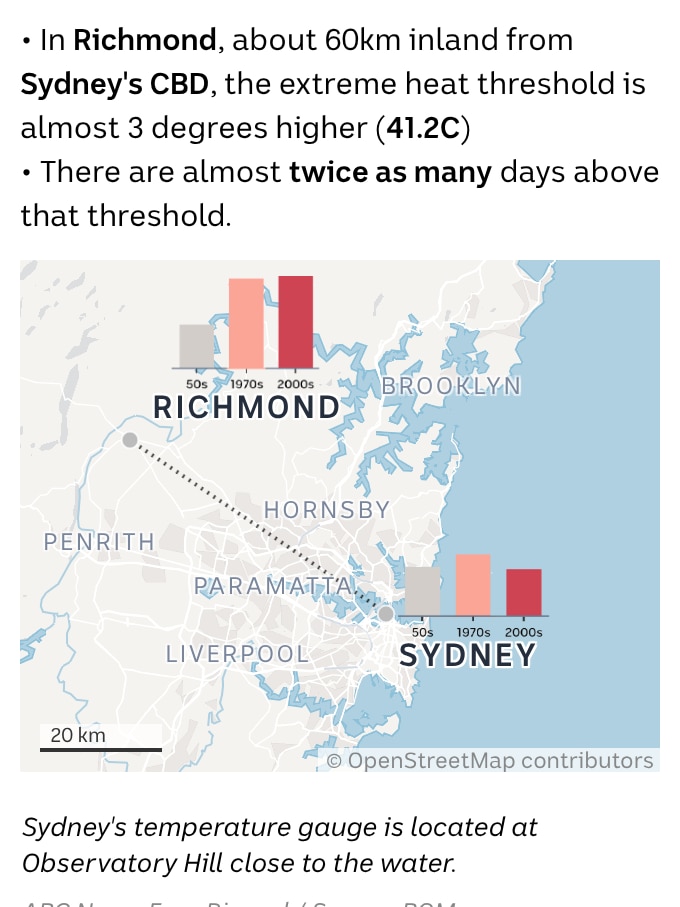 A map of Sydney showing the coastal effect on heat.(ABC News)
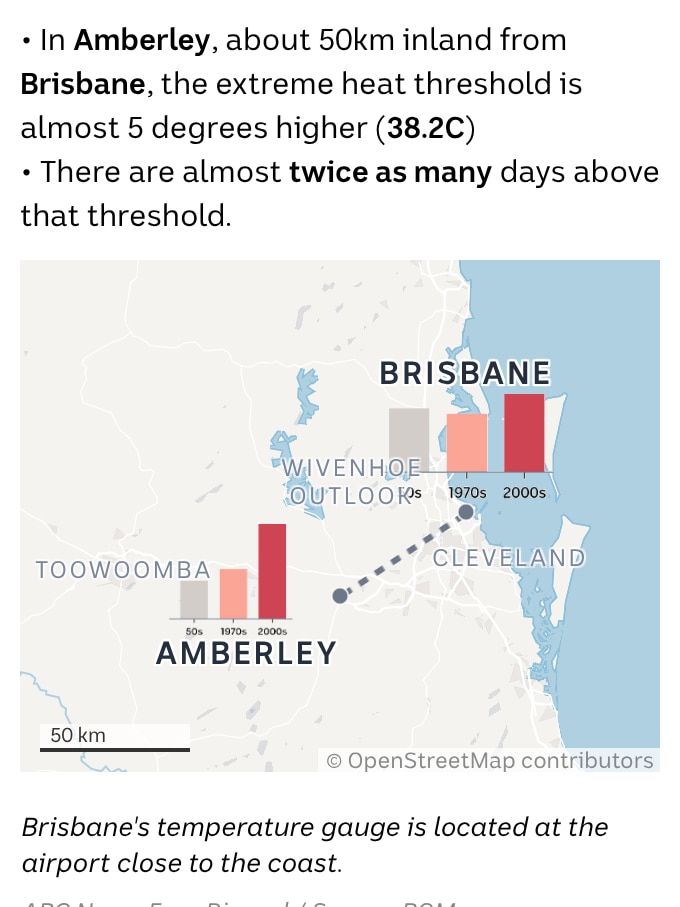 A map of Brisbane showing the coastal effect on heat.(ABC News)
Summer also needs to be looked at with a bit of nuance. Australia is a big country, and the weather conditions during summer look different depending on where you live.
Sydney’s hottest day of the year, for example, has occurred outside the summer months, during October, on multiple occasions.
Yamba, in northern New South Wales, has previously recorded its hottest day of the year in winter (August).
Night-time temperature increases
There is one part of summer that has gotten warmer since the 1950s for all capitals: the nights.
Hot nights don’t get the same flashy headlines in the news that hot days do.
But experts say they are just as important. They provide the necessary and sometimes missing relief from daytime heat to the body and environment.
 Hot nights are often the crucial factor triggering a heatwave warning.(ABC News: Sharon Gordon)
The Bureau of Meteorology considers anything above 25C a ‘very hot night’.
A night-time temperature of 29C becomes a health risk, according to Professor Ollie Jay, director of the Heat and Health Research Centre at the University of Sydney.
It’s at about this point where, without any cooling, the body loses enough sweat during the night, you wake up dehydrated, increasing health risks if faced with heat again the next day.
“If you are sufficiently dehydrated, it really does amplify the strain that your body experiences.”
The data shows only Darwin and Adelaide are recording nights this hot. But they are coming around far more often today.
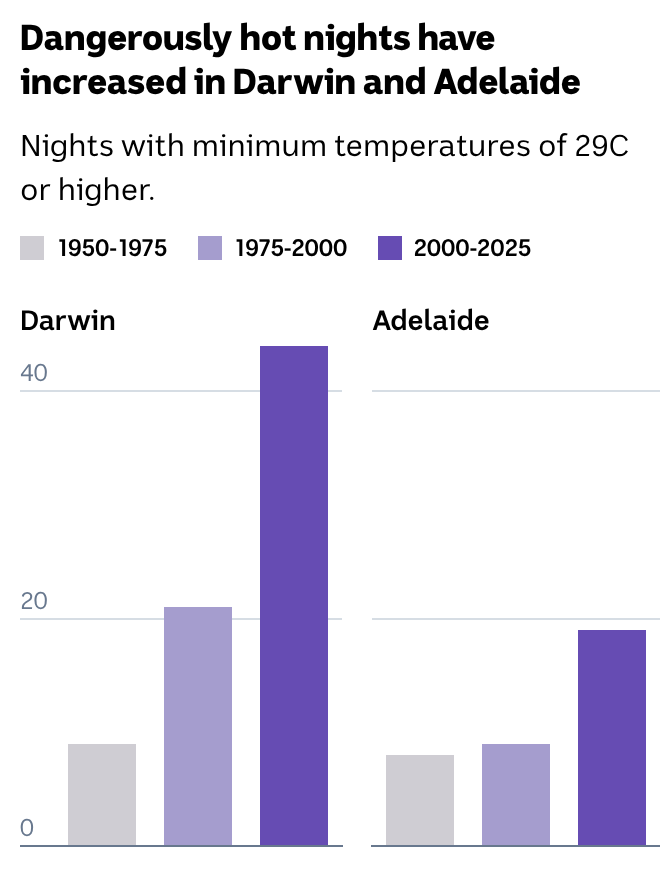 Count includes the annual total number of hot nights for each city.(ABC News)The signature of this summer
This summer is a great example of how extremes can hide in the data.
Overall, Australia’s summer was warm but not remarkable. It was the eighth warmest summer on record for Australia.
But within the season, there were several remarkable events.
During two major heatwaves in January, hospital admissions went up, major bushfires broke out and big sporting events were suspended before giving way to major flooding from heavy rain systems dumping months’ worth of water in days.
Sixty-three all-time heat records were broken over summer, according to the BOM, almost all in the space of just one week.
Port Augusta is now the southernmost location in Australia to have recorded a temperature of 50C.
Even further south, Renmark in South Australia also came incredibly close to the milestone, reaching a record 49.6C in late January.
 Renmark local and retired fruit grower Robert Tucker’s 94th summer was a hot one.(ABC: Shannon Pearce)
For 94 years, Renmark local Robert Tucker has seen his fair share of really hot days. But this January’s heat was noticed.
“In my 20s, I don’t think it took a toll on us like it does today,” he said.
“Weather didn’t seem to affect us [then] like it does now. When you’re young and senseless you tolerate it more.”
Recent research shows the first heatwave in early January was made five times more likely by human-caused climate change.
Heatwave five times more likely due to climate change
Australia National University professor of Climate Science Sarah Perkins-Kirkpatrick said, statistically, these types of events will become far more common as climate change intensifies.
“There will be summers ahead of us where we see those types of heatwaves occur at least four or five times in one season,” she said.
Importantly, she said the extreme conditions seen this year occurred without the help of natural heat drivers, like an El Niño.
In future years, when these types of drivers are in play on top of the influence of climate change, she said it could become a “recipe for disaster”.
As summers change, so do we
Of course, as our climate has changed, so has our ability to handle it.
Robert Tucker remembers growing up without the luxuries of air conditioning.
“The best thing you could do was, well, wash yourself down with a garden hose,” he said.
But the heat drove people to get creative with makeshift cooling systems. His father, a fruit grower, had his own evaporative air conditioning methods.
“Because we used hessian in drying dried fruits, he detached the hessian to the gutter and let it hang down and would throw buckets of water at it.”
Most people have air conditioning. Australia now has an official heatwave warning system. The effect of heat on health and critical infrastructure, like transport and electricity, is much better understood.
Beyond adaptation, Australia also has policies aimed at reducing greenhouse gas emissions to net zero by 2050 to stop the cause of the warming — something that is essential, according to climate scientists.
 Renmark resident Nathan Wadin and his dog cool off at a fountain during the January heatwave.(ABC Riverland: Amelia Walters)
But Professor Newell and other scientists said while we quickly get used to this new climate, we can’t let it outrun the necessary further changes to adapt and prevent it from getting worse.
“If we believe the idea that people are slowly shifting their baseline and perception of what counts as remarkable types of weather … then the urgency with which to change is not quite so prominent,” he said.
“It’s kind of an illustration of the boiling frog, really. Things are incrementally getting worse, but we don’t move the needle on it.”
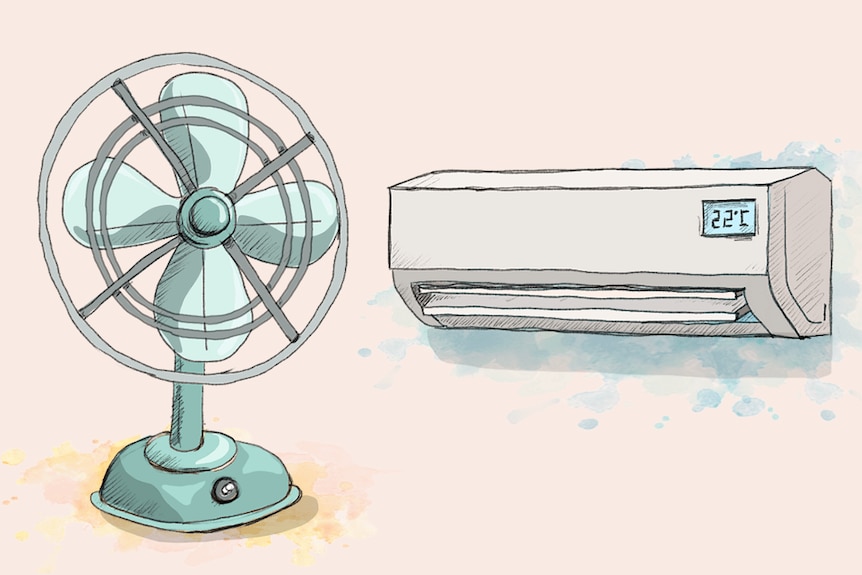 It’s getting hotter, but we have learned to adapt.(ABC News: Sharon Gordon)
This is not just a consideration for the current generation, according to Dr Ashcroft, but for those to come.
“Of course the climate has always changed,” Dr Ashcroft said.
“But what we’re seeing now is the rate in which the climate is changing is faster than any part of our Earth system can keep up with — our plants, our animals, our infrastructure, us.
“If you care about your grandkids, then you should care about climate change.”
CreditsWords: Tyne Logan, additional reporting by Shannon PearceProduction: Fran Rimrod and Alex LimIllustrations: Sharon GordonMethodology
Data is based on the Bureau of Meteorology’s ACORN-SAT, combined with records from corresponding sites from 2025 onwards.
The ACORN-SAT datasets provide homogenised, ground-based temperature records. Combined, these stations hold over 100 years of records.
The ABC has consulted with several climate scientists on datasets and methodology, including BOM senior climatologist Blair Trewin.
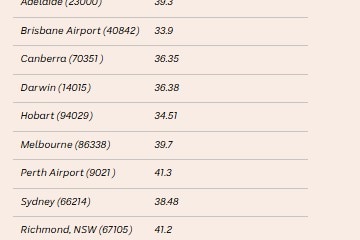 Extreme heat thresholds used throughout the story.(ABC News)StationExtreme heat day threshold (C)Adelaide (23000)39.3Brisbane Airport (40842)33.9Canberra (70351)36.35Darwin (14015)36.38Hobart (94029)34.51Melbourne (86338)39.7Perth Airport (9021)41.3Sydney (66214)38.48Richmond, NSW (67105)41.2Amberley (40004)38.2
Definitions:
Extreme heat days: 99th percentile of summer days, relative to the 1950-1975 eraSummer: December, January, February for all capitals except Darwin. Darwin’s ‘summer’ is defined as ‘September, October, November’ as it does not experience a traditional summer like the other capitals.
Summer length methodology:Summer season lengths are calculated from the rolling 31-day mean maximum daily temperatures, averaged over each 25-year period. The season is considered the period during which the rolling mean maximum temperature is greater than the summertime mean maximum temperature for the period 1950-1975.