
Dozens of countries have agreed to the largest release of emergency oil stocks in history, amid fresh attacks on ships in the Strait of Hormuz.
The International Energy Agency (IEA) agreed to release 400 million barrels of oil to try to rein in crude prices, which have soared due to supply shocks from the US-Israeli war on Iran.
The IEA said the release had been backed unanimously by 32 member countries, the sixth such move and the “largest ever” it has made since its creation in the 1970s.
Iran war live updates: For the latest news on the Middle East crisis read our blog.
It is aimed at preventing a further rise in oil prices on fears that Iranian attacks will continue to block Middle East oil exports from reaching markets, as the Strait of Hormuz becomes a critical frontline in the war.
A spokesperson for Energy Minister Chris Bowen said Australia was considering the IEA’s decision and that it was a “voluntary call, which gives countries time to respond pending their national circumstance”.
It would involve releasing oil reserves into the domestic market and would not require Australia to send oil overseas, the statement said.
“If we do join this action, Australia will not be required to send fuel overseas but rather use its existing domestic reserves to take pressure out of the global market,” they said.
“Any action taken as part of a collective action will be in our national interest.”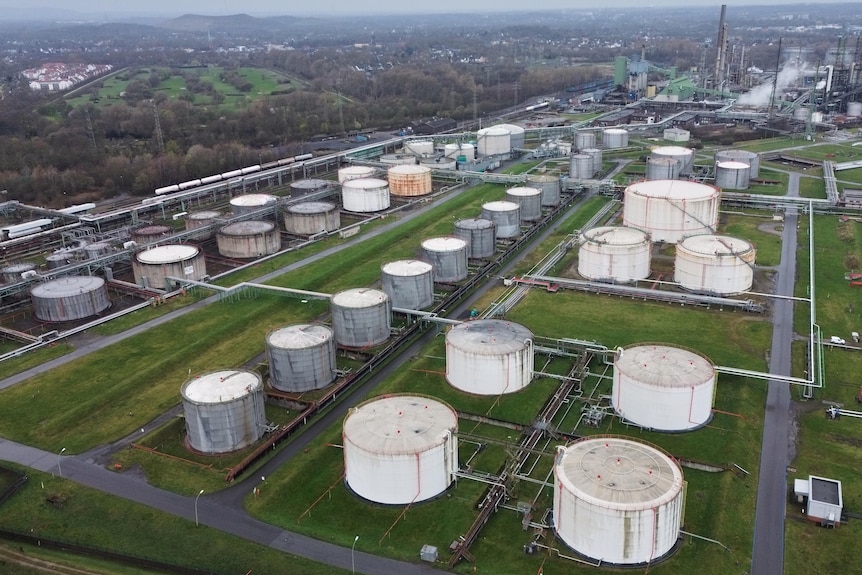
Oil tanks in front of the BP refinery in Gelsenkirchen, one of the biggest fuel producers in Germany. (AP: Martin Meissner)
IEA executive director Fatih Birol said the oil market challenges were “unprecedented in scale”.
“Therefore, I am very glad that IEA member countries have responded with an emergency collective action of unprecedented size,” Mr Birol said.
The emergency stocks are much larger than the 182.7 million barrels that the IEA’s member countries released in 2022 in response to Russia’s invasion of Ukraine.
They will be “made available to the market over a timeframe that is appropriate to the national circumstances of each member country,” the IEA said, adding this would be “supplemented by additional emergency measures by some countries”.
G7 leaders meet
The Paris-based organisation made its comments as French President Emmanuel Macron chaired a G7 leaders’ meeting to discuss energy issues.
During his introductory remarks, Mr Macron praised the IEA decision, saying it amounted to the equivalent of “20 days of the volume being exported through the Strait of Hormuz”. The amount being released by the G7 nations alone comprises 70 per cent of the total, he said.
Read more about the Iran war:
The G7 comprises Canada, the United States, France, Italy, Japan, Germany and Britain.
Germany, Austria and Japan said earlier on Wednesday they would release parts of their oil reserves following an IEA request.
Germany’s economy minister, Katherina Reiche, said the IEA asked Germany to release 2.64 million tons of its oil reserves. She said it would take a couple of days before the first quantities were delivered.
It was not immediately clear how much Austria, which is not a G7 member, was releasing.
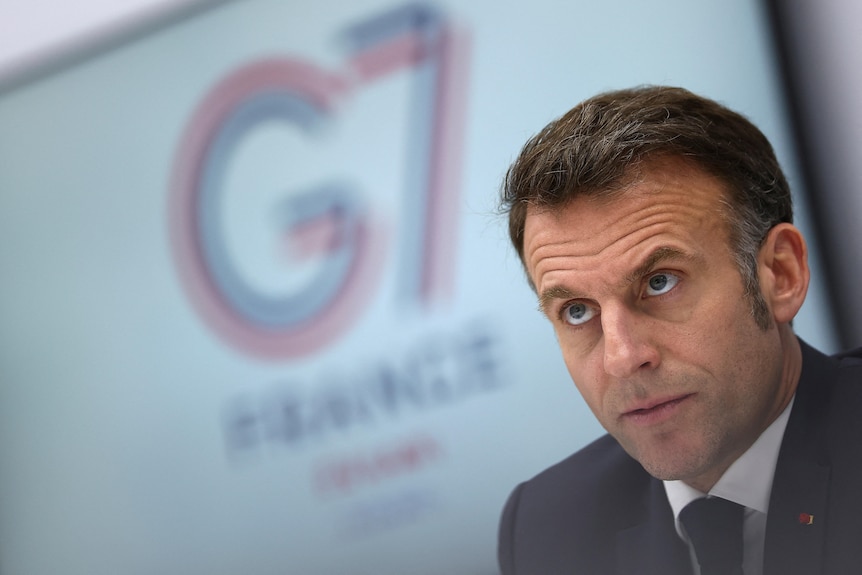
Emmanuel Macron chairs a video conference of G7 leaders. (Reuters: Gonzalo Fuentes/Pool)
Japan said it planned to release about 80 million barrels from its private and national oil reserves as its contribution.
“Rather than wait for formal IEA approval of a coordinated international reserve release, Japan will act first to ease global energy market supply and demand, releasing reserves as early as the 16th of this month,” Prime Minister Sanae Takaichi said in a broadcast statement.
Western economies coordinate their strategic oil stockpiles through the IEA, which was formed in 1974 after the oil crisis.
Loading
IEA members hold more than 1.2 billion barrels of emergency stockpiles and another 600 million barrels of industry stocks under government obligation.
However, oil prices rebounded on Wednesday as markets doubted whether the IEA’s plan could offset the volumes of oil blocked by the conflict.
Three more vessels hit in the Strait of Hormuz
Meanwhile, three vessels were hit by projectiles in the Strait of Hormuz, maritime security and risk firms said on Wednesday.
Attacks have targeted about 20 commercial vessels in or near the Strait of Hormuz, data analyst groups and the AFP news agency report, as the blockaded waterway becomes a frontline in the war in the Middle East.
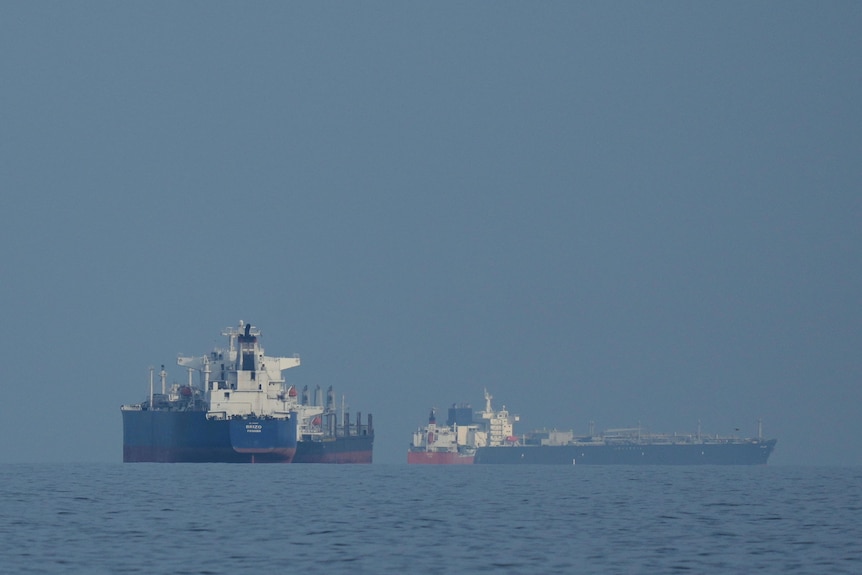
Oil tankers and cargo ships line up in the Strait of Hormuz as seen from Khor Fakkan, United Arab Emirates. (AP: Altaf Qadri)
Iran’s quest to inflict maximum pain on the global economy in retaliation for US-Israeli strikes on its territory has all but shut the narrow strait through which 20 per cent of global crude and LNG normally passes.
At least 10 oil tankers have been hit, targeted or reported attacks between the start of the conflict and midday on March 11, according to data from the UK Maritime Trade Operations (UKMTO), the International Maritime Organization (IMO) and Iranian authorities.
Seven were reported to the UKMTO: the Skylight, MKD Vyom, Hercules Star, Ocean Electra, Stena Imperative, Libra Trader and Sonangol Namibe.
Iran’s Revolutionary Guard claimed drone strikes on three other tankers: the Athe Nova, the Prima and the Louis P. The AFP was not in a position to independently verify these claims.
Four bulk carriers, three container ships, a tugboat, an oil drilling vessel and a cargo ship also reported explosions, strikes or suspicious activity in the area to UKMTO.
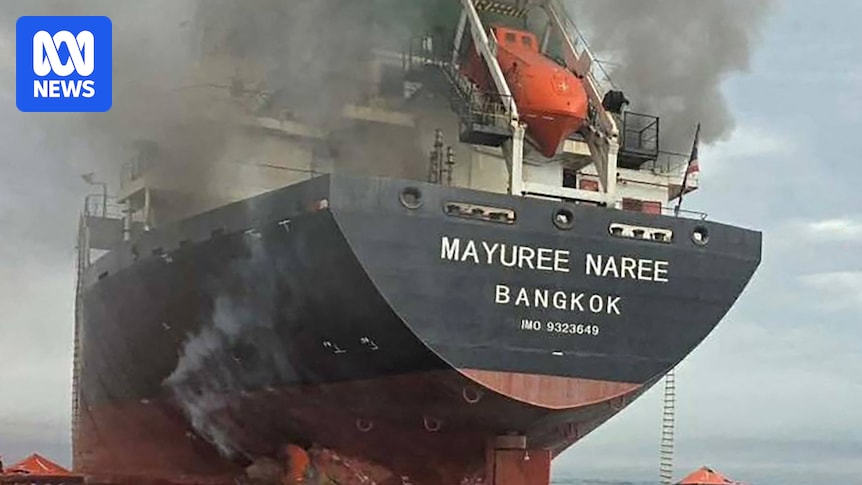
Thailand’s navy said its bulk carrier, the Mayuree Naree, was attacked while transiting the strait. Oman’s navy rescued 20 crew members, but efforts were underway to find three more. The Revolutionary Guard claimed the attack on Wednesday.
Ships belonging to the US, Israel or allies ‘legitimate targets’: Iran’s military
Iranian officials have issued contradictory statements regarding the Strait of Hormuz since the war’s outbreak.
Early last week, a Revolutionary Guard general threatened to “burn any ship” attempting to cross the strait and to block all oil exports from the Gulf.
But three days later, Foreign Minister Abbas Araghchi said Iran had “no intention” of closing the passage.
On Wednesday, IRGC naval commander Alireza Tangsiri said in a social media post that “any vessel intending to pass must get permission from Iran”.
Separately, the Iranian military’s operational command declared on state television that any vessel that belongs to the US, Israel or their allies would be considered a legitimate target and repeated a warning that it would “not allow a single litre of oil to transit” the strait.
ABC/Wires
Loading…