
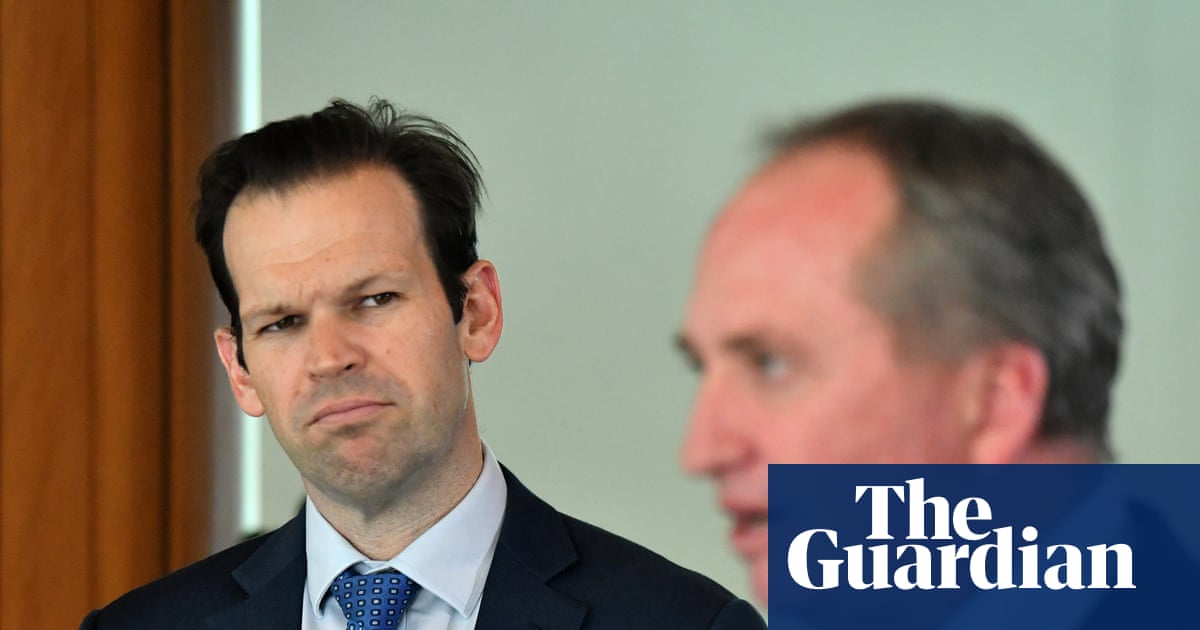
During the 2010 federal election campaign, Matt Canavan and his new boss Barnaby Joyce found themselves booked in a tiny hotel room with a pair of single beds a mere half-a-metre apart. The young political staffer had forgotten to call his wife, Andrea, that night, so decided to text her instead.
“Hi babe, love you lots miss you,” the message read.
“At least, I thought it went to my wife,” Canavan recounted in his maiden speech to the Senate in 2014.
“Instead I had been texting Barnaby so much it went to him by mistake.”
Almost inseparable for more than a decade-and-a-half until Joyce’s defection to One Nation in December, Canavan is now charged with combating his one-time political mentor and his new party after being installed as Nationals leader on Wednesday.
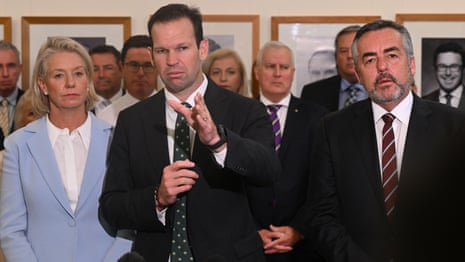 Matt Canavan says we need ‘more Australian everything’ in first speech as Nationals leader – video
In selecting the straight-talking, pro-coal, “anti-woke” religious conservative from Queensland as their official flag bearer, the Nationals have decided that if the party is to survive, it must lurch further to the populist right.
“We need to have more Australian everything. We need to manifest a hyper-Australia,” a pumped-up Canavan told his first press conference as leader, after defeating Kevin Hogan and Bridget McKenzie in a party room vote.
“We need more Australian babies. We need more Australian humour, more Australian jokes, more Australian barbecues, sometimes often fuelled by fossil fuels.”
From Marxist to influential senator
Canavan, 45, charted an unusual path to become the first federal minister born in the 1980s and now the 16th leader of the federal Nationals.
A self-proclaimed Marxist during his days at the University of Queensland, he worked at the Productivity Commission – a cog in the Canberra bureaucracy he would come to loathe – before stepping into the world of politics.
Staring at his computer one day, the then public servant cold-called the office of Tony Abbott asking if it needed an economist. It didn’t – but a maverick Nationals senator from Queensland did.
Canavan and Joyce would strike up a 15-year alliance that would permanently disrupt and reshape the conservative side of politics in Australia, dragging the Coalition further to the right – particularly on climate and energy policy.
Elected to parliament in 2013, Canavan was elevated to cabinet as the minister for resources just three years later, forcing the then prime minister Malcolm Turnbull to contend with another climate change sceptic within his senior ranks as he attempted to land an emissions reduction policy.
Sign up: AU Breaking News email
Speaking on Wednesday prior to the Nationals leadership vote, Turnbull recounted how Canavan, Joyce and others once lobbied him to fund a chain of coal-fired power stations across the country.
After explaining the economic irrationality of the idea, Turnbull said the rump of Nationals remained unconvinced.
Turnbull said McKenzie, then the Nationals deputy leader, hung back after the meeting and explained her colleagues’ mindset.
“She said, ‘You know, PM, the numbers are fine, but they’re not going to persuade them … they’re not actually interested in the economics. It’s religion for them,’” Turnbull recalled of the private conversation.
“And that’s basically the problem. They are unshackled from reality.”
After briefly resigning from cabinet in 2017 after being caught up in the dual citizenship saga, Canavan permanently stood down from the frontbench in 2020 to support Joyce’s failed bid to reclaim the leadership.
Where others recede into obscurity on the backbench, Canavan’s influence only grew with the unrestrained freedom to peddle his rightwing agenda.
An uncomfortable economic partner for the Liberals
After the town of Orange in regional New South Wales was covered in snow in June 2021, Canavan posted his thoughts to Twitter.
“Climate change,” he wrote above a news article headlined “Sydney set for coldest day in 25 years while Orange blanketed in snow”.
The social media post encapsulated the essence of Canavan’s political brand; unashamed climate denialism, provocatively expressed, usually online, and with little regard for his colleagues (much less the planet).
Canavan interviewed in front of a screen with the words ‘Build coal power stations’ during the 2022 election campaign. Photograph: Afternoon Briefing/ABC
In the middle of the 2022 election campaign, just months after Scott Morrison signed the Coalition up to net zero emissions by 2050, Canavan went on ABC television and declared the target was “sort of dead”.
He conducted the interview in front of a black screen with the words “Build coal power stations”.
Liberal MPs who lost their seat in 2022 – including to teal independents in heartland electorates – apportion far more blame to Canavan and Joyce than Morrison for the political disaster that ended their careers.
Canavan intensified his anti-net zero campaign after the 2025 election, capitalising on an internal Nationals review process to push his party – and ultimately the Liberals – to junk the Morrison-era goal.
He was then instrumental in the Nationals’ decision to oppose hate speech laws drafted after the Bondi massacre, which blew up the Coalition for a second time in eight months.
The two cases helped crystallise a view for many Coalition MPs that it was Canavan – not David Littleproud – who was actually in charge of the Nationals.
After that was formalised just after 10.30am on Wednesday, some of the surviving city-based Liberals worried what further damage Canavan could cause their party’s already tarnished brand.
Installing Canavan may stem the bleeding to One Nation in regional areas and prevent the rumoured defection of Colin Boyce and Llew O’Brien, but Liberals fear it won’t aid their prospects of returning to power.
Canavan during Senate debate on the bill to amend the Marriage Act in 2017. Photograph: Mike Bowers/The Guardian
Along with his obsession with curtailing climate action, Canavan holds deeply conservative social views, opposing same-sex marriage and abortion and backing Donald Trump’s move to only recognise the male and female sexes.
His criticism of the US’s “regime change war” in Iran conflicts with the Coalition’s official stance but echoes the isolationist strain that runs through the Make America Great Again (Maga) movement.
An opponent of vaccine mandates and the social media age ban, Canavan’s closest ideological allies have often been those on the far-right fringes – including Alex Antic and Ralph Babet.
His economic outlook will sit uncomfortably with the Liberals.
Interventionist and hostile towards big business, his views on tax, industry subsidies and welfare are light years away from those of the opposition leader, Angus Taylor, and shadow treasurer, Tim Wilson.
“His [Canavan’s] views might resonate in regional Queensland but we have to be an option for all Australia – not just an option for a narrow group,” one Liberal MP told Guardian Australia.
Another Liberal joked that even the One Nation leader, Pauline Hanson, was more moderate that Canavan.
“He does not play well in the suburbs. The few remaining Liberal suburban seats will be under even more pressure, given the inevitable policies Canavan will demand,” they said.
Canavan unsuccessfully challenged Littleproud for the leadership after the 2025 election, when Labor and Anthony Albanese appeared to still be the Nationals’ primary opponent.
Nine months on, the Nationals are fighting a different battle. And when a “buggered” Littleproud unexpectedly resigned on Tuesday afternoon, the party was bound to turn to the colleague who understands the enemy better than anyone.