
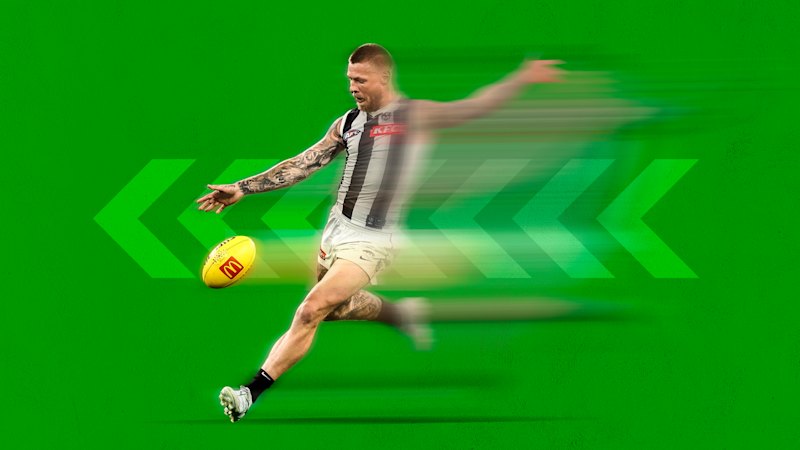
Here’s how the new rules will affect tactics.
Last disposal rule (between the arcs)
The safe dump kick down the line is no longer safe. Wingers and defenders can’t simply gain territory and reset – the ball will come straight back at them. In opening round, 29 last-disposal free kicks were paid.
Sides will be pushed towards corridor kicks and lower, flatter ball movement. There will be less boundary hugging, more scoring from the centre of the ground, and conservative exits from defence will be punished.
Without the guarantee of a boundary throw-in, teams no longer have the luxury of resetting. They’ll have to flip instantly from chasing the ball to transitioning into attack or defence if a last-touch out of bounds is called. A split second of hesitation could be costly.
Kick-in time reduced
There’s less time to set up and lock the ball inside forward 50m. Your team’s forward-half defence now must be organised before even conceding a point.
Defence becomes about reacting while running, not standing and directing. Over four quarters, that’s hard to sustain, and it opens the game up to more end-to-end scoring. One player out of position creates an opening that can be exploited on kick-outs.
The reduced time also means the team that concedes can’t slow the game down. We’re already seeing quicker kick-ins designed to catch opponents out of shape and get the ball out the back.
Ruck nomination and centre ball-up changes
There will be less wrestling and more genuine contests at centre ball-ups. Rucks who can cover the ground quickly will become more important than ever. If they can’t get to the stoppage, they’re letting their midfielders down.
Around the ground, quick ball-ups will reduce time for teams to reset their stoppage structure. Clearances will become instinctive and chaotic. There’s also greater potential for “out the back” goals from centre ball-ups, with teams no longer required to have a player start deep in the goal square.
Stand rule tightening
The team without the ball must “stand” and hold their ground inside the five-metre zone of any mark or free kick paid to their opponent. This will speed up ball movement and open more attacking options. There will be greater opportunities for teams to create overlap through handball receives.
It’s already catching teams out: several 50m penalties were paid in opening round against players who backed out when the umpire called “stand”.
On a few occasions, two players stood the mark, creating chaos for the defensive team and leaving them a defender short further afield.
No sub rule
Strategy at selection is vital. Durability, versatility and aerobic capacity will be called upon. Ruck selection will be crucial. Rucks will need to cover more ground, faster than ever.
There’ll be no safety net for any player slightly underdone or at risk of re-injury. Collingwood showed an early example in opening round, managing veteran Scott Pendlebury’s workload to just 55 per cent of the game.
Players who can swing roles – midfield and forward, for example (ie, Melbourne’s Kysaiah Pickett) – will become valuable rotation savers.
The physical impact
To understand the impact of the rule changes, examine the type of athlete demanded by the modern game.
Aerobic athletes – like cyclist Cadel Evans and marathon runner Jessica Stenson – sustain effort over long periods, and have the ability to repeat it.
By contrast, anaerobic athletes – sprinters like Cathy Freeman and Rohan Browning – generate energy for short, explosive bursts, prioritising speed, power and acceleration over endurance.
Most footballers are hybrids of those two types. But different roles prioritise different strengths, and the rule changes shift the game further in favour of the aerobic types.

Cyclist Cadel Evans and marathon runner Jessica Stenson are examples of athletes who rely heavily on aerobic capacity, while explosive athletes, such as sprinters Cathy Freeman and Rohan Browning, depend far more on anaerobic power.Credit: Agencies
With less rest time, there are more repeat high-speed efforts, more two-way running, and more transition kilometres.
The downtime that used to be available when the ball went out of bounds, a ball-up was called or after a behind has been reduced, meaning players will need to respond immediately, increasing the aerobic load.
With breathers largely gone, fatigue will compound.Forwards lead harder, midfielders spread wider, wings cover extra ground. Half-backs push higher, creating overlap under the stand rule. Defenders are stretched. Repeat defensive sprints become constant, and skill errors can be expected to spike.
This environment challenges more purely anaerobic athletes, such as Jordan De Goey, Patrick Dangerfield, Tom Papley, Jake Stringer and Patrick Cripps, who traditionally use those pauses to reload explosive efforts.
Physiologically, they’ll need tighter management, with shorter midfield bursts, more forward time, and smart rotations to preserve their speed.
But the genuine two-way runners will stand out. Marcus Bontempelli, Matt Rowell (when he returns), Nick Daicos, Lachie Neale, Zak Butters, and Errol Goulden will thrive because they can repeat efforts deep into games.
The changes to centre ball-ups mean rucks are jumping more, bringing athletic types – such as Tom De Koning and Luke Jackson – back into vogue. However, the potential for increased knee-on-knee contact could expose them to a greater risk of posterior cruciate ligament (PCL) injuries.
More high-speed running will increase risk of soft-tissue injuries, such as the calf injury that the Brisbane Lions’ Hugh McCluggage sustained in opening round. It’s also possible there will be more high-speed contact injuries.
The modern game isn’t just faster – it’s more relentless. Teams with the biggest engines, and the smartest management, will have the edge.
These changes are exciting for the game, but it will take time for players and their bodies to adjust to the new physical toll.
Libby Birch is a four-time AFLW premiership player, qualified physiotherapist and respected injury analyst.