
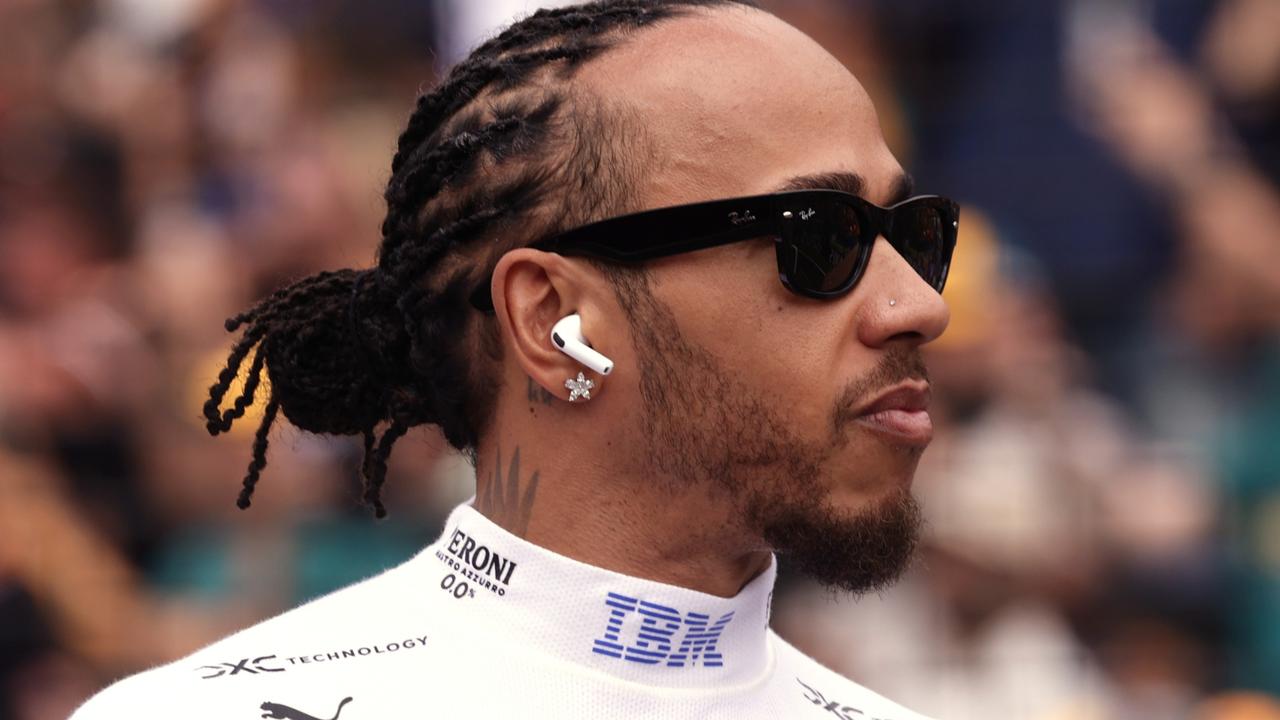
Lewis Hamilton was in good form at the Australian Grand Prix, the seven-time champion starting his follow-up Ferrari season looking refreshed and rejuvenated after a demoralising 2025.
Then he saw the results.
Ferrari had been competitive in the opening phase of the grand prix, with Charles Leclerc trading blows with George Russell for the lead while Hamilton maintained a watching brief from third. Mercedes had dominated qualifying, but in race trim the Italian team looked as feisty as some had suggested during pre-season testing.

Fox Sports, available on Kayo Sports, is the only place to watch every practice, qualifying session and race in the 2026 FIA Formula One World Championship™ LIVE in 4K. New to Kayo? Join now and get your first month for just $1.
But then a virtual safety car set the two teams down different strategy paths. Mercedes picked the right one, allowing Russell and teammate Andrea Kimi Antonelli to cruise to a comfortable one-two finish.
Despite having fresher tyres, Leclerc gained just two seconds on Russell over the last 32 laps of the grand prix. Hamilton fared a little better, reducing his six-second deficit to Leclerc to just 0.6 seconds at the flag, but it wasn’t enough to leave any real impression that he could have caught the Mercedes drivers in different circumstances.
Mercedes and Ferrari were clear at the front of the field, but the German marque had an obvious edge that hadn’t been apparent previously.
“I don’t understand it exactly,” Hamilton lamented after the race. “They didn’t show that they could turn it up in testing, and now they’ve got this extra power from somewhere and we need to understand what that is.
“I hope it’s not this compression ratio thing, hopefully it’s just pure power and we’ve got to do a better job.”
The compression ratio controversy had barely got a look-in before Hamilton’s comments during a weekend replete with talking points of its own.
Mercedes had long been suspected by rival teams to have exploited the regulation measuring the compression ratio of its internal combustion engine — in effect, how much pressure the cylinder head can apply to the air and fuel mixture before ignition.
The rules stated explicitly that the compression ratio was measured at ambient temperature, but Mercedes had apparently found a way to increase compression when the engine was running hot, a trick some manufacturers thought could be worth several tenths of a second.
A mighty political brawl ensued, and the FIA, determined not to have the issue overshadow the start of the season, made a compromise. The rule would remain until June, before the Monaco Grand Prix, after which the compression ratio would be measured both at ambient and at operating temperature, closing the loophole and putting the matter to bed.
PIT TALK PODCAST: The 2026 Formula 1 season is underway, with George Russell leading a Mercedes one-two to victory in Melbourne. But not every driver was thrilled with their first experience of the new rules.
But after being on the receiving end of a thorough beating by Mercedes, Hamilton didn’t think it was enough.
“If it is the compression ratio, then I’ll be disappointed that the FIA have allowed that to be the case,” he said. “It’s not to the [rule] book, and I’ll be pushing my team to do the same thing so we can get more power.”
The issue, he said, was imperative.
“If they have a few months of that, then the season’s done — I mean, not done, but seven races, a few months, you lose a lot of points with a second behind in quali,” he argued.
One should always be wary about making sweeping statements about the outcome of the championship after just one race.
That’s especially when the rules are so new and when there’s still so much uncertainty about how the 2026 engines will respond to different circuits with different demands.
Then again, Hamilton would recognise all the signs of impending domination — he was the one meting out the punishment for most of the last decade with Mercedes. He knows what the team is capable of.
So is the season really over just as it’s beginning? Or can we still hope for the wide-open competition we were teased at the start of the year?
Is McLaren the right place for Piastri? | 02:24
FERRARI LOOKS COMPETITIVE
Hamilton and his Ferrari team are one of the principal reasons to be cautious about writing off the year in Mercedes’s favour. Though it wasn’t in the fight for victory after the first 11 laps, the team gave Mercedes a good run for its money at the start of the race.
There are two reasons this is heartening.
One is that, even if Mercedes’s exploitation of the compression ratio loophole has given it a power boost, Ferrari has a handy trick of its own that’s clearly working to devastating effect.
Its smaller turbocharger generates a mighty kick off the line. Leclerc used to it rocket from fourth on the grid into the lead by the first corner. Hamilton followed him forward, rising from sixth to third on the first lap.
That same engine design also gives the Ferrari a real punch out of slower corners. That was only just perceptible at Albert Park, where most of the slower corners were expunged at the start of the decade, but it will be more evident at other tracks.
The advantage of getting a head start that can be serviced out of the corners is clear, and it’s boosted by the fact other teams can’t redesign their engines during the season — and we’ll have to see if they try to follow suit next year.
The second is that these regulations appear to make it hard for a driver to overwhelm another with superior pace. The strategic use of the electric motor means it’s difficult to execute an overtake without making yourself vulnerable to a battery-assisted move later around the lap.
This aspect of the rules has been criticised by some as making the racing artificial, but there’s no doubting that it kept the competition close, with neither Leclerc nor Russell able to break away from each other, which also allowed Hamilton into the fight.
The performance profile of Ferrari’s engine, then, seems ideally suited to these regulations.
The car has also been praised by rivals, with the SF-26 the fastest through the corners. Its aerodynamic philosophy — albeit at this extremely early stage of the season — seems like a fruitful one.
If it can be developed quickly and Ferrari can say in the same ballpark as Mercedes, there’s no reason to think it can’t be a contender.
Was OP’s crash a car or driver error? | 02:47
MERCEDES IS BEST PREPARED — BUT THAT DOESN’T MEAN IT CAN’T BE CAUGHT
The reverse is also true of Mercedes. Though it’s clear the German marque turned up to Melbourne as by far the best prepared team in Formula 1, it can’t rely on that advantage lasting for the entire season.
We know one element of its performance will definitely be curtailed in the next few months once the new compression ratio regulation comes into effect in June.
Hamilton lamented that it would arrive seven races too late, once the season was almost one-third of the way through.
Given the probable cancellation of the Bahrain and Saudi Arabian grands prix, however, that amnesty time could end up lasting just five races — still enough to do some damage, but with a long time still to run before the season finale in December.
There are other rule tweaks looming that could also hamstring Mercedes and benefit its rivals.
It’s clear Mercedes has done the best job mastering the new power unit regulations, but given the widespread criticism of the way the new motors need to be managed after Melbourne, the FIA appears poised to make changes to the regulations as soon as after the Chinese Grand Prix this weekend.
If the sport does resolve to make modifications, they are likely to help teams recover electrical energy more easily. At some point the sport might consider detuning the electric motors to help the batteries last longer.
Given Mercedes is most on top of both these elements, rule changes in these areas could serve to neuter the team’s advantage by levelling the playing field to benefit other engine builders.
And given the centrality of the engine to the new rules — the better the engine, the more you can focus on charging the battery without hurting lap time, which makes the engine better and so on — any such boost could potentially have a significant effect in closing the gaps between manufacturers.
Not that the gaps are that significant. Ferrari proved at Albert Park — which is one of the top four most difficult circuits for the new engine — that it’s thereabouts. At a track closer to the average, like at this weekend’s Chinese Grand Prix, the gap might naturally be smaller — and the Scuderia already showed it was close enough in Melbourne to hold the lead early in the race.
There’s just so much unknown about how these cars and engines will work together over the season, and there’s so much development still to come and lessons still to be imparted, that the form guide should still be considered fluid just week into the year.
‘Oscar are you OK?’ Aussie in pure shock | 00:28
ANTONELLI COULD AT LEAST GIVE US A FIGHT
But let’s say Mercedes really does have an unimpeachable advantage this year and that Ferrari, McLaren and Red Bull Racing have no hope of catching up.
That doesn’t mean the tile fight has to be over.
Antonelli, in just his second season in Formula 1, had the pace in Australia to suggest he could be a real thorn in Russell’s side.
The Italian blew hot and cold in his debut season but came on strong late in the year with some impressive and complete weekends, most notably in Brazil, where he had his teammate’s measure all weekend. He also held back title contender Piastri throughout the Las Vegas Grand Prix to earn himself a place on the podium.
Mercedes is adamant that Antonelli can be Formula 1’s next big thing, and in Melbourne he demonstrated why, even if he took the most convoluted route to his strong second-place finish.
The Italian’s big crash in FP3 — though it sits in the category of odd engine-related drama — came close to ruling him out of qualifying. He only just got out in Q1 — ironically thanks to Max Verstappen’s motor-related off — but didn’t have time to set up the car to his liking.
He cruised through to Q3, but he binned his first lap running off the road. No matter — his second lap was enough to pinch provisional pole from Russell until the Briton took back top spot.
Antonelli lost five places off the line after being swamped at the first turn thanks to a depleted battery but was back up to fourth place at the first virtual safety car. Double stacked with Russell, he rejoined sixth but was the faster Mercedes driver during the long final stint, ending the race less than three seconds behind his teammate.
“He’s literally learning it the hard way, which makes him stronger,” team boss Toto Wolff said. “He was very, very strong on Friday, and his pace on Saturday was there, but then the accident happened — and that can happen.
“It’s a miracle that the mechanics were able to put the car back on track for qualifying. You can see that it’s just a very solid base of a car — there wasn’t any set-up on it. We didn’t measure the car, and he was able to qualify so well and then execute in the race.
“At the end it’s a very good second place. He was very fast at the end. He had the pace, and there’s more to be expected — he will expect more from him and we will expect more performance from the car and to get rid of those gremlins and have the two race each other fair and square, hopefully with some of the other cars.”
Sometimes teammate battles make for the most tense championship duels.
But even if Antonelli can’t go the distance with an in-form Russell, he could delay the Briton opening a championship advantage for long enough that rivals can catch up — just as Lando Norris and Oscar Piastri almost opened the door to an unlikely Max Verstappen title last year.
It’s yet another reason to believe that the 2026 season is far from finished, despite Hamilton’s pessimism.