
The 12th of the 12th, 2012. Vail, Colorado.
It’s the lead-up to the 2013 IPC Alpine Skiing World Championships. The Sochi 2014 Paralympic Games are not too far away.
“It was just Tobes and I,” Mitch Gourley says, referring to his great mate and former teammate, Toby Kane.
“And I just remember it was one of our best training days ever. We did a double session, GS (giant slalom) in the morning, and I was standing there at the top of the slalom – it was the end of a block, I had no energy left – and I watched Toby just absolutely tear one.
“It was one of the best one-legged slalom runs I’ve ever seen. And I’m standing there thinking to myself, ‘OK, well, I just have to go harder. I’ve got to go with that or I’ll be left behind’.”
Gourley would go on to become a four-time Paralympian and World Championship gold medallist. But the fact that this – a training session – is one of his most poignant skiing memories, goes to show the mindset that characterised that era in Australian Paralympic skiing.
There have been a couple of key periods in Australian Para alpine skiing since the Paralympic Winter Games was established in 1976. Certainly, the decade between 1992 and 2002 yielded plenty of medals. But the time from the start of the post-Torino 2006 cycle through to PyeongChang 2018 is held in high regard by many in the Australian Para alpine skiing community.
It wasn’t necessarily a medal deluge – eight minor medals were won by Australian skiers at Vancouver 2010, Sochi 2014 and PyeongChang. Rather, it is a revered time because of the depth, skill and camaraderie that existed in the group, setting a template for today’s team members to follow.
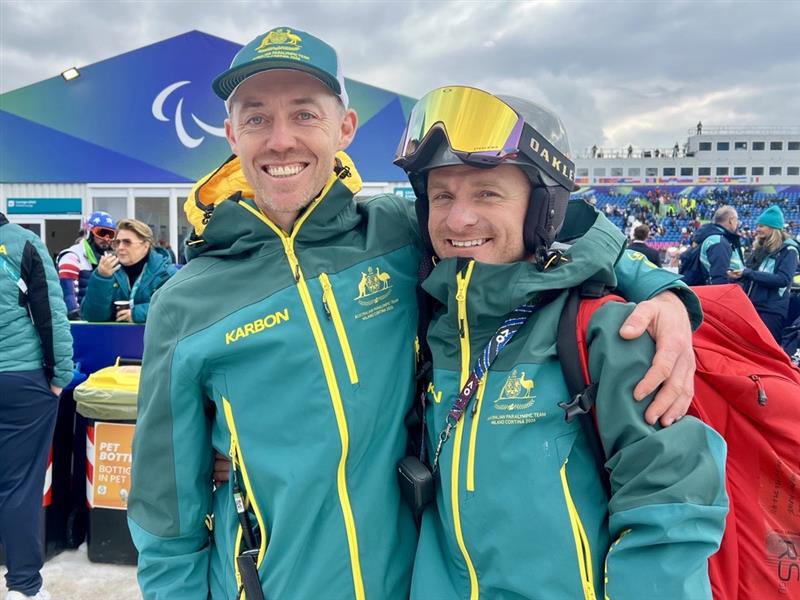
What is more, three of the stars of Para alpine skiing from the period are at Milano Cortina, working in various capacities with the Australian team. Kane is Deputy Chef de Mission, Melissa Perrine is the alpine skiing team’s physiotherapist and Gourley is spending time with the Australian team while working with the IPC Athletes’ Council.
“There was myself, Cameron Rahles-Rabula, Marty Mayberry and Mitch in the standing classes. Michael Milton had just retired,” Kane said. “We had consistent great coaching with Steve Graham, there were women emerging on the team as well, with Mel Perrine and Jess Gallagher.
“We were teammates, we were competitors, and that competition and camaraderie happened every single day in training. It made it a pretty amazing environment to be in, to be able to push each other in training, support each other in races, but also just go hard.
“There was a high expectation to perform. If you look back on some of the results that the team had, both at a World Cup level and at Paralympic level, we were punching well above our weight.
“It was an everyday thing. Every single day, if you weren’t skiing at a high level in training, you were left behind.”
The late Mayberry won silver in the downhill at the Vancouver Paralympics in 2010, Kane won Paralympic bronze medals at Torino 2006 and at Sochi 2014, and two further medals at world championships, and Gourley won gold and bronze world championship medals. Rahles-Rabula won two Paralympic bronze medals at Vancouver 2010 and at world championships he won three gold medals, a silver and a bronze.
As the young kid on the block, Gourley said the environment had a major impact on him, on and off the slopes.
“For me, that was 15 to 23, so some of the most formative years of my life,” he said.
“I credit that core group for not only the impact they had on my skiing, but also on my view on the world and who I am today.
“I think Tobes was 19, 20 and I really looked up to him, and Marty as well. They taught me how to tune my skis, taught me about what commitment looked like, what being a good friend and a good teammate looked like, how to cook, how to do my laundry …
“In training, I learned pretty quickly that it was really competitive. It was a case of setting a good course, put the timer in the ground, and then let four or five of the top 10 guys in the world just go at each other with full intensity, but also a real friendly spirit.
“The confidence it brings when you’ve got that many good guys in the training environment, it’s like, if you win training, you know that you’re on a World Cup podium.”
There is a strong understanding in Australian Paralympic sport that modern day athletes ride on the shoulders of their predecessors who, in most cases, were less resourced and less respected.
Furthermore, this Para alpine skiing group made its mark at a time when standards and professionalism in Paralympic Winter sport were going through the roof. Winter sport was in many ways in its infancy in Australia, despite the feats of earlier athletes, and the Australians had to look outside to gain an understanding of just how special their success was.
There was one particular experience that proved to Gourley his value as a Para skier and how elite the environment in which he was competing truly was.
In a gondola at Whistler once, Gourley was relaying to Mayberry his excitement about the feats of a non-disabled skier he’d seen perform in a recent World Cup race.
“Marty kind of shot it down,” Gourley said. “He was like, ‘Ah, don’t worry about it, we’re just as good as those guys. We’re just missing stuff’.
“At the time, as a teenager, I didn’t really believe it. And then Matthias Lanzinger, the Austrian athlete, came across from Olympic skiing to Para after losing his leg.
“He was one of the best skiers in the world, put a prosthetic on, and when he came over he was competitive, but he didn’t dominate. That was this incredible validation that what Marty said in the gondola five years earlier was bang on.”
Kane added: “That stretched into our own team; we also got external validation. For example, we skied with World Cup athletes in America and we skied college races with able bods, and I remember I had one of the best slalom skiers in the world come up to me and tell me that he was – with some swear words in there – very, very impressed with Mitch’s slalom skiing.
“They’re the moments that I look back on and think, a bunch of us were pushing the boundaries of what was possible for Aussie skiers. To be in a group of people that were consistently pushing that, I see it as a real treat and pleasure.”
And it was fun.
Gourley said: “We skied fast, but we also knew the difference between being nice and being kind. Being nice to someone is telling them what they want to hear. Being kind is saying what they need to hear. That’s something that our group did really well.”
Kane added: “It’s funny, when we were all skiing, I thought nothing of the word ‘inspiration’. We were just interested in skiing fast and winning races. But, with a bit of an older head now, I hope what we did provides a bit of inspiration for some of the people that are here competing for Australia at these Games.”
By: David Sygall, Paralympics Australia
Published: 12 March 2026