
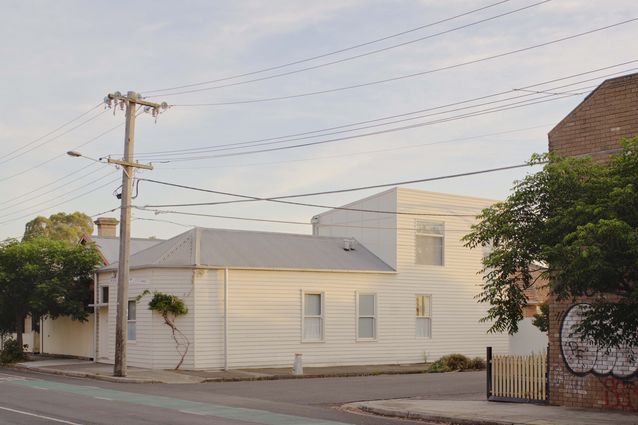
Australian homes have been expanding, while household sizes are diminishing. New houses continue to swell with more rooms, ensuites for every bedroom, giant pantries for non-existent butlers – more of everything, it seems, aside from outdoor space. Brunswick Corner House offers a refreshing reminder that bigger is not always better. A once-cramped cottage on a corner block in Melbourne’s inner north, located at the intersection of single-storey cottages and industrial sheds, has been reimagined by Office Fora into a light-filled, flexible home for a young family. Instead of excess, the design celebrates looseness and adaptability, and makes every square metre work harder.
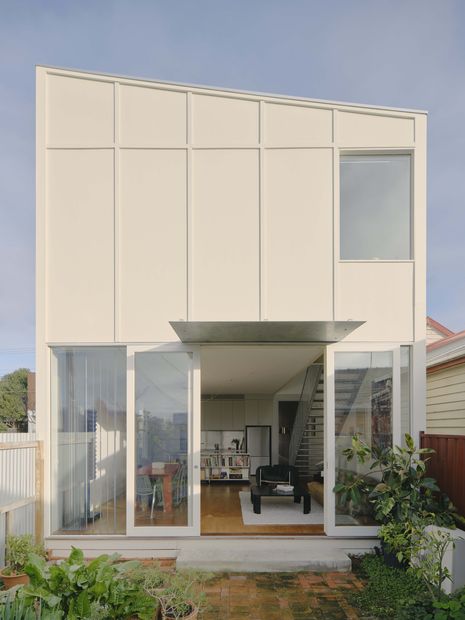
The project began as a series of conversations between Office Fora’s Alexander Wright and Stephanie Poole and the clients, their friends Laura and Rowan. Over time, these discussions revealed clear ambitions: to reuse and refine rather than replace; to work economically with space and material; and to design a home that could evolve over time. The couple – an academic and an artist/software developer – had lived in the house for ten years and began slowly, renovating the existing house first before tackling the addition. The home that has resulted from this gradual progression is compact yet generous, and feels firmly rooted in its context. The surrounding area has been sampled subtly without feeling like collage or pastiche, and the work blurs new and old elements of the house, making the extension feel more like a growth from the existing rather than an add-on.
View gallery
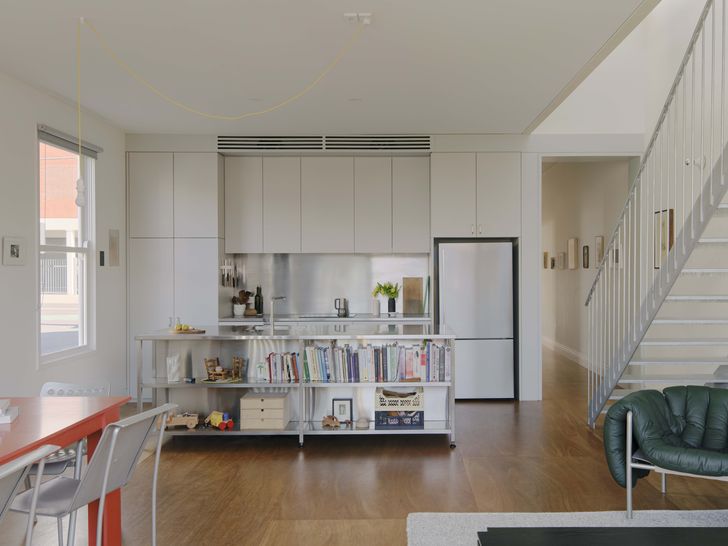
Inside, there is a sense of practicality. Exposed connections and a raw palette make the spaces feel honest and intentional – nothing is unnecessary or wasteful. Details are resolved but unfussy. Collaboration between architects and fabricators comes through in customised elements such as galvanised steel stairs, a commercial stainless-steel bench, and a steel bath frame and vanity.
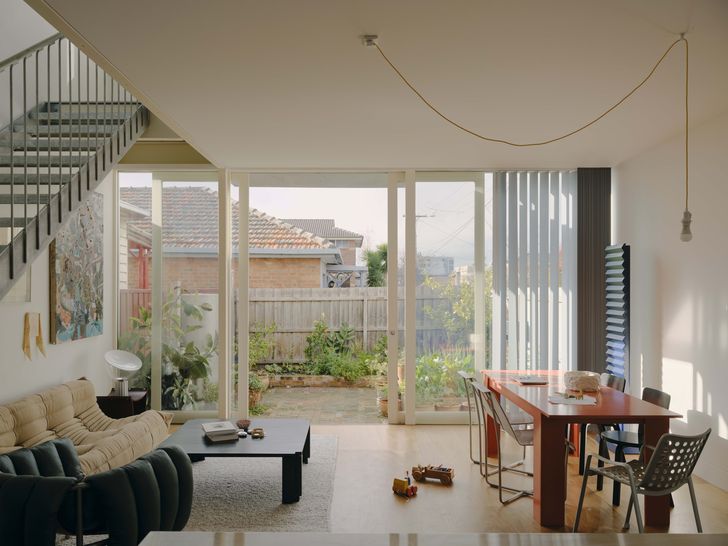
The house unfolds gradually, and with height favoured over an expansive open plan. Carefully positioned openings bring light deep into the plan. A widened hallway doubles as a gallery and allows rooms to borrow this space and expand out; the living area opens to a new garden; and upstairs, a glazed screen in the stair void – which references the typical mezzanine office of a factory – frames long views across Brunswick rooftops without the need for privacy screens. The spaces feel loose and open to change – the kind of rooms that can shift from playroom to studio to guest space as family life evolves. There is limited built-in joinery, and the clients have added creative elements and storage over time.
View gallery
Materials are used with restraint but also generosity. Warm plywood floors balance the cool tactility of metal. Even the bathroom, cleverly divided into a wet and dry zone to allow dual use, demonstrates the project’s clear thinking: efficiency without compromise. Throughout the home, the nimble adaptation of standard or modular elements coupled with a quiet disregard for convention is refreshing.
Perhaps what makes Brunswick Corner House most compelling is a sense of design that challenges the “normal” response without shouting about it. It is inventive without being showy, direct without being austere. By engaging meaningfully with its surroundings and proving that generosity need not depend on scale, the home reminds us that the most important luxury in contemporary housing may be adaptability.
View gallery