

If you’ve noticed more feral rabbits around than usual, you’re right. Much of Australia is experiencing a bunny boom, driven by consecutive years of good breeding conditions.
But with an estimated 200 million feral European rabbits (Oryctolagus cuniculus) currently hopping around the continent, you might also have wondered if the viruses that kept their numbers down in the past — myxoma virus and a calicivirus that causes rabbit haemorrhagic disease — still work.
Loading…
Heidi Kleinert, national feral rabbit management coordinator at the Centre for Invasive Species Solutions, says ideally Australia needs to develop and release a new biocontrol every 10 to 15 years to keep rabbit numbers as low as possible.
“It takes time to find another effective virus that we know is targeted specifically to rabbits, and we know is proven and tested and has approval from government organisations,” Ms Kleinert says.
“Across Australia, we’re seeing more rabbits in peri-urban and urban areas. That’s why we need that continuous pipeline of biological control, because in these areas we can’t use bait and toxins close to domestic housing and domestic pets.”
So how do myxoma and rabbit haemorrhagic disease viruses work, and what goes into finding the next bunny biocontrol weapon?
History of rabbits and biocontrol in Australia
Rabbits have been in Australia since the First Fleet arrived in 1788. They (and subsequent importations over the next few decades) were kept and bred for food and skins. If any escaped or were released, they didn’t manage to spread.
But that all changed in 1859, when a grazier named Thomas Austin released 24 wild rabbits imported from his birthplace of England onto his Barwon Park estate near Geelong in Victoria.
These rabbits managed to gain a foothold in the environment, perhaps because they had a genetic edge over previous rabbit imports.
Despite being hunted for sport, skins and meat, no-one could get on top of their breeding capacity: Rabbits in a good season can breed every 28 days.
“Seven years later, Barwon Park recorded 14,000 rabbits shot,” Ms Kleinert says.
It soon became apparent the rabbits were damaging the environment by nibbling fresh shoots of regenerating plants, competing with native animals for food and shelter, and causing soil erosion.
And they were rapidly spreading. By 1874, they’d reached the NSW border, and would soon overrun the mainland.
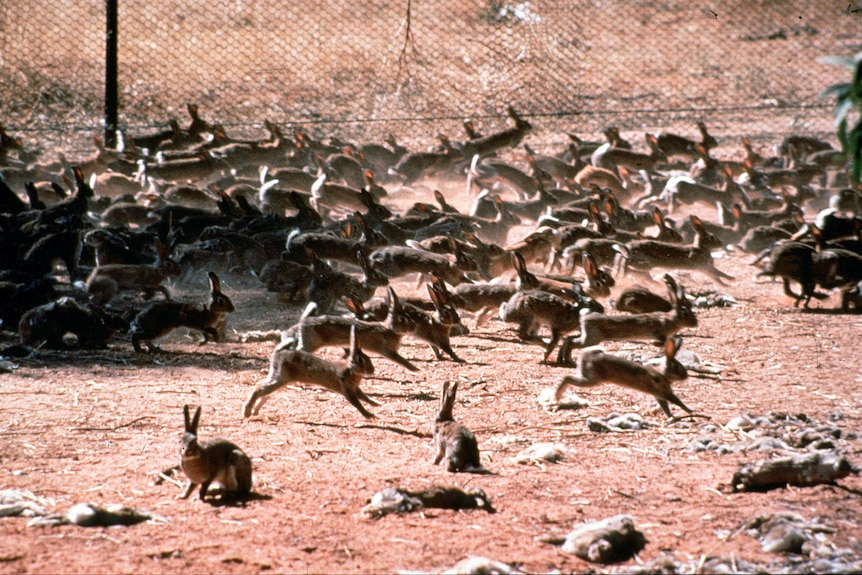
It’s hard to estimate exactly how big the rabbit population got in Australia, but some estimates put their numbers in the billions. (Getty Images: John Carnemolla)
Governments of the day decided something had to be done. One early trial involved releasing more than 1,000 mongoose in Victoria, NSW and South Australia.
Another idea was put forward by French chemist Louis Pasteur. He thought a bacterium that caused chicken cholera could kill rabbits too. A trial found the bacterium, while lethal to rabbits, did not transmit easily between them.
It also killed all birds.
Pasteur’s biocontrol hit a dead end, and Australia would have to wait until the next century before a viable one became available.
Biocontrol success stories
In the 1890s, a disease called myxomatosis, caused by myxoma virus, was discovered in Uruguay.
The virus spread via biting insects, such as mosquitoes, and close contact between rabbits, causing benign disease in its natural native hosts.
But if it infected European rabbits, very few survived.
In 1919, myxoma virus was proposed as a potential biocontrol for the rabbits overrunning Australia. Field trials conducted from the 1930s weren’t terribly successful until 1950, when heavy rainfall boosted the mosquito population at a trial site in northern Victoria.
Suddenly, dead rabbits were everywhere.
Australia’s biocontrol success stories
Within two years, myxomatosis had killed an estimated 500 million rabbits across most of Australia. But within another few years, its mortality rate started to drop.
This was not just because rabbits started developing genetic resistance to the virus, but also because the virus itself was causing milder disease, according to Maria Jenckel, a rabbit biocontrol scientist at CSIRO.
“It’s a classic example of virus-to-host coevolution.
“It’s not the virus’s intention to kill its host if it depends on a living host to spread [which myxoma virus does],” Dr Jenckel says.
By the mid 1980s, rabbit numbers had risen again, not quite to pre-myxomatosis levels, but they were a problem.
So a second biocontrol was explored, and another candidate identified: rabbit haemorrhagic disease calicivirus, which had popped up in China.
While undergoing tests at a trial site on Wardang Island, South Australia, in October 1995 the calicivirus accidentally spread to the mainland.
It was intentionally released at dozens of sites around the country the following year.
The calicivirus had a couple of advantages over myxoma virus. For one, it killed rabbits faster, which was better from an animal welfare perspective.
But it was also spread by insects that fed on dead animals. This meant that, unlike myxoma virus, it was in the calicivirus’s best interests to kill its host and remain highly virulent.
Still, rabbits started developing a population immunity to the calicivirus. Benign calicivirus is present in rabbits living in cool, wet coastal areas, which provides some cross-protection against the lethal calicivirus, Dr Jenckel says.
“The virulent calicivirus has never worked as well in those areas as it does in the dry and arid areas.”
Since 1996, two further strains of the calicivirus have been released into wild populations, one of which works better in areas where benign caliciviruses circulate.
Then nature “threw us a curveball”, Dr Jenckel says. A strain of calicivirus not released by CSIRO was detected in Canberra in 2015. This strain originated in France in 2010, and no-one knows how it got into Australia.
It is now the dominant calicivirus strain killing rabbits in Australia.
But, as the recent rabbit boom illustrates, there is still a need for new biocontrols.
What’s next for rabbit biocontrol?
Scientists like Dr Jenckel at the CSIRO are exploring a couple of different avenues in the search for the next rabbit control method.
One is a “gene drive” that would limit rabbit fertility.
A gene drive refers to a gene (or collection of genes) that pass rapidly and preferentially through generations, becoming increasingly more common.
If the gene renders female offspring infertile, or ensures only male offspring are born, then rabbits might breed themselves out of existence.
The search is on for a new virus too. Candidates must fulfil certain requirements, including:
it can have no adverse effects on other species, especially native species;vaccines must be developed to protect pet and farmed rabbits from the disease before the virus is released;the suffering of infected rabbits is minimised.
Dr Jenckel says while she and her colleagues are selecting and testing new viruses, it will still be some time before anything new is released.
“Even if the research doesn’t take that long, then there’s the whole registration process to fulfil all our regulatory hurdles.
“There’s quite a lot that is expected of us beyond just providing a virus.”
Just like myxoma and the caliciviruses, any future rabbit biocontrol should be viewed as a rabbit suppression tool, not a rabbit eradication tool, she adds.
“It’s also important to do the work while rabbit numbers are low, like removing resources, destroying burrows, and removing survivors after an outbreak, because that helps keep populations low.
“Rabbit biocontrol shouldn’t be the only thing we use to keep rabbit populations down.
“Unfortunately, it’s not the silver bullet everyone wants it to be.”
Listen to As rabbit numbers boom, what’s next for biological control? on The Science Show. Tune into ABC Radio National at 12pm on Saturdays to hear the full program or subscribe to podcast for more mind-bending science.